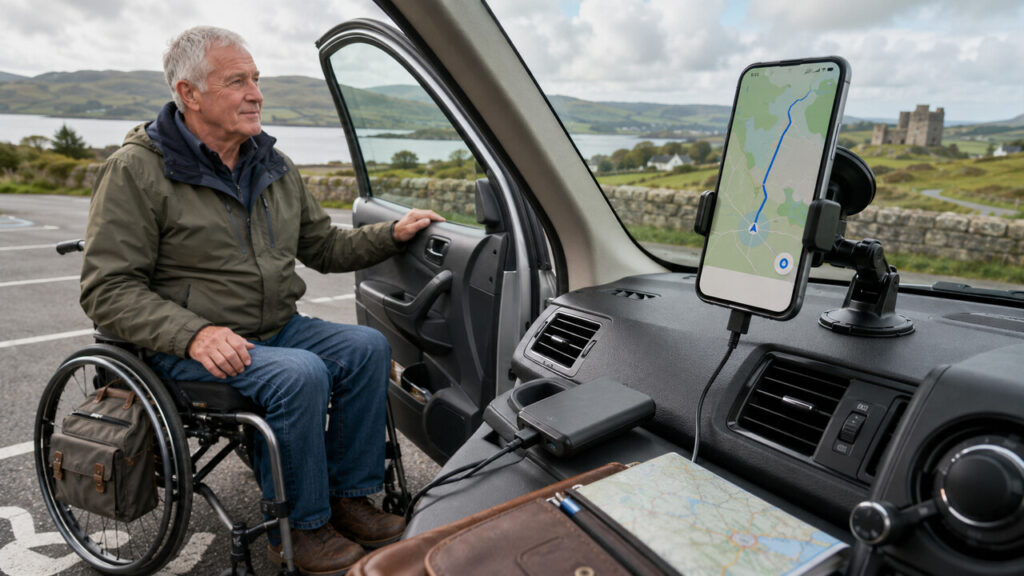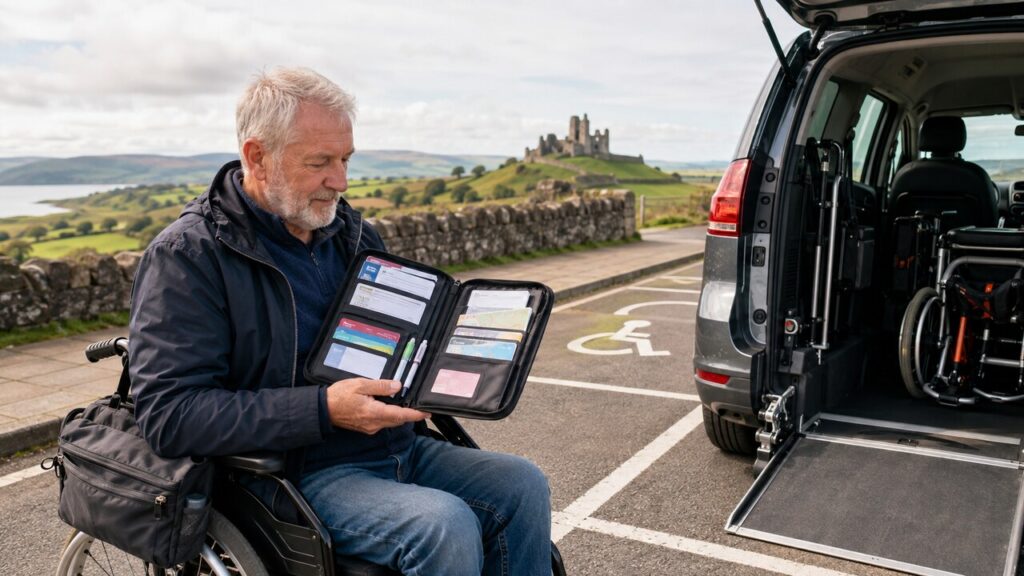
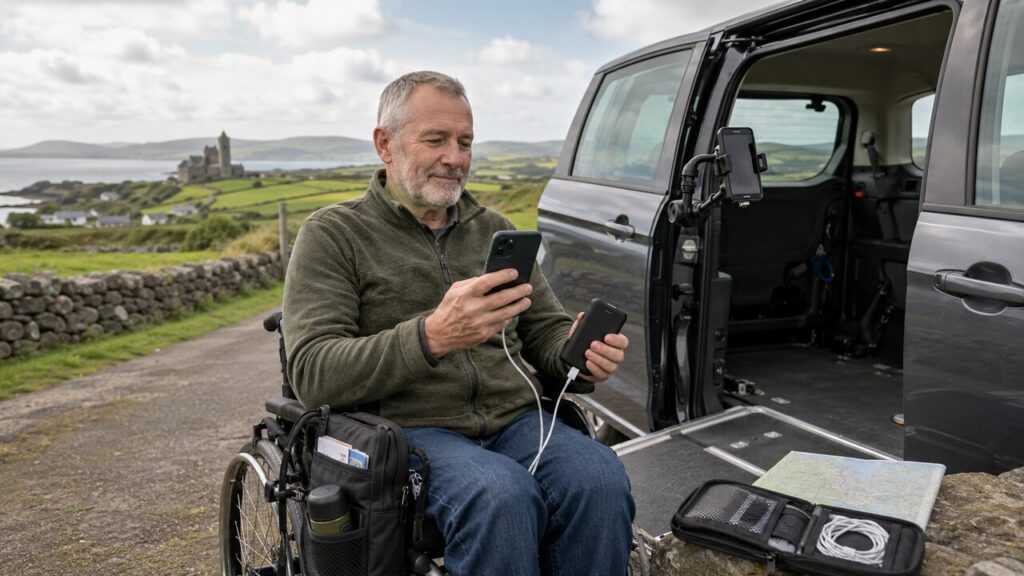
An accessible road trip around Ireland can offer an unforgettable sense of freedom. You can explore quiet coastal roads, historic castles, green countryside and welcoming small towns at your own pace.
However, travelling with a wheelchair or another mobility aid often requires more preparation than an ordinary day trip. Your smartphone may be used for navigation, checking accessibility information, contacting accommodation providers, storing booking confirmations and calling for assistance.
That is why a reliable power bank can become one of the most useful items in your travel bag.
A power bank may be small, but it can help you remain connected, organised and independent throughout your journey.
Affiliate disclosure: This article contains affiliate links. If you make a purchase through one of these links, I may earn a small commission at no extra cost to you.
Your Phone Is an Important Travel Tool
For many travellers, a smartphone is no longer used only for making calls. During an accessible road trip around Ireland, it may perform several important tasks at the same time.
You might use it to:
- follow GPS directions;
- find accessible parking;
- check hotel or attraction details;
- contact a restaurant or visitor centre;
- show digital booking confirmations;
- take photographs;
- check the weather;
- translate information;
- contact family or friends.
Using several applications throughout the day can quickly reduce your phone’s battery level. GPS navigation, mobile data, photography and video are particularly demanding.
A power bank allows you to recharge your phone without searching for a wall socket or waiting inside a café.
It Helps You Continue Using Navigation
Driving through Ireland can be a wonderful experience, but some rural routes may include narrow roads, unexpected turns and long distances between larger towns.
Navigation applications can help you find your accommodation, accessible attractions and suitable stopping points. They can also help you avoid becoming lost on an unfamiliar rural road.
However, running GPS navigation for several hours may use a considerable amount of battery power.
A power bank gives you a backup source of energy when your phone battery begins to fall. This is especially useful when your vehicle does not have a reliable USB charging port or when the available socket is already being used by another device.
When travelling alone, keeping your navigation device powered can provide additional confidence.
Remember that it is illegal to hold a mobile phone while driving in Ireland. Set your route before starting the journey, use a secure phone mount and stop safely before changing your destination or checking detailed information.
It Can Help During a Breakdown or Emergency
A flat battery is inconvenient at any time. During a breakdown, it can become a serious problem.
Imagine that your vehicle develops a fault on a quiet road. You may need to call roadside assistance, explain your location or contact your hotel to say that you will arrive late.
For a wheelchair user, leaving the vehicle and travelling to find help may be difficult or unsafe. Remaining inside or close to the vehicle while contacting assistance may be the most practical option.
A charged power bank can keep your phone working until help arrives.
In a genuine emergency in Ireland, you can call 112 or 999 free of charge. The Irish government also advises callers to provide the phone number they are calling from so that emergency services can call back if the connection is lost.
This makes preserving your phone battery particularly important.
It Supports Accessible Travel Planning During the Day
Accessibility information is not always complete or easy to verify before a journey.
A hotel may describe itself as accessible, but you might still need to call and ask about:
- the width of the entrance;
- step-free access;
- accessible parking;
- bathroom layout;
- lift dimensions;
- space beside the bed;
- ramps or alternative entrances.
You may also need to check whether a castle, museum, café or viewpoint has a suitable route for your wheelchair.
Having a charged phone allows you to confirm these details while travelling. This can prevent unnecessary detours and reduce the risk of arriving somewhere that does not meet your needs.
A power bank therefore supports more than convenience. It can help you make informed decisions throughout the journey.
It Keeps Digital Documents Available
Many travellers now keep important documents on their phones.
These may include:
- hotel reservations;
- ferry or flight confirmations;
- vehicle hire details;
- insurance documents;
- attraction tickets;
- maps;
- emergency contact information;
- photographs of identification documents.
Digital documents are useful because they reduce the amount of paperwork you need to carry. However, they are not very helpful when your phone has no power.
A compact power bank helps ensure that your bookings, directions and contact details remain available when you need them.
It is still sensible to carry printed copies of the most important information, particularly your accommodation address, insurance details and emergency contacts.
It Can Charge More Than a Smartphone
Depending on the model, a power bank may also charge other useful travel devices.
These could include:
- wireless headphones;
- a smartwatch;
- a small camera;
- an e-reader;
- a portable light;
- a tablet;
- certain rechargeable accessibility accessories.
Before travelling, check which cables and connectors your devices require. A short charging cable may be easier to manage inside the vehicle than a long cable that can become tangled around luggage or mobility equipment.
Do not assume that a standard phone power bank can charge the battery of a powered wheelchair or mobility scooter. These mobility devices normally require their own specialist charger and appropriate power supply.
What Size Power Bank Is Best for a Road Trip?
Power bank capacity is normally measured in milliampere-hours, written as mAh.
For a day trip, a compact power bank of around 10,000 mAh may be sufficient for many travellers. It can usually provide more than one partial or full phone recharge, although the actual result depends on the phone, battery condition and charging efficiency.
For longer days or several devices, a 20,000 mAh model may be more practical. The disadvantage is that it will usually be larger and heavier.
For accessible travel, the best power bank is not automatically the one with the largest capacity. Consider how easily you can:
- lift it;
- hold it;
- connect the cable;
- see the battery indicator;
- reach it from your wheelchair or car seat;
- store it securely.
A slightly smaller device that is easy to handle may be more useful than a heavy model that remains at the bottom of your luggage.
Features Worth Looking For
When choosing a power bank for an accessible road trip around Ireland, look for practical features rather than unnecessary extras.
Useful features may include:
- a clear battery-level display;
- USB-C charging;
- more than one charging port;
- fast-charging support;
- a non-slip surface;
- rounded edges;
- simple buttons;
- overcharge and overheating protection;
- a size that fits an accessible pocket or small travel bag.
Choose a product from a reputable retailer and check for safety warnings or product recalls. Power banks contain lithium batteries, and damaged or defective units can overheat. Ireland’s Competition and Consumer Protection Commission publishes product-safety information and recall notices.
Stop using a power bank if it becomes swollen, unusually hot, damaged or produces an unusual smell.
Where Should You Keep It?
Keep the power bank somewhere you can reach without unpacking the entire vehicle.
A small organiser attached to the wheelchair, a secure door pocket or an accessible section of your travel bag may work well.
Do not leave the device loose in the vehicle. The Road Safety Authority advises securing smaller objects such as phones and laptops because loose items can become dangerous during sudden braking or a collision.
Avoid leaving a power bank in direct sunlight or inside an extremely hot parked car. Protect it from rain, moisture and physical damage.
Before leaving your accommodation each morning, check that both your phone and power bank are fully charged.
Travelling to Ireland by Plane
When flying, remember that power banks are treated as spare lithium batteries and are subject to aviation safety rules.
They generally need to remain in your cabin baggage rather than checked luggage, but capacity limits and airline policies may vary. The Irish Aviation Authority publishes current guidance about travelling with devices containing lithium batteries and introduced more restrictive power-bank requirements in 2026.
Always check the current rules of your airline before travelling.
A Small Item That Provides Greater Independence
A power bank will not make a road trip completely problem-free. However, it can remove one common source of stress: worrying that your phone will stop working when you need it most.
For an accessible road trip around Ireland, a charged phone can support navigation, communication, bookings, accessibility research and emergency contact.
Pack the power bank somewhere easy to reach, bring the correct charging cables and recharge it every evening.
It is a simple addition to your travel kit, but it can help you explore Ireland with greater confidence, security and independence.
Affiliate disclosure: This article contains affiliate links. If you make a purchase through one of these links, I may earn a small commission at no extra cost to you.