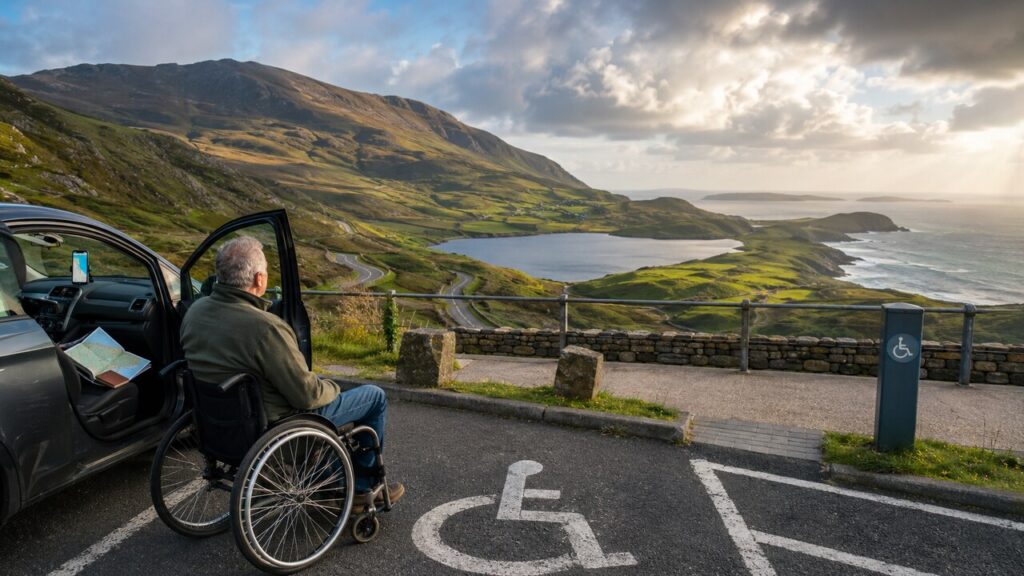
Ireland seems made for road trips. Mountain roads reveal dark lakes without warning, Atlantic cliffs rise beyond stone walls, and small towns offer the promise of tea, shelter and conversation.
For a wheelchair user, however, a beautiful route is only part of the story. A journey also needs usable parking, enough space to transfer safely, accessible toilets, smooth surfaces and stops that can be enjoyed without climbing steps or crossing rough ground.
That is why this guide does not simply list Ireland’s most famous drives. It looks at routes that can work well for wheelchair users and travellers with limited mobility when planned carefully.
Some provide accessible visitor centres or level viewpoints. Others are rewarding mainly because so much of the scenery can be enjoyed through the windscreen.
Conditions and facilities can change, so always confirm the details that matter to you before setting out.
Important: “Wheelchair-friendly” describes the overall driving experience, not every lay-by, trail or attraction. Never assume that an unstaffed viewpoint has a dropped kerb, level surface or accessible toilet.
What Makes a Scenic Drive Wheelchair-Friendly?
A route becomes genuinely useful when it reduces uncertainty. The most impressive viewpoint in Ireland is of little value if the only parking space is on a steep camber or the nearest toilet is an hour away.
Before choosing a drive, consider the complete chain of access from your vehicle to the viewpoint, café and toilet.
Look for:
- scenery visible from the road or a properly surfaced parking area;
- several stopping options, so one inaccessible or crowded lay-by does not ruin the day;
- towns, visitor centres or attractions with confirmed accessible facilities;
- roads suitable for your vehicle and driving confidence;
- realistic distances, with time for transfers, rest and unexpected delays;
- mobile coverage or downloaded maps, particularly in remote mountain and coastal areas.
Ireland’s weather deserves equal attention. Wind can make transfers difficult, rain can turn gravel or grass into a barrier, and fog may remove the views entirely.
A flexible plan is often more valuable than a rigid itinerary.
1. The Ring of Kerry, County Kerry
The Ring of Kerry is the classic Irish scenic drive and one of the easiest major routes to adapt into an accessible day out.
The approximately 179-kilometre circuit around the Iveragh Peninsula combines mountain scenery, Atlantic coastline, colourful villages and frequent services.
Killarney is the most practical starting point because it offers fuel, food, pharmacies and a wide choice of accommodation.
Travelling via Killorglin, Glenbeigh, Cahersiveen, Waterville, Sneem and Kenmare creates a full loop. The road can be busy during summer, but the number of towns provides valuable backup options if a planned stop turns out to be unsuitable.
Rather than trying to visit every attraction, choose two or three dependable stops and treat the landscape between them as the main event.
Good Accessible Stops
- Killarney: A strong base with services and accessible accommodation options.
- Ross Castle: Discover Ireland states that the ground floor has access for disabled visitors. Free parking is also available.
- Waterville and Sneem: Useful places to pause for refreshments, although access to individual cafés and restaurants should be checked directly.
- Killarney National Park: Selected locations have parking, but surfaces and distances vary. Confirm the exact area you plan to visit.
Accessibility Considerations
Some coastal viewpoints have rough gravel, narrow pull-ins or no marked accessible parking bay. Tour coaches can also make safe transfers difficult.
Start early, avoid rushing and be willing to enjoy a viewpoint from inside your vehicle if the surface does not look safe.
The entire circuit can take a full day. If you want a more relaxed journey, drive only part of the Ring of Kerry and return to Killarney using the same route.
2. Slea Head Drive, Dingle Peninsula
Slea Head offers one of Ireland’s most dramatic combinations of ocean, islands, cliffs and traditional Gaeltacht culture.
The circuit from Dingle is approximately 47 kilometres long and is normally driven clockwise through Ventry, Slea Head, Dunquin and Ballyferriter before returning to Dingle.
Driving clockwise is strongly recommended because sections of the road are extremely narrow, and congestion can become stressful.
This is a superb choice for anyone who enjoys scenery from the vehicle. The sea views appear repeatedly, and a passenger can experience much of the peninsula without needing to leave the car.
Dingle itself is the most sensible place to find an accessible toilet, get some food and make a final check of the weather.
The Best Way to Approach Slea Head
- Leave Dingle earlier in the morning to reduce pressure from tour traffic.
- Use larger and safer stopping areas instead of squeezing into small roadside gaps.
- Treat Dunquin Pier primarily as a visual stop because its famous steep path is not a practical wheelchair route.
- Check access directly before paying to enter small heritage attractions.
- Plan your toilet and refreshment stops in Dingle or another established village.
Accessibility Considerations
Slea Head is memorable, but it is less forgiving than the Ring of Kerry. There may be few safe opportunities to turn around, and some sections of the road feel exposed.
It is best suited to a confident driver using a car or compact adapted vehicle. A larger wheelchair-accessible van can travel the route, but careful planning and patience are essential.
The road should be avoided during severe wind, heavy rain or very poor visibility.
3. Connemara Loop, County Galway
Connemara delivers a quieter kind of drama. Its landscape combines bogland, granite mountains, white beaches and lakes that seem to change colour with the sky.
A practical loop can begin in Galway or, more comfortably, in Clifden. Follow the N59 towards Letterfrack, visit the Connemara National Park area, continue towards Kylemore and return through the region’s lake and coastal landscapes.
This route earns its place because much of the scenery is broad and visible from the road, while Clifden and Letterfrack provide useful stopping points.
Connemara National Park’s visitor centre has designated parking spaces for visitors with disabilities near the kiosk. The park also advises that people who need to park next to the visitor centre can telephone ahead to arrange access.
Good Accessible Stops
- Connemara National Park Visitor Centre: Free entry and parking, with specific arrangements available for visitors with disabilities.
- Clifden: The best service stop for cafés, fuel and supplies before entering quieter areas.
- Galway Wind Park near Oughterard: Discover Ireland lists a route designed to be accessible to wheelchair users and families with buggies.
- Letterfrack: A useful place to stop before or after visiting the national park.
Accessibility Considerations
Do not assume that beaches, bog roads or informal viewpoints are accessible simply because they appear level from the vehicle.
Soft sand, loose gravel, drainage channels and muddy ground can stop a wheelchair very quickly.
Connemara is most enjoyable when confirmed facilities are used as anchors and informal pull-ins are treated as optional additions.
Mobile coverage can be unreliable in remote areas, so download your maps before leaving.
4. The Ring of Beara and Healy Pass
The Beara Peninsula is wilder and often quieter than the neighbouring Ring of Kerry.
Its approximately 137-kilometre coastal drive links Glengarriff, Castletownbere, Allihies, Eyeries and Kenmare.
For travellers who dislike crowded attractions, Beara offers space, powerful coastal views and colourful villages.
The Healy Pass is the spectacular mountain alternative between Adrigole and Lauragh. Its 12 kilometres of bends climb through rugged terrain, creating immense views without requiring a walk.
It is best attempted in good visibility by a confident driver who is comfortable with narrow roads, steep sections and hairpin bends.
A Wheelchair-Friendly Strategy
- Use Glengarriff, Castletownbere or Kenmare as your main comfort stops.
- Choose either the complete coastal circuit or a shorter return journey.
- Do not overload the day with too many attractions.
- Enjoy Healy Pass primarily from your vehicle.
- Stop only where the parking area is clearly safe and reasonably level.
- Carry food, water and essential supplies.
Accessibility Considerations
Beara’s charm comes with fewer facilities and longer gaps between suitable toilets. Mobile coverage may also be inconsistent.
Download your route and identify at least two possible toilet stops before leaving.
The Dursey Island cable car should not be treated as automatically wheelchair accessible. Confirm its current operating arrangements, doorway dimensions and wheelchair restrictions before making it a central part of your trip.
If the weather changes, the coastal section may be a more comfortable option than the exposed mountain pass.
5. Sally Gap and Wicklow Gap
For a scenic drive close to Dublin, the Wicklow Mountains are difficult to beat.
Sally Gap reveals open moorland, mountain roads and views towards Lough Tay. The Wicklow Gap road runs for approximately 26 kilometres between Hollywood and Laragh.
These routes can be combined with a carefully planned stop at Glendalough.
The main advantage is visual: large parts of the landscape can be appreciated directly from the road.
The viewpoint above Lough Tay is located along the Military Road. The lake itself is on private property and cannot be visited.
Roadside pull-ins may be crowded or uneven, so the best view is not always the safest place to transfer from your vehicle.
Good Accessible Stops
- Laragh: A practical stop for food and toilets before or after exploring the mountain roads.
- Glendalough: The Lower Lake boardwalk is used by many wheelchair users, although the National Park states that none of its trails is officially approved for wheelchairs.
- Wicklow Gap: Enjoy the scenery from designated parking areas and avoid rough roadside verges.
- Lough Tay viewpoint: The panorama can be enjoyed from close to the road, but parking conditions should be assessed carefully.
Accessibility Considerations
Weather can change quickly in the Wicklow Mountains. Fog, ice, strong wind and standing water can transform a straightforward drive.
If conditions are poor, shorten the route and use Glendalough or a nearby town as the day’s main destination rather than forcing yourself to complete the entire circuit.
Avoid remote mountain roads after dark if you do not know the area.
6. Causeway Coastal Route, Northern Ireland
The Causeway Coastal Route passes through a different jurisdiction, but it belongs on any list covering the whole island of Ireland.
The Antrim coast combines sea cliffs, traditional villages, castle ruins and distant views towards Scotland.
A practical section connects Ballycastle, the Giant’s Causeway, Bushmills, Portrush and Portstewart. Travellers with more time can continue towards Downhill and the Binevenagh area.
The Giant’s Causeway is the standout accessible anchor on this route.
Official visitor information describes the Green Trail as an accessible clifftop route. The Blue Trail leads down towards the famous stone formations.
Exact gradients, assistance, shuttle arrangements and parking should be confirmed with the National Trust before travelling, particularly if you use a manual wheelchair.
Good Accessible Stops
- Giant’s Causeway Visitor Centre: The main accessible attraction along the route.
- Giant’s Causeway Green Trail: An accessible clifftop route offering coastal views.
- Bushmills: A useful place for food, toilets and a break from the coastal roads.
- Portrush and Portstewart: Larger seaside towns with more services than the isolated viewpoints.
- Gortmore viewpoint: A potential stop for a wide coastal panorama, subject to current parking and surface conditions.
Accessibility Considerations
Not every photogenic harbour or historic ruin is accessible.
Ballintoy Harbour, cliff paths and older sites can involve steep gradients, uneven surfaces or limited parking. Some viewpoints may be enjoyable only from inside the vehicle.
Build the day around one confirmed accessible attraction. Treat the remaining landmarks as optional stops or drive-by views.
Remember that parking regulations and disability badge arrangements may differ between the Republic of Ireland and Northern Ireland.
7. Glenveagh and the North-West Coast, County Donegal
Donegal rewards travellers who value space, remote scenery and a slower pace.
Instead of attempting a huge section of the Wild Atlantic Way in a single day, create a shorter drive around Glenveagh National Park and selected coastal viewpoints.
The park is a particularly useful accessible anchor. It lists wheelchair-accessible electric buses, an accessible toilet at the visitor centre and limited Blue Badge access near the castle by prior arrangement.
A realistic day could combine Glenveagh with Letterkenny, Dunfanaghy or a coastal section selected according to the weather and your available driving time.
Distances in Donegal often look modest on a map but take considerably longer than expected because the roads are winding and the stops are part of the experience.
Good Accessible Stops
- Glenveagh Visitor Centre: Accessible toilets and wheelchair-accessible electric buses.
- Glenveagh Castle: Contact the park in advance if you require special parking arrangements.
- Letterkenny: A dependable base for accommodation, shopping, fuel and accessible facilities.
- Larger towns and villages: Use them deliberately for food and toilets instead of waiting for an isolated viewpoint.
Accessibility Considerations
Some garden areas at Glenveagh remain inaccessible because of steps and steep or uneven ground.
Coastal cliffs and beaches elsewhere in Donegal may also lack suitable parking and firm surfaces.
Choose quality over quantity. One well-planned park visit and one coastal viewpoint can create a much better day than a rushed list of inaccessible landmarks.
How to Plan an Accessible Scenic Drive in Ireland
1. Choose One Main Route and One Accessible Attraction
Give the day a dependable centre. Even if rain or fog hides the views, you will still have one destination that you have checked in advance.
2. Contact Important Stops
Ask specifically about:
- accessible parking spaces;
- space beside the vehicle;
- surface type;
- gradients;
- door thresholds;
- accessible toilets;
- the distance between the car park and entrance.
A general statement that a place is “accessible” may not answer the questions that matter to you.
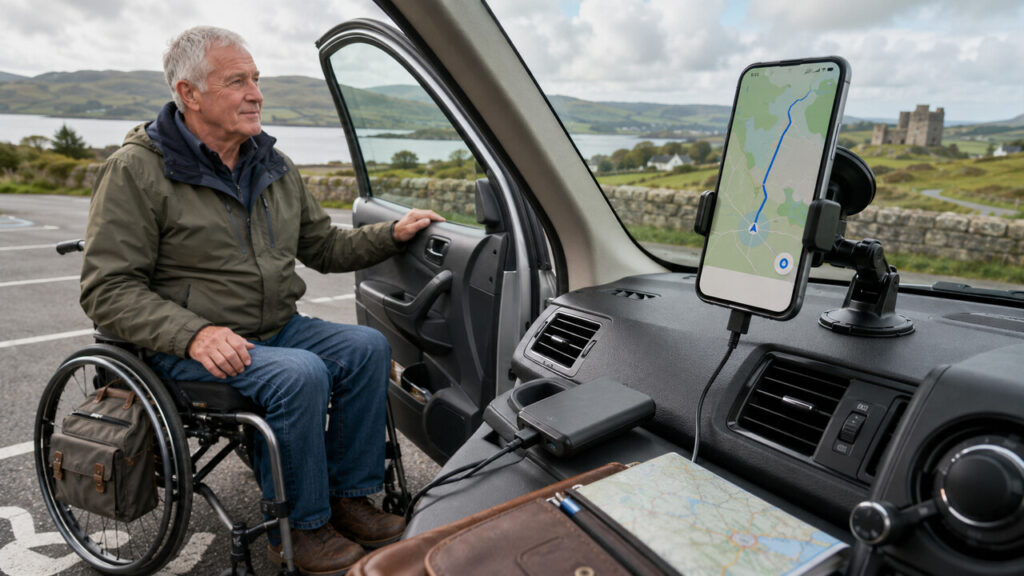
3. Download Maps and Save Telephone Numbers
Mobile coverage may disappear in mountain valleys and remote coastal areas.
Download your maps before leaving and save the contact details of visitor centres, accommodation and assistance services.
4. Plan Toilets Before Viewpoints
A town, hotel, visitor centre or major attraction is usually more dependable than an isolated lay-by.
Check opening hours and keep at least one alternative available.
5. Check the Weather Twice
Check the forecast on the evening before your journey and again before departure.
Wind can be just as important as rain. A strong gust can make transferring between a wheelchair and vehicle uncomfortable or unsafe.
6. Allow More Time Than the Map Suggests
A route covering 150 kilometres can easily fill an entire day once rest breaks, meals, transfers and photography are included.
Driving slowly also makes it easier to enjoy the scenery.
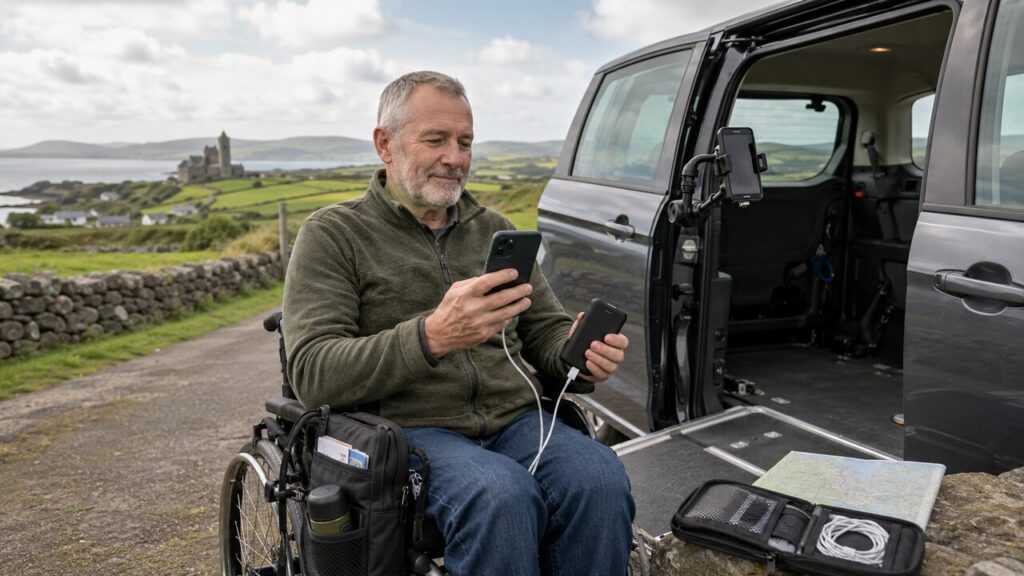
7. Carry a Simple Backup Kit
Useful items include:
- a charged power bank;
- a phone charging cable;
- a waterproof jacket or wheelchair rain cover;
- drinking water;
- essential medication;
- a small wheelchair repair kit;
- a compact tyre pump;
- emergency contact details;
- a paper copy of your main route.
Driving Your Own Vehicle or Booking a Tour?
Travelling in your own car or wheelchair-accessible vehicle provides flexibility.
You can wait for a busy parking bay to clear, change the route when rain arrives and take breaks without explaining your pace.
It is usually the best option for travellers who understand their own transfer routine and equipment.
A private wheelchair-accessible tour removes the pressure of navigating narrow roads. It can also allow everyone in the group to concentrate on the scenery.
Discover Ireland lists wheelchair-friendly sightseeing providers with adapted vehicles, but suitability must still be confirmed.
Ask about:
- compatibility with your wheelchair;
- ramp or lift capacity;
- internal headroom;
- wheelchair securement;
- passenger seating;
- accessible stops included in the itinerary;
- toilet breaks;
- assistance provided by the driver.
Ask whether the guide has personally checked the proposed stops instead of relying only on a general description of them as accessible.
A Simple Three-Day Accessible Scenic-Drive Plan
Day 1: Killarney and Part of the Ring of Kerry
Begin in Killarney and visit one confirmed accessible attraction.
Continue towards Glenbeigh or Waterville, depending on your energy and the weather. Return without feeling obliged to complete the entire Ring of Kerry.
Day 2: Slea Head from Dingle
Start early and travel clockwise around the peninsula.
Use Dingle as your reliable base for food and accessible facilities. Keep your stops selective and enjoy the narrow coastal section mainly from the vehicle.
Day 3: Connemara from Clifden
Use the Connemara National Park Visitor Centre as the day’s accessible anchor.
Add a scenic drive through Letterfrack and the surrounding lake country before returning to Clifden while it is still light.
Frequently Asked Questions
Are Ireland’s Scenic Drives Fully Wheelchair Accessible?
No. The driving routes can be enjoyable, but individual viewpoints, beaches, paths and historic sites vary greatly.
Confirm every essential stop directly and always have an alternative.
Which Route Is Best for a First Accessible Road Trip?
The Ring of Kerry is the strongest all-round choice because it combines famous scenery with several towns and service stops.
A shorter section starting in Killarney is often better than attempting the full circuit on your first day.
Which Route Offers the Best Scenery Without Leaving the Car?
Slea Head, Healy Pass and the Wicklow mountain roads all provide extensive views from the vehicle.
Slea Head is particularly dramatic but has very narrow sections. Healy Pass requires confidence with bends and mountain driving.
Can I Rely on Accessible Toilets at Viewpoints?
Usually not.
Plan your toilet breaks around visitor centres, larger attractions and established towns. Check opening hours and keep a second option in reserve.
Can I Use My Disability Parking Badge Everywhere in Ireland?
Parking rules and badge recognition can differ between the Republic of Ireland and Northern Ireland.
Check current official guidance for both jurisdictions before travelling. A disability badge also does not guarantee that a parking space will provide enough room for a wheelchair transfer.
What Is the Best Time of Year for a Scenic Drive?
Late spring and early autumn can provide a good balance between longer days and fewer visitors.
Summer offers the longest daylight hours, but major routes and viewpoints can become crowded. Winter journeys require more caution because of short days, ice, fog and rapidly changing weather.
Final Thoughts
The best wheelchair-friendly scenic drive is not necessarily the route with the most famous photograph.
It is the one that allows you to relax, see something extraordinary and finish the day without unnecessary stress.
In Ireland, that usually means combining spectacular views from your vehicle with a small number of verified accessible stops.
Start with the Ring of Kerry if you want the broadest choice of services. Choose Slea Head for concentrated coastal drama, Connemara for space and changing light, Beara for a quieter adventure, Wicklow for a shorter journey from Dublin, the Causeway Coast for a strong accessible attraction, or Donegal for a wild north-western experience.
Plan carefully, remain flexible and let the road itself become part of the adventure.
Accessibility information, facilities and opening arrangements can change. Contact individual attractions and visitor centres before travelling.