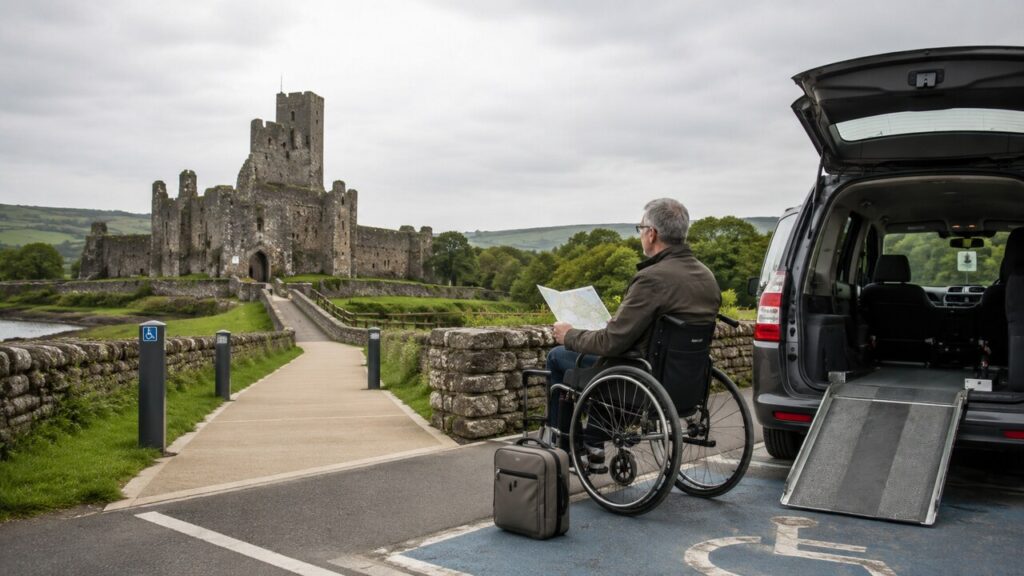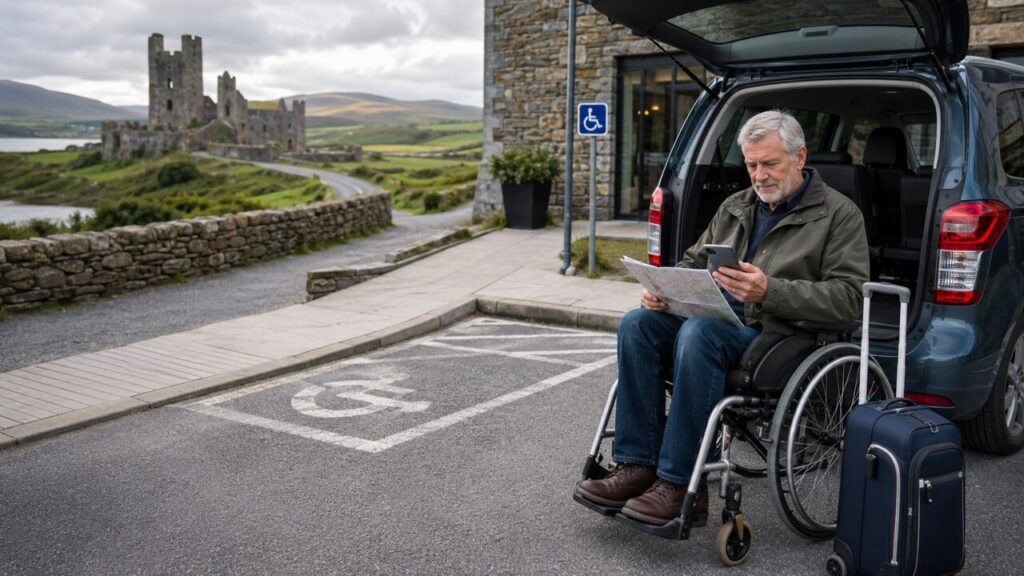
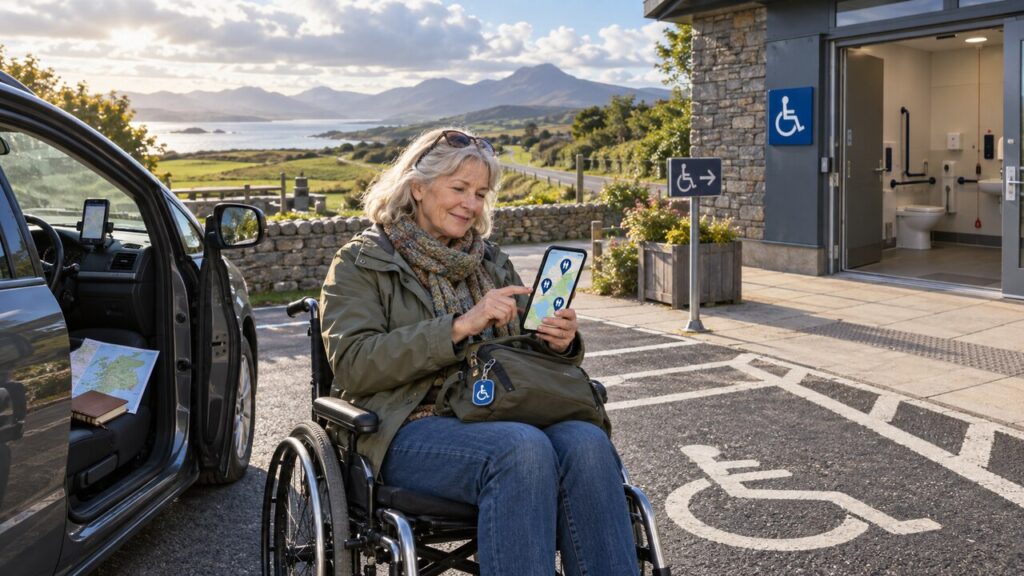
Ireland is made for memorable road trips. A single day can take you from a lively town to a quiet harbour, a mountain pass or an Atlantic viewpoint. However, for a wheelchair user or anyone with limited mobility, one practical question can shape the whole journey: where will the next genuinely accessible toilet be?
This is not a minor detail. A toilet symbol on a map does not tell you whether the route is step-free, the doorway is wide enough, the room has sufficient turning space or the grab rails are positioned where you need them. It may not tell you whether the facility is open, locked, out of order or located behind a heavy door.
The reassuring news is that travelling around Ireland becomes much easier when you use several sources instead of trusting one map. The most dependable method is to plan your toilet stops before your scenic stops, confirm the important details and keep a second option nearby.
This guide explains how to find accessible toilets in Ireland, what to ask before you travel and how to create a simple backup plan without allowing toilet anxiety to take over your trip.
Why Finding an Accessible Toilet in Ireland Can Be Difficult
Ireland has accessible toilets in many shopping centres, visitor attractions, motorway service areas, transport stations, libraries, hotels and public buildings.
The difficulty is that information is spread across different websites and maps. Council pages may cover only one area, community maps depend on user updates, and a venue may say “accessible facilities” without explaining the actual layout.
Rural travel creates another challenge. A spectacular viewpoint may have a car park but no toilet, while a remote facility may open only seasonally. Mobile coverage can also be unreliable, making last-minute searching harder.
That is why the best system has three parts:
- Find possible toilets using two or more maps or official pages.
- Verify the facilities that matter to you.
- Save a main stop and a backup stop for each part of the journey.
Start With the Right Meaning of “Accessible”
People do not all need the same toilet layout.
Someone who can walk a short distance with a stick may have different requirements from a person using a large powered wheelchair. A traveller who transfers independently may need clear space on one particular side of the toilet. Another person may need help from a companion, a changing bench or a hoist.
Before searching, write down your non-negotiable requirements. These may include:
- a completely step-free route from the car park or entrance;
- enough space to turn your wheelchair;
- transfer space on the left, right or both sides;
- secure grab rails;
- a toilet seat at a suitable height;
- a reachable washbasin and usable door;
- a working emergency cord;
- room for a companion if needed;
- a ceiling or mobile hoist;
- an adult-sized changing bench;
- nearby accessible parking.
This personal checklist is more useful than a general accessibility label. It gives you specific questions to ask and helps you reject a location that will not work before you arrive.
Standard Accessible Toilets and Changing Places Are Not the Same
A standard wheelchair-accessible toilet usually provides more room than an ordinary cubicle, step-free entry and support rails. However, the precise layout varies, and it may not offer enough space for a person who cannot transfer independently.
A Changing Places toilet is designed for people who need more space and specialist equipment.
Changing Places Ireland describes this type of facility as including:
- a toilet;
- a hoist;
- a washbasin;
- an adult-sized changing bench;
- adequate room for a disabled person and any assistants.
If you require a hoist or adult changing bench, do not rely on the words “disabled toilet” or “accessible WC”. Search specifically for a Changing Places facility and check its equipment before travelling.
Some locations listed by Changing Places Ireland are described as step-down facilities. These can offer more than a standard accessible toilet but do not include every feature of a full Changing Places facility.
The Best Tools for Finding Accessible Toilets in Ireland
No single tool contains every accessible toilet in Ireland. The safest approach is to use the following resources as separate layers.
One source may help you discover a possible toilet, while another may provide opening times, photographs, contact details or more precise accessibility information.
1. Changing Places Ireland Map
The Changing Places Ireland map should be your first stop if you need a hoist, an adult-sized changing bench, extra room or assistance from a companion.
Listings for registered facilities in the Republic of Ireland can include:
- the address;
- contact information;
- available equipment;
- opening hours;
- access instructions.
Check whether the listing refers to a facility registered to current standards, an earlier standard or a step-down facility.
Contact the venue to confirm that the toilet will be available on the day of your visit and that the equipment is working.
If you need to use a hoist, ask whether you must bring your own sling. Venues may not supply slings because of hygiene and compatibility requirements.
If your trip crosses into Northern Ireland, use the UK Changing Places toilet map as well. Do not assume that a Republic of Ireland list covers the entire island.
2. Healthmatic Public Toilet App
Healthmatic operates public toilets for a number of Irish local authorities.
The Healthmatic public toilet app provides locations and may show opening hours, charges and other information about participating facilities.
It can be particularly useful when you are already in a town or city and need to identify nearby public toilets.
However, a public toilet listing is not automatically proof that the facility is suitable for a wheelchair user. Check the accessibility details when your requirements are specific.
3. Pee.ie
Pee.ie is a shared map of public toilets around Ireland.
It can be helpful when official information is fragmented or when you want to see possible toilet stops along a longer driving route.
Some toilets listed on the map are located inside:
- shops;
- cafés;
- shopping centres;
- service stations;
- other private businesses.
The map relies on updates from toilet users, so some information may become outdated. Cross-check the location with Google Maps, the venue’s official website or a telephone call.
If you discover that a listing has changed, submitting an update can help the next traveller.
4. Wheelmap
Wheelmap is a community-based map of wheelchair-accessible places.
It can help you look beyond dedicated public toilets and identify cafés, restaurants, cultural venues and other buildings that may have a usable toilet.
Wheelmap’s published criteria for a wheelchair-accessible toilet include:
- a step-free route;
- a doorway at least 90 centimetres wide;
- clear floor space of at least 150 by 150 centimetres.
Because ratings are contributed by users, an unrated location does not necessarily mean that the venue is inaccessible.
Equally, a positive rating may not answer a specific question about transfer space, door weight or the position of grab rails. Read the comments, check when the information was added and verify any details that are essential to you.
5. Google Maps and Venue Websites
Google Maps is often the fastest way to search for phrases such as:
- “accessible toilet near me”;
- “wheelchair accessible toilet Galway”;
- “accessible toilet Cork”;
- “service station accessible toilet”;
- “Changing Places toilet near me”.
Photographs and recent reviews may reveal useful details about the entrance, parking surface, doorway or toilet layout.
Use Google Maps as a discovery tool rather than a guarantee.
The wheelchair-accessible symbol may apply to the building entrance but not necessarily to the toilet. Reviews may also be old or written by people whose accessibility requirements differ from yours.
Once you identify a promising venue, open its official website. Look for:
- an accessibility page;
- visitor information;
- a floor plan;
- photographs;
- an access guide;
- contact details.
If the wording remains vague, telephone or email the venue.
6. Local Authority Websites and Open-Data Maps
City and county councils manage many public toilets, parks, libraries and civic buildings.
Search the relevant council website using phrases such as:
- “public toilets”;
- “accessible toilets”;
- “Changing Places”;
- “public toilet opening hours”.
This approach is particularly useful when you are staying in one county for several days. Local pages may contain more precise seasonal information than a general travel app.
Reliable Places to Investigate First
When planning your route, begin with locations that are more likely to have staff, regular opening hours and maintained facilities.
Motorway Service Areas
Motorway service areas can be useful anchors for an accessible road trip.
Transport Infrastructure Ireland lists online service areas on routes including the M1, M4, M6, M9 and M11.
Check the specific service area and your direction of travel rather than assuming every fuel station or roadside rest area has the same facilities.
A service area on the opposite side of the motorway may not be easy to reach without leaving the route and travelling to another junction.
Bus and Rail Stations
Transport for Ireland lists accessible toilets and other features at a number of Bus Éireann stations around the country.
Iarnród Éireann station pages also show whether an accessible toilet is available at a particular railway station.
Access may depend on:
- station opening hours;
- staff availability;
- the toilet being unlocked;
- the part of the station you can enter.
Do not rely on a station toilet without checking, particularly during an early morning or evening journey.
Visitor Centres and Major Attractions
Popular visitor centres, museums, heritage sites and larger attractions are often more dependable than remote scenic viewpoints.
Staff may be able to answer specific questions or send you photographs of the route and toilet layout.
You may need an admission ticket to enter some venues. If you intend to use the location only as a planned comfort stop, ask whether the toilet can be accessed without purchasing admission.
Shopping Centres and Larger Supermarkets
Shopping centres can provide:
- accessible parking;
- level entrances;
- lifts;
- cafés;
- accessible toilets.
However, confirm the toilet’s location inside the building. A toilet may be on another floor, behind a heavy door or at the far end of a long corridor.
Larger supermarkets may also provide customer toilets, but availability varies between locations.
Hotels, Cafés and Restaurants
Hotels, cafés and restaurants can be useful backup options, especially when a public toilet is closed.
These are private premises, so ask before depending on them. Buying a drink or meal is considerate when the toilet is intended for customers.
Always confirm that the toilet itself is accessible. A step-free entrance does not automatically mean that the entire venue is wheelchair-friendly.
Seven Questions to Ask Before Relying on a Toilet
The phrase “Yes, we are accessible” is too broad to be genuinely useful.
A short but specific conversation can provide much better information. Ask:
- Is the entire route from the accessible parking space or street entrance to the toilet step-free?
- How wide is the narrowest doorway, and is the door heavy or difficult to open?
- Is there clear space beside the toilet for a wheelchair transfer, and on which side?
- Is there enough room inside for my wheelchair and, if needed, a companion?
- Are the grab rails secure and correctly positioned?
- Is the toilet unlocked during my planned visit, or will I need a key or assistance from staff?
- What are the exact opening hours, and is there an alternative if the facility is unavailable?
If you require a Changing Places toilet, also ask about:
- the type of hoist;
- its safe working load;
- the height of the changing bench;
- the venue’s sling policy;
- the access procedure.
Never use unfamiliar lifting equipment without checking that it is suitable for you and can be operated safely.
Consider Carrying an Irish Universal Toilet Key
Some accessible toilets in Ireland are locked to prevent vandalism or misuse.
The Irish Wheelchair Association publishes information about obtaining a universal key for accessible toilets.
Changing Places Ireland also recommends a RADAR-type key where a Changing Places facility must be locked for security.
It may be worth arranging a key before your trip rather than discovering a locked door when you need the toilet.
Check the current supplier, price and delivery arrangements on the Irish Wheelchair Association website before ordering.
A key is helpful, but it does not guarantee access to every accessible toilet. Some facilities are opened by:
- reception staff;
- an attendant;
- an intercom;
- a separate venue key;
- a door code.
Record the access method for every planned toilet stop.
Build a Toilet-First Route in Six Simple Steps
Step 1: Divide the Journey Into Short Sections
Break a long day into manageable stages rather than treating the entire route as one journey.
Your preferred interval between stops will depend on your health, medication, fluid intake and personal routine.
Plan conservatively. Avoid creating a schedule that only works when every road is clear, every venue is open and every facility is available.
Step 2: Choose the Primary Toilet for Each Stage
Start with staffed locations such as:
- motorway service areas;
- visitor centres;
- transport stations;
- shopping centres;
- major attractions.
Check the route into the building as well as the toilet itself.
Step 3: Choose a Backup Nearby
For every primary stop, save at least one alternative.
The backup should be genuinely practical, not another uncertain location several kilometres down a narrow road.
In a town, your alternative might be:
- a hotel;
- a library;
- a shopping centre;
- a transport station;
- a larger supermarket;
- a staffed visitor attraction.
Step 4: Save the Essential Details
In your phone, record:
- the venue name and Eircode;
- the telephone number;
- opening hours;
- the accessible parking location;
- the toilet’s location inside the venue;
- key or staff-access instructions;
- the features you confirmed;
- the date you checked the information;
- your backup location.
The Eircode is particularly useful in rural Ireland, where a business name or general address may not guide you to the correct entrance.
Step 5: Download Information for Offline Use
Take screenshots of:
- maps;
- access instructions;
- opening hours;
- photographs;
- contact details.
Save important telephone numbers before setting out and download an offline map of the area.
This prevents weak mobile coverage from turning a small change of plan into a stressful situation.
Step 6: Recheck on the Day
A last-minute closure, maintenance problem or private event can affect access.
Check the venue’s website or call shortly before departure, particularly when the toilet is essential and alternatives are limited.
Common Mistakes to Avoid
Trusting a Wheelchair Symbol Without Checking the Toilet
The symbol may refer only to the entrance or accessible parking. Confirm the toilet separately.
Relying on One Crowdsourced Map
Facilities change. Cross-check important community listings with an official website or direct contact.
Planning Around Remote Viewpoints
Many beautiful coastal and mountain viewpoints have limited facilities. Use a nearby town or visitor centre as the reliable toilet stop and then continue to the viewpoint.
Ignoring Closing Times
A pin on a map is not proof that the door will be open, especially outside the main tourist season.
Assuming Every Accessible Toilet Suits Every Wheelchair User
Room size, transfer side, door weight and the position of grab rails can make a major difference.
Leaving the Backup Too Far Away
A backup requiring a long detour may not be realistic. Choose your alternative while you still have several options.
What to Do if the Planned Toilet Is Closed
Use the backup saved in your route notes and call ahead from a safe parking place.
If that option also fails, search for a nearby:
- hotel;
- shopping centre;
- library;
- large supermarket;
- visitor attraction;
- motorway service area;
- staffed transport station.
Explain clearly that you need a wheelchair-accessible toilet. Ask staff to confirm that the route is step-free and the toilet is currently open before travelling there.
If repeated failures leave you without a safe option, shorten the day.
Turning back or changing the route is not a failed trip. It is sensible accessible travel planning.
Frequently Asked Questions
Is There One Complete Map of Accessible Toilets in Ireland?
No single map can be treated as complete and guaranteed to be current.
Combine specialist maps, local authority information, official venue pages, recent reviews and direct confirmation.
What Is the Best App for Public Toilets in Ireland?
The best option depends on the area and the type of facility you need.
Healthmatic provides information about participating facilities, Pee.ie offers a community-maintained map, and Wheelmap includes accessibility ratings.
Use more than one source for important stops.
How Can I Find a Changing Places Toilet in Ireland?
Use the Changing Places Ireland map for facilities in the Republic of Ireland.
Check the facility category, equipment, access method and opening hours. Contact the venue when the toilet is essential to your journey.
For Northern Ireland, consult the UK Changing Places map.
Do I Need a Key for Accessible Toilets in Ireland?
Some locked accessible toilets use a universal or RADAR-type key. Other facilities require assistance from staff, an intercom or a separate venue key.
The Irish Wheelchair Association provides current information about obtaining a universal toilet key.
Check the access method for each venue.
Can I Rely on Accessible Toilets at Service Stations?
Larger motorway service areas are good places to investigate, but standards and layouts vary.
Confirm the specific site, direction of travel, opening hours and toilet features you need.
Should I Reduce How Much I Drink Before Travelling?
Do not deliberately dehydrate yourself to avoid toilet stops.
This can be harmful, particularly during warm weather or if you take medication affected by hydration.
If bladder or bowel management makes travelling difficult, seek personalised advice from a qualified healthcare professional.
Final Thoughts
Finding accessible toilets while travelling around Ireland requires more preparation than it should, but it does not have to prevent you from enjoying the journey.
The most reliable approach is simple:
- know exactly what “accessible” means for you;
- search using several tools;
- confirm the critical details;
- keep a realistic backup;
- save important information offline;
- recheck essential stops on the day.
Plan your toilet stops before your scenic viewpoints.
That preparation gives you something more valuable than a collection of pins on a map. It gives you the confidence to concentrate on Ireland itself: the coast, the small towns, the changing light and the freedom of the road.
Accessibility information, opening hours and access arrangements can change. Always confirm essential facilities directly before travelling.