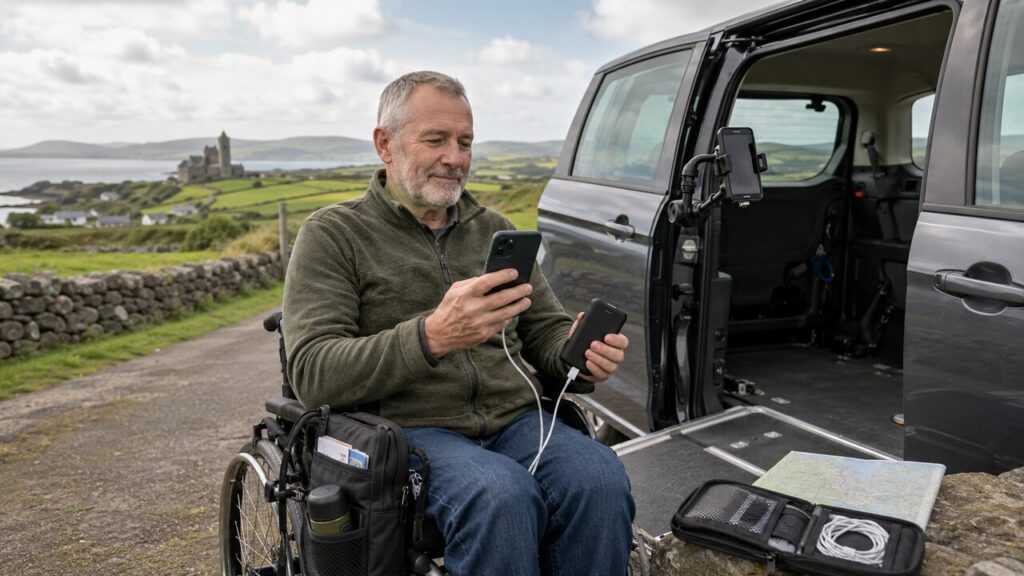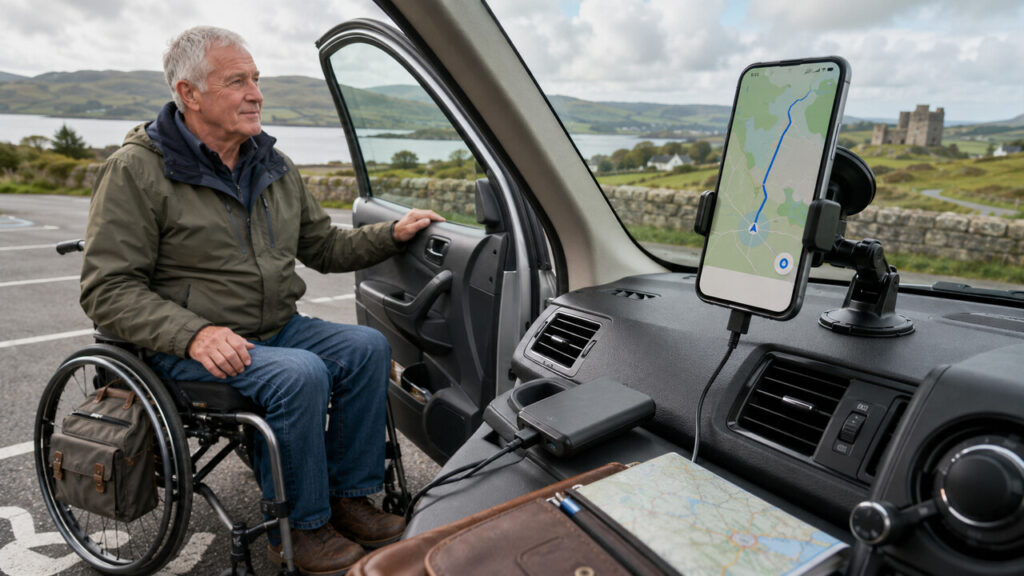
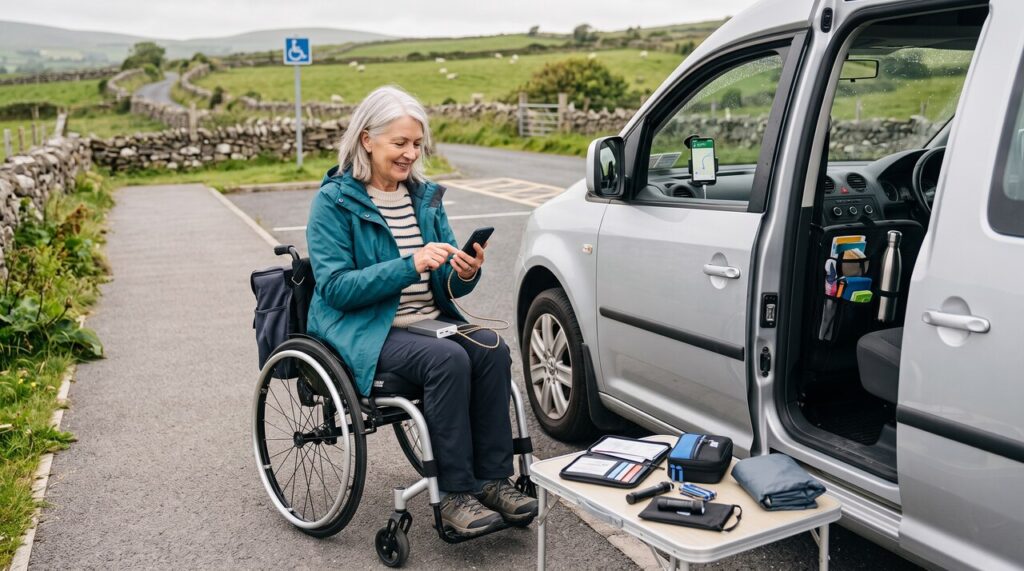
An accessible road trip around Ireland can be a wonderful way to explore the country at your own pace. From the rugged Atlantic coast to historic castles, small towns and peaceful countryside, travelling by car gives you much more flexibility than relying entirely on public transport.
For wheelchair users and travellers with reduced mobility, however, a little preparation can make a big difference.
Ireland has many accessible attractions, accommodation options and transport services, and wheelchair-accessible vehicles can also be hired for road trips. But accessibility can vary considerably from one location to another, particularly in rural areas.
The right products will not remove every challenge, but they can make everyday travel easier, safer and more comfortable.
Here are some of the most useful items to consider taking on an accessible road trip around Ireland.
1. A Reliable Power Bank
Best for: travellers who want something simple and easy to reach from a wheelchair.
A power bank is one of the simplest things you can pack, but it can also be one of the most useful.
During a road trip, your smartphone may be used for:
- navigation;
- checking attraction opening times;
- finding accessible toilets;
- booking accommodation;
- making emergency calls;
- taking photographs;
- checking weather forecasts.
Using maps and mobile data throughout the day can drain a battery surprisingly quickly.
A high-capacity power bank allows you to recharge your phone even when you are away from the car or staying somewhere without a convenient socket beside you.
You can also link internally to your article about why a power bank is useful for an accessible road trip around Ireland.
2. A Secure Smartphone Mount
Why I picked it: compact, practical and suitable for keeping essential items close at hand.
A smartphone mount can make navigation considerably easier when driving.
Instead of placing the phone on the passenger seat or trying to hold it, a dashboard or windscreen mount keeps the navigation screen in a practical position.
This is particularly useful on unfamiliar Irish roads, where directions can change quickly and some rural roads can be narrow.
The Road Safety Authority warns that mobile-phone use is a major source of driver distraction, so your phone should be set up before driving and not handled while the vehicle is moving.
Look for a mount that:
- holds the phone firmly;
- can be adjusted easily;
- works with your phone case;
- does not block your view of the road.
3. A Travel Document Organiser
Best for: travellers who want something simple and easy to reach from a wheelchair.
Road trips involve more paperwork than we sometimes expect.
You may need to keep together:
- identification;
- driving documents;
- insurance information;
- ferry tickets;
- accommodation confirmations;
- attraction bookings;
- emergency contact details;
- parking permits.
A zipped travel organiser keeps everything in one place and can be especially useful when you want important documents within easy reach.
Ireland operates a Disabled Parking Scheme, so travellers who use an eligible parking permit should check the relevant rules before travelling and keep the permit accessible.
This is another perfect place to link to your existing article about travel document organisers for accessible Irish road trips.
4. A Long Charging Cable and Car Charger
Why I picked it: compact, practical and suitable for keeping essential items close at hand.
A power bank is useful outside the vehicle, but a USB car charger and a longer charging cable can keep devices powered while you travel.
A longer cable can be particularly convenient if the passenger using the device sits farther from the vehicle’s charging socket.
Consider carrying two cables rather than one. They weigh almost nothing, and losing or damaging your only charging cable during a long trip can be surprisingly inconvenient.
5. A Compact Wheelchair Repair Kit
Best for: travellers who want something simple and easy to reach from a wheelchair.
If you use a manual wheelchair, a small repair kit can provide valuable peace of mind.
Depending on your wheelchair, useful items may include:
- a compact tyre pump;
- tyre levers;
- puncture repair patches;
- a small multitool;
- spare inner tube;
- cable ties.
You do not need to carry an entire workshop.
The aim is simply to deal with small problems that could otherwise interrupt your day — particularly when visiting rural locations where specialist wheelchair repair services may not be nearby.
For powered wheelchairs, check your manufacturer’s recommendations before travelling and make sure charging equipment is compatible with your accommodation.
6. A Lightweight Waterproof Cover
Why I picked it: compact, practical and suitable for keeping essential items close at hand.
Ireland’s scenery is famously green for a reason.
Weather can change quickly, particularly around coastal areas, so a lightweight waterproof jacket or wheelchair rain cover is worth keeping in the car even when the morning looks promising.
Choose something that packs into a small bag.
A compact waterproof cover can also protect:
- wheelchair controls;
- bags;
- phones;
- maps;
- travel documents.
Keeping waterproof equipment permanently in the vehicle means you do not have to remember it every morning.
7. An Accessible Car Storage Organiser
Best for: travellers who want something simple and easy to reach from a wheelchair.
When mobility is limited, having frequently used items within reach becomes especially important.
A seat-back or car storage organiser can hold things such as:
- water;
- medication;
- charging cables;
- snacks;
- sunglasses;
- tissues;
- documents;
- small tools.
Rather than storing everything in the boot, keep essential items where they can be reached without repeatedly getting in and out of the vehicle.
For an accessible road trip, convenience often matters just as much as the product itself.
8. A Reusable Water Bottle
Why I picked it: compact, practical and suitable for keeping essential items close at hand.
It sounds obvious, but water is one of the easiest things to forget.
Long drives, attraction visits and unexpected delays can leave you away from shops or cafés longer than planned.
A reusable bottle with an easy-open lid is often more practical than buying disposable bottles throughout the journey.
If hand strength or coordination is limited, look for a bottle you can comfortably open and hold with one hand.
9. A Torch and Basic Vehicle Emergency Kit
Best for: travellers who want something simple and easy to reach from a wheelchair.
A small emergency kit deserves a permanent place in the car.
Ireland’s Road Safety Authority advises motorists to carry useful safety equipment including a warning triangle, first-aid kit and other emergency items. Its vehicle safety guidance also recommends essentials such as a high-visibility vest and working torch.
For a road trip, I would consider carrying:
- LED torch;
- high-visibility vest;
- first-aid kit;
- warning triangle;
- basic tyre equipment;
- emergency contact information.
Hopefully you will never need them, but they take up very little space.
10. A Small Wheelchair-Friendly Day Bag
Why I picked it: compact, practical and suitable for keeping essential items close at hand.
Finally, consider a small bag designed to attach securely to a wheelchair.
It should be large enough for daily essentials without becoming heavy or interfering with the wheels.
A useful day bag might contain:
- phone;
- power bank;
- charging cable;
- wallet;
- water;
- waterproof jacket;
- small snack;
- travel documents.
Having everything attached securely to the wheelchair can make stops much easier than repeatedly unpacking the car.
Choose Practical Products, Not More Products
Preparing for an accessible road trip does not mean filling your vehicle with gadgets.
The best products are usually the ones that solve small, everyday problems.
A secure phone mount helps with navigation. A power bank keeps communication available. A document organiser keeps important paperwork together. A simple wheelchair repair kit may prevent a minor problem from ruining an entire day.
And before travelling, always check accessibility directly with hotels, attractions and transport providers rather than assuming that every location labelled “accessible” will meet your individual needs. Even official Irish tourism guidance notes that accessibility can vary; for example, many ferries provide disabled access while individual piers or harbours may still present difficulties for wheelchair users.
A little preparation gives you more freedom to concentrate on what the road trip is really about:
seeing Ireland, discovering new places and enjoying the journey.