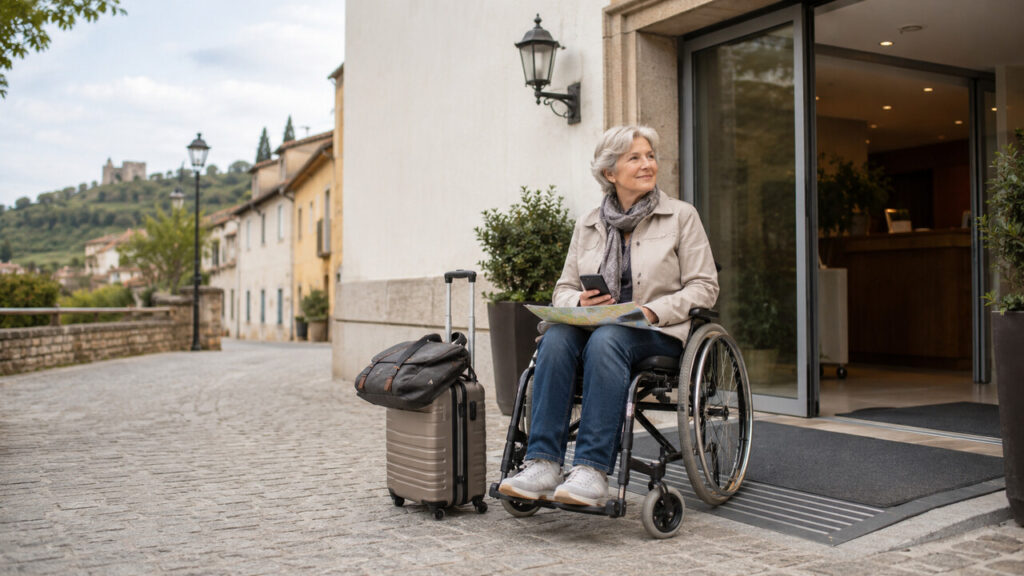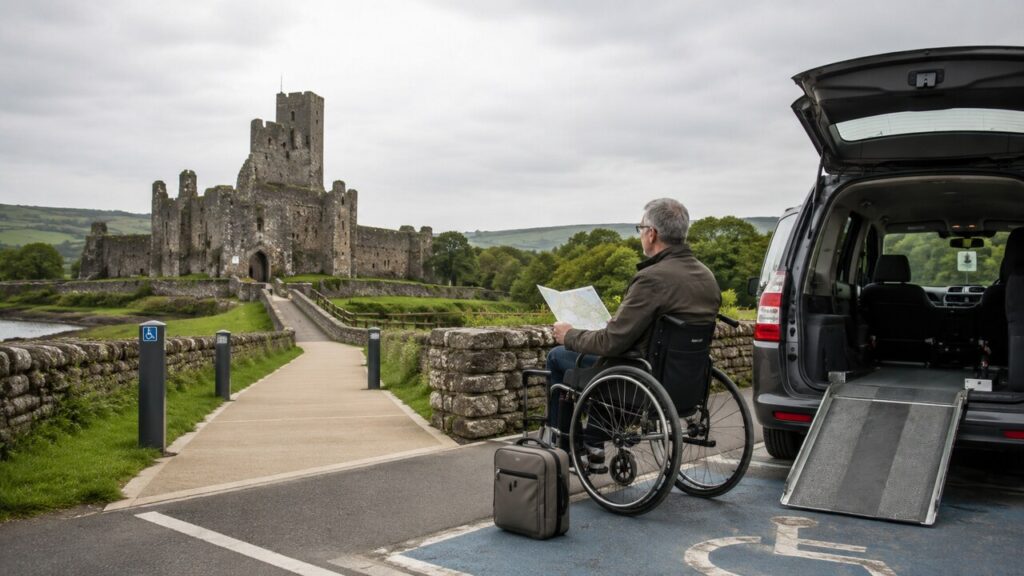
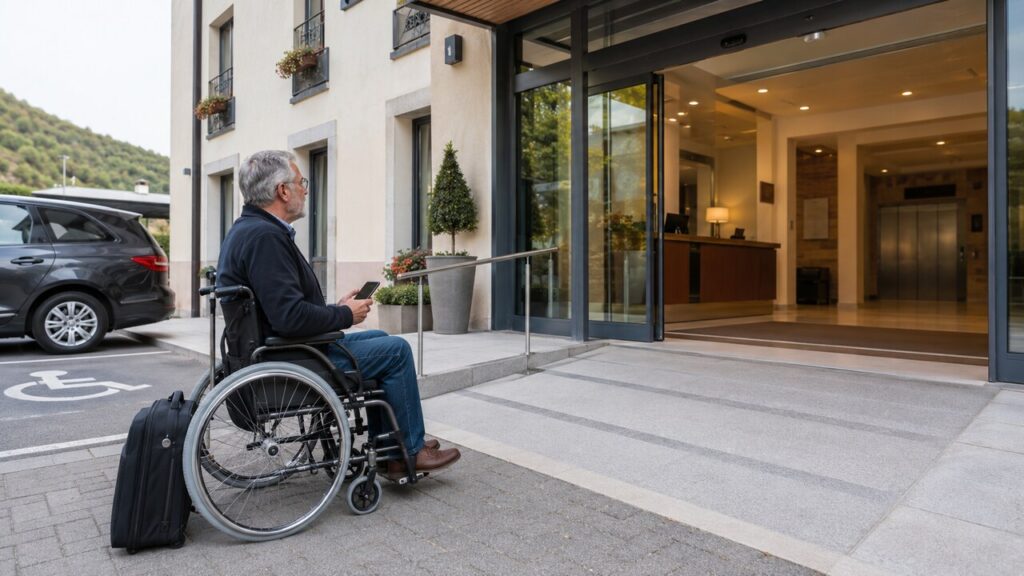
Booking a hotel should be one of the most enjoyable parts of planning a trip. You choose a destination, look at photographs, compare prices and imagine yourself finally arriving after a long journey.
For a wheelchair user, however, booking accommodation can involve much more than finding a comfortable bed and a good breakfast.
A hotel may describe itself as “accessible”, “wheelchair friendly” or “suitable for guests with reduced mobility”, but these phrases can mean very different things. One property may offer a genuinely step-free room with a roll-in shower, sufficient turning space and accessible parking. Another may simply have a ramp at the main entrance while the bedroom, bathroom or restaurant remains difficult to use.
That is why it is important to look beyond the accessibility symbol.
The right hotel can give you independence, comfort and confidence throughout your stay. The wrong one can leave you unable to enter the bathroom, reach the bed, use the shower or move around safely.
This practical guide explains what to check before booking a wheelchair-accessible hotel, which questions to ask and how to reduce the risk of an unpleasant surprise when you arrive.
Why “Wheelchair Accessible” Is Not Specific Enough
Accessibility is not the same for every traveller.
A guest who can walk a short distance may be comfortable in a room that would be unsuitable for someone who remains in a wheelchair. A manual wheelchair user may have different requirements from a person using a large powered wheelchair. Some travellers can transfer independently, while others need assistance, a portable hoist or space for a carer.
Hotels also use accessibility terms inconsistently.
“Wheelchair friendly” might mean:
- there is a portable ramp at reception;
- one bedroom is located on the ground floor;
- the hotel has a lift;
- the bathroom contains one grab rail;
- the public areas are accessible, but the bedrooms are not fully adapted.
These features may be useful, but they do not automatically make the whole hotel suitable for your needs.
European accessible-tourism guidance emphasises that accessibility should cover the complete travel experience, including information, booking, transport, entrances, accommodation and other services—not just one isolated feature.
Before searching for a hotel, write down the facilities you personally need. This turns a vague search for an “accessible hotel” into a much more accurate search for a room that works for you.
1. Check the Route from the Car Park to Reception
Accessibility begins before you enter the building.
Look at the route from the accessible parking space, taxi drop-off point or pavement to the hotel entrance. A hotel may have an accessible bedroom but still be difficult to reach because of steep slopes, gravel, kerbs, narrow gates or steps.
Ask the hotel:
- Is accessible parking available?
- Can it be reserved?
- How far is it from the entrance?
- Is the route level, smooth and step-free?
- Are there dropped kerbs?
- Is the parking area well lit?
- Is there enough space beside the vehicle for a wheelchair or transfer?
An accessible parking bay is much more useful when it is close to the entrance and connected to the building by a safe, level route.
This is especially important when travelling in a wheelchair-accessible vehicle or using a ramp at the side or rear of the car. A standard parking space may not provide enough room to unload safely.
Also ask whether the hotel entrance has automatic doors. Heavy manual doors can be difficult to open while controlling a wheelchair, carrying luggage or using a mobility aid.
If a ramp is provided, ask whether it is permanent or portable. A portable ramp may require a member of staff to bring and position it whenever you enter or leave. That arrangement can reduce your independence, particularly early in the morning or late at night.
2. Confirm That the Entire Route to the Room Is Step-Free
A step-free main entrance does not guarantee a step-free journey to the bedroom.
Ask the hotel to describe the complete route from reception to your room.
Check whether it includes:
- steps or raised thresholds;
- narrow corridors;
- heavy fire doors;
- thick carpets;
- steep ramps;
- small lifts;
- split-level floors;
- outdoor pathways;
- difficult corners.
Thick carpet can create considerable resistance for a manual wheelchair. A powered wheelchair may struggle with tight corners, raised doorway strips or narrow lift entrances.
If the accessible bedroom is on an upper floor, confirm that the lift is large enough for your wheelchair and any companion travelling with you.
Do not ask only, “Do you have a lift?”
Instead, ask:
- What is the width of the lift door?
- What are the internal dimensions?
- Is there space for a wheelchair and another person?
- Are the buttons positioned at a reachable height?
- Is the lift available at all times?
- What happens if the lift is out of service?
When possible, a genuinely accessible ground-floor room may provide greater security and independence than an upper-floor room that relies completely on one lift.
3. Ask for Exact Doorway Measurements
One of the most useful questions you can ask is also one of the most frequently overlooked:
How wide is the narrowest doorway on the route to the room and inside the bathroom?
Do not assume that your wheelchair will fit simply because the hotel uses an accessibility symbol.
Measure the widest part of your wheelchair before travelling. Remember to include hand rims, armrests or any equipment attached to the chair.
Check the width of:
- the main entrance;
- the bedroom entrance;
- the bathroom entrance;
- the shower entrance;
- any internal connecting doors;
- the lift door.
Measurements are more dependable than descriptions such as “wide”, “spacious” or “wheelchair suitable”.
Also ask about thresholds. Even a relatively small raised lip can be uncomfortable or difficult to cross, especially in a manual wheelchair or when balance and upper-body strength are limited.
4. Check the Space Beside the Bed
A large bedroom does not necessarily provide usable space.
Furniture may reduce the clear area available for turning, approaching the bed or transferring. Decorative chairs, luggage benches, desks and bedside tables can make an apparently spacious room difficult to navigate.
Ask whether there is clear wheelchair access:
- beside the bed;
- at the foot of the bed;
- between the bed and the bathroom;
- near wardrobes and storage;
- around the desk or table;
- beside electrical sockets and light controls.
The side of the bed you use for transferring matters. Tell the hotel whether you need clear space on the left, right or both sides.
Ask for photographs showing the complete room from several angles. Promotional pictures often focus on the bed and decoration while hiding the actual distance between the furniture.
A useful photograph should show:
- both sides of the bed;
- the route from the door to the bathroom;
- the space at the foot of the bed;
- the position of furniture;
- the flooring;
- the location of sockets and controls.
If the room would work after a chair, table or luggage rack is removed, ask the hotel to arrange this before your arrival and confirm the request in writing.
5. Confirm the Bed Height
Bed height can determine whether you can transfer safely.
A bed that is too high may be impossible to reach from a wheelchair. A very low bed may make standing or transferring more difficult. Modern hotel beds are sometimes placed on tall bases or topped with deep mattresses, making them higher than they appear in photographs.
Measure the height of your wheelchair seat and compare it with the height of the hotel bed.
Ask the hotel to measure from the floor to the top of the mattress. Do not rely on an estimate.
Also check:
- whether the bed has a solid base;
- whether there is space underneath for a portable hoist;
- whether the mattress can be removed or changed;
- whether the bed can be moved;
- whether a bed rail can be provided;
- whether the bed is positioned against a wall.
If you use a mobile hoist, the clearance beneath the bed is particularly important. A room may be described as accessible while the bed frame prevents the hoist legs from passing underneath.
Hotels do not always provide lifting equipment. Ask whether you need to hire equipment from a local mobility company and whether the hotel will accept delivery before you arrive.
6. Examine the Bathroom Carefully
The bathroom is often the most important part of an accessible hotel room—and the place where vague descriptions create the greatest problems.
A bathroom can be called accessible even when it contains features that are unsuitable for a full-time wheelchair user.
Request photographs and exact details before booking.
Is the Shower Truly Step-Free?
Ask whether the room has:
- a level-access shower;
- a roll-in shower;
- a wet room;
- a shower tray with a raised edge;
- a shower over a bath.
A “walk-in shower” is not always a roll-in shower. It may still have a raised tray or narrow glass entrance that prevents wheelchair access.
Check:
- whether there is a threshold;
- the width of the shower entrance;
- the size of the shower area;
- the position of screens or doors;
- whether the floor becomes slippery;
- whether water drains correctly.
Is a Shower Seat Available?
Ask whether the seat is:
- fixed to the wall;
- height adjustable;
- freestanding;
- designed with a backrest;
- fitted with arm supports;
- strong enough for your needs.
A small folding seat may not provide sufficient support or stability. If you use your own shower chair, confirm that there is enough room for it.
Ask whether the shower controls and handheld shower head can be reached from the seat.
Where Are the Grab Rails?
“Grab rails are available” is not enough information.
Ask where they are installed:
- beside the toilet;
- behind the toilet;
- next to the shower seat;
- near the washbasin;
- on both sides or only one side.
Their position should match your transfer method. A rail on the wrong side may offer little practical help.
Is There Space Beside the Toilet?
For wheelchair users who transfer sideways, the clear space beside the toilet is essential.
Ask:
- Which side has transfer space?
- How wide is that space?
- Is there a wall, bin or radiator in the way?
- Can the wheelchair be positioned beside the toilet?
- Is there a drop-down rail?
- What is the height of the toilet seat?
Also check whether the bathroom door opens inward. An inward-opening door can reduce usable space and may become dangerous if someone falls behind it.
Is the Washbasin Accessible?
Look for:
- knee space underneath;
- reachable taps;
- a mirror visible from a seated position;
- accessible shelves;
- reachable towels and toiletries;
- pipes that are covered or safely positioned.
A pedestal underneath the sink can prevent a wheelchair user from getting close enough to use it comfortably.
7. Ask About Emergency Procedures
Emergency planning is not the most exciting part of preparing for a holiday, but it should not be ignored.
Ask the hotel what would happen if there were:
- a fire alarm;
- a power cut;
- a lift failure;
- an evacuation;
- an emergency during the night.
If your room is above the ground floor, ask how a wheelchair user would be evacuated when lifts cannot be used.
The hotel should be able to explain:
- its emergency evacuation procedure;
- whether evacuation chairs are available;
- whether staff are trained to use them;
- whether accessible rooms have alarm systems suitable for guests with different disabilities;
- whether a personal emergency evacuation plan can be arranged;
- whether staff are present overnight.
Official accessibility guidance for lodging facilities includes accessible routes and means of emergency exit as important parts of accessibility planning.
Do not accept a vague answer such as, “Our staff will help.” Ask how that assistance would work in practice.
8. Check Access to Restaurants and Other Facilities
A suitable bedroom is only one part of the stay.
Ask whether you can independently access:
- the breakfast room;
- restaurant;
- bar;
- garden;
- terrace;
- swimming pool;
- spa;
- meeting rooms;
- lounge;
- public toilets;
- vending machines;
- laundry facilities.
Some hotels have an accessible entrance and bedroom but place breakfast in a room reached only by steps. Others may have an accessible restaurant but no suitable public toilet nearby.
Check whether tables provide enough knee clearance and whether chairs can be removed to create a comfortable wheelchair space.
If breakfast is served as a buffet, consider whether you can reach the food, carry a plate and move through the serving area. Ask whether staff can help or provide table service.
You do not need to use every hotel facility, but you should know in advance which areas will be available to you.
9. Consider the Area Outside the Hotel
The hotel itself may be accessible while its surroundings are not.
Before booking, examine the immediate area using recent photographs, maps, street-level imagery and reviews.
Look for:
- steep hills;
- cobbled streets;
- damaged pavements;
- narrow footpaths;
- missing dropped kerbs;
- busy roads;
- steps between the hotel and town centre;
- gravel paths;
- accessible public transport;
- nearby accessible restaurants and toilets.
A central hotel is not necessarily the most practical choice. A property slightly farther from the main attractions may offer smoother pavements, better parking and easier vehicle access.
If you plan to use public transport, check the route between the hotel and the nearest station or bus stop. “Five minutes from the station” may refer to walking time and may not account for steep slopes, broken pavements or inaccessible entrances.
Ask the hotel staff whether wheelchair users regularly stay there and how they usually reach local attractions.
10. Read Reviews—but Search for Specific Details
General reviews rarely tell you everything you need to know about accessibility.
A guest may describe a hotel as perfectly accessible because they used a walking stick and needed only a lift. Another traveller using a powered wheelchair may have a very different experience.
Search reviews for terms such as:
- wheelchair;
- accessible room;
- disabled room;
- wet room;
- roll-in shower;
- grab rails;
- lift;
- steps;
- ramp;
- parking;
- mobility scooter;
- shower chair;
- bed height.
Pay attention to reviews written by guests with similar requirements to yours.
Recent reviews are particularly helpful because rooms may be refurbished, lifts may be replaced and access routes may change. However, reviews should support—not replace—direct confirmation from the hotel.
Online photographs uploaded by guests can sometimes provide a more realistic view than professionally staged images.
11. Contact the Hotel Directly
Online booking platforms are useful for comparing prices and locations, but accessibility information is often limited.
After finding a suitable property, contact the hotel directly before paying, especially when the booking is non-refundable.
Email is usually better than relying only on a telephone conversation because it provides a written record.
Explain your needs clearly and specifically.
Instead of asking:
“Is your hotel wheelchair accessible?”
Write:
“I use a powered wheelchair and cannot walk. I need a completely step-free route from the entrance to the bedroom, a doorway wide enough for my wheelchair, clear transfer space on the right-hand side of the bed, a level-access shower with a secure shower seat and clear space beside the toilet.”
This gives the hotel a much better chance of providing an accurate answer.
Ask the staff member to confirm:
- the exact room type;
- the room number, if possible;
- the bathroom arrangement;
- the bed height;
- the doorway width;
- the transfer side;
- the shower type;
- the availability of accessible parking;
- any equipment you requested.
In the United States, reservation rules for accessible lodging require accessible-room information to be provided in enough detail to allow guests to judge whether a room meets their needs, and accessible rooms should be held for the people who reserve them. Although regulations differ between countries, the practical lesson applies everywhere: your accessibility requirements should be connected to the actual reservation, not left as a general note.
12. Ask for Photographs or a Video
Photographs can answer questions that hotel descriptions cannot.
Request current images of:
- the entrance;
- parking route;
- bedroom doorway;
- space beside the bed;
- bathroom entrance;
- shower;
- toilet area;
- grab rails;
- lift;
- restaurant access.
A short video showing the route from reception to the room can be even more useful.
Ask for a continuous video rather than separate close-up clips. This allows you to see thresholds, corners, doorways and distances between important areas.
You can also suggest a brief video call with a member of staff if your requirements are complex. It may take only a few minutes and could prevent an unsuitable booking.
13. Get Every Important Promise in Writing
Telephone calls are useful, but written confirmation is safer.
After speaking to the hotel, send a short email summarising what was agreed.
For example:
“Thank you for confirming that the reserved room has step-free access, a roll-in shower, clear transfer space on the left side of the bed and an accessible parking bay near the entrance.”
Ask the hotel to reply and confirm that the information is correct.
Save:
- emails;
- screenshots;
- room descriptions;
- photographs;
- booking confirmations;
- accessibility requests;
- names of staff members;
- dates of conversations.
Add your requirements to the official reservation, not only to a separate email.
A note saying “guest requests accessible room” may not guarantee that a particular accessible room has been allocated. Ask whether the room is confirmed or merely requested.
14. Check the Cancellation and Room-Change Policies
Accessible rooms are often limited in number. If the hotel changes your room because of maintenance, overbooking or another operational problem, a standard room may not be a usable alternative.
Ask:
- Is the accessible room guaranteed?
- Could the room type be changed?
- What happens if the accessible room becomes unavailable?
- Will the hotel find equivalent accessible accommodation?
- Can you cancel without charge if the agreed accessibility features are unavailable?
- Are extra costs covered if you must move to another property?
Travel insurance may provide additional protection, but policies vary. Check whether the policy covers accessibility-related problems, mobility equipment and the cost of alternative accommodation.
Do not assume that ordinary travel insurance automatically covers a hotel that turns out to be unsuitable.
15. Reconfirm Shortly Before Travelling
Even after receiving written confirmation, contact the hotel again several days before arrival.
Ask the staff to verify that:
- the accessible room remains allocated to you;
- requested furniture has been removed;
- equipment has been arranged;
- accessible parking is reserved;
- the shower seat is available;
- maintenance work has not affected access;
- staff on duty know about your requirements.
Bring copies of the confirmation on your phone and, when practical, as a printed document.
Also save the hotel’s direct telephone number so you can contact reception during your journey.
A Practical Accessibility Checklist
Before paying for a wheelchair-accessible hotel, confirm the following.
Arrival
- Accessible parking or drop-off point
- Sufficient unloading space
- Smooth and step-free route
- Dropped kerbs
- Accessible main entrance
- Automatic or easy-to-open doors
Route to the Room
- Completely step-free access
- Suitable lift dimensions
- Wide corridors and doorways
- No difficult thresholds
- Manageable flooring
- Accessible emergency route
Bedroom
- Enough turning space
- Clear access beside the bed
- Correct transfer side
- Suitable bed height
- Hoist clearance if required
- Reachable sockets and controls
- Movable furniture
- Space for mobility equipment
Bathroom
- Wide entrance
- Level-access or roll-in shower
- Suitable shower seat
- Reachable shower controls
- Correctly positioned grab rails
- Clear transfer space beside the toilet
- Suitable toilet height
- Accessible washbasin
- Non-slip flooring
- Emergency pull cord that reaches the floor
Hotel Facilities
- Accessible reception
- Accessible restaurant and breakfast area
- Suitable public toilets
- Step-free access to the facilities you plan to use
- Staff available when assistance is required
Confirmation
- Current photographs or video
- Written answers from the hotel
- Accessibility request added to the reservation
- Accessible room confirmed, not merely requested
- Cancellation policy checked
- Booking reconfirmed before travelling
Red Flags to Watch For
Be cautious when a hotel:
- repeatedly says “fully accessible” but provides no details;
- refuses to give measurements;
- has no photographs of the accessible bathroom;
- cannot explain the difference between a walk-in and roll-in shower;
- says that a member of staff can lift your wheelchair over a step;
- relies on a portable ramp that is not always available;
- cannot explain its emergency procedure;
- refuses to confirm the accessible room in writing;
- describes access differently each time you contact the property;
- says, “It should probably be fine.”
“Probably” is not enough when the usability of your room depends on exact details.
Final Thoughts
A wheelchair-accessible hotel should offer more than a ramp and a label on a booking page.
It should provide a safe route into the building, enough space to move around, a bathroom that matches your transfer needs and access to the services you intend to use.
The most important rule is simple: ask specific questions.
Do not ask only whether the hotel is accessible. Ask about measurements, transfer space, shower thresholds, bed height, parking, lift dimensions and emergency arrangements.
Request photographs. Get important promises in writing. Reconfirm everything before travelling.
This preparation may take a little longer, but it can protect your independence and make the difference between a stressful stay and a comfortable, enjoyable journey.