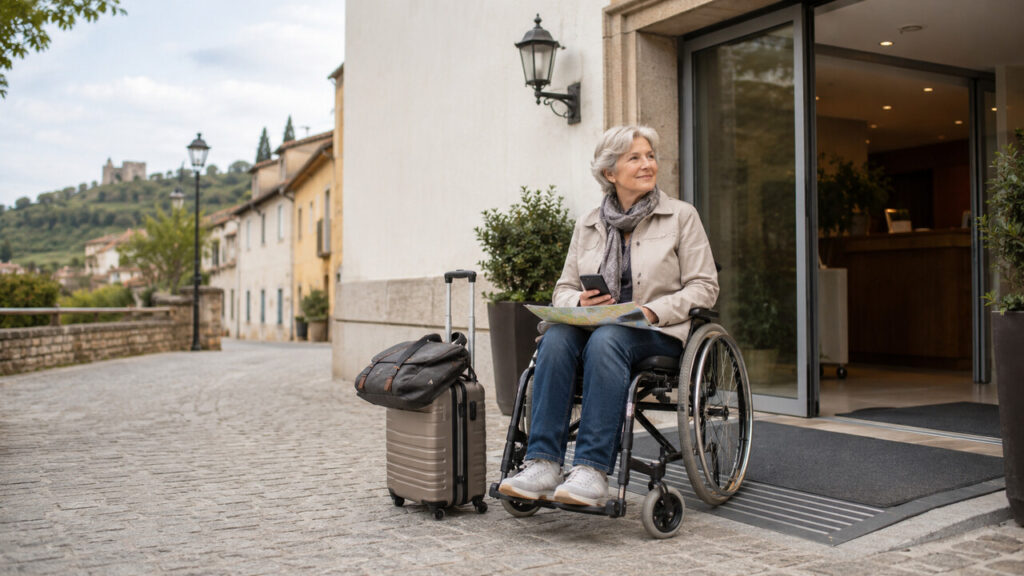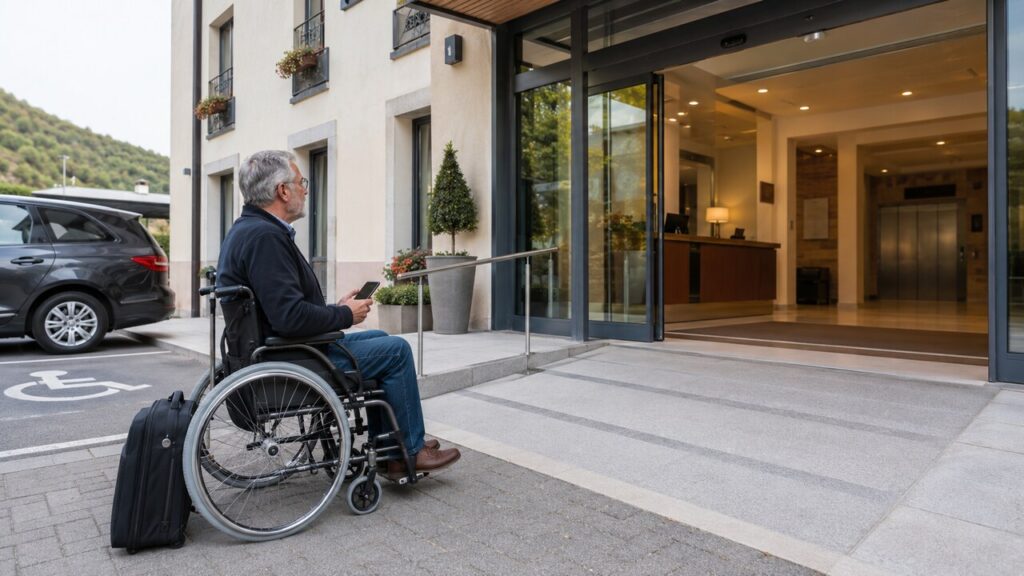
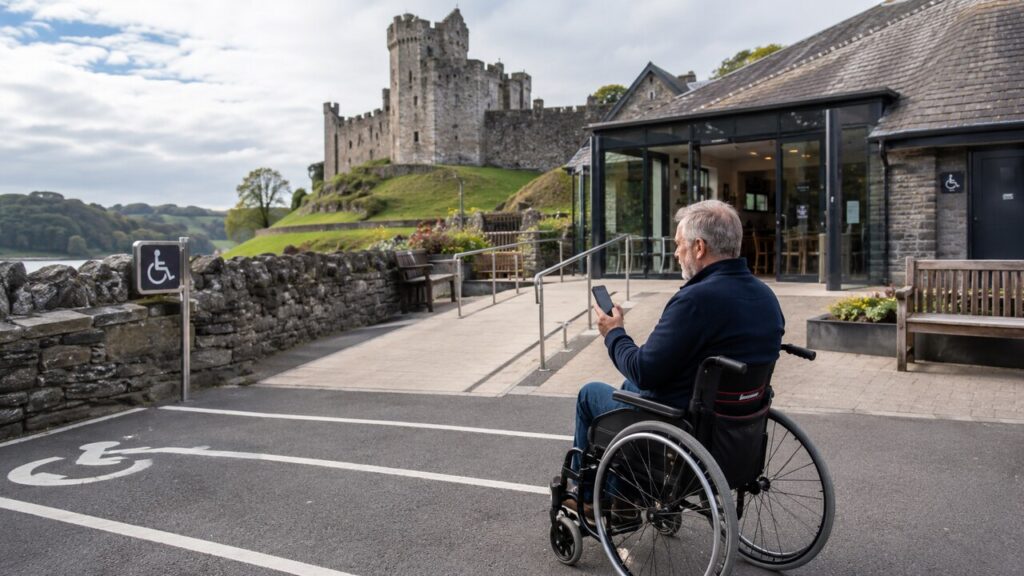
Ireland is an extraordinary country to explore.
Historic castles, dramatic coastal viewpoints, museums, gardens, heritage centres and small towns can turn even a simple day trip into something memorable.
But if you use a wheelchair, choosing an attraction often involves more preparation than simply checking opening hours and buying a ticket.
A website might describe an attraction as “wheelchair accessible”, but what exactly does that mean?
Is there an accessible parking space?
Is the route from the car park actually level?
Can you enter the building without steps?
Are all parts of the attraction accessible, or only the visitor centre?
Is there an accessible toilet?
Will a manual wheelchair cope with the paths?
And perhaps most importantly, will you be able to enjoy the attraction rather than spending the entire visit worrying about the next obstacle?
These are the questions worth asking before you leave.
Ireland’s tourism sector has been putting increasing emphasis on accessible and inclusive tourism. Fáilte Ireland now provides accessibility guidance and dedicated visitor-attraction checklists, encouraging businesses to describe their facilities clearly and create detailed Access Welcome Guides rather than relying on vague claims that a place is simply “accessible”.
That is encouraging.
However, accessibility can still vary considerably from one attraction to another, particularly when historic buildings, archaeological sites and rural locations are involved.
Here is what wheelchair users should look for before visiting an attraction in Ireland.
1. Do Not Rely on the Word “Accessible”
The first thing to remember is that accessibility is not an all-or-nothing description.
Two attractions may both call themselves wheelchair accessible while offering completely different experiences.
At one attraction, you might find:
- designated accessible parking;
- a level entrance;
- automatic doors;
- lifts between floors;
- wide corridors;
- an accessible toilet;
- a wheelchair-friendly café;
- level outdoor paths.
At another, “wheelchair accessible” might simply mean that you can enter the reception area.
This is particularly important when visiting historic buildings.
Ireland has hundreds of castles, abbeys, historic houses and archaeological attractions. Many were built hundreds of years before accessibility was something architects considered.
Some have been successfully adapted.
Others may have accessible visitor centres while the historic ruins themselves remain difficult or impossible to reach.
Irish accessibility legislation also recognises that alterations to certain heritage buildings and protected structures may be limited where changes would negatively affect conservation.
Therefore, look beyond the accessibility symbol.
Try to find specific information about exactly what you can access.
2. Check the Parking Before You Go
For wheelchair users travelling around Ireland by car, the accessibility of an attraction often begins in the car park.
A beautiful visitor centre is not much use if you cannot safely get from your vehicle to the entrance.
Check whether the attraction provides designated accessible parking spaces and, if possible, how close they are to the main entrance.
You may also want to know:
- whether the parking surface is tarmac, gravel or grass;
- whether there is enough room beside the vehicle to transfer safely;
- whether there are dropped kerbs;
- whether the route from the parking space is level;
- whether accessible spaces are likely to be available during busy periods.
This can matter particularly at rural attractions.
Small heritage sites, beaches, viewpoints and countryside attractions may have informal parking areas rather than conventional car parks.
If you use a wheelchair-accessible vehicle, side-loading ramp or need additional transfer space, checking beforehand becomes even more important.
Do not hesitate to phone the attraction.
A two-minute conversation may answer questions that the website does not.
3. Look at the Route From the Car Park to the Entrance
The distance between an accessible parking space and the entrance may only be 50 metres, but those 50 metres can make a huge difference.
Look for information about the surface.
Smooth tarmac, paving or compact surfaces are usually far easier than loose gravel.
Also check for:
- steep slopes;
- cross slopes;
- cobbles;
- narrow gates;
- steps;
- drainage channels;
- uneven paving;
- long ramps.
Ireland’s historic towns and attractions often contain cobbled surfaces because they form part of the character of the location.
They can look wonderful in photographs while being considerably less enjoyable in a wheelchair.
A power-assisted wheelchair or mobility scooter may handle these conditions differently from a lightweight manual wheelchair.
The important question is not simply:
“Is there a path?”
It is:
“What is the path actually like?”
4. Check Whether There Is a Step-Free Entrance
Never assume that the main entrance is accessible.
Sometimes wheelchair access is through a side entrance, courtyard or separate door.
That is not necessarily a problem.
What matters is knowing where it is before you arrive.
Look for information about:
- ramps;
- automatic doors;
- entrance width;
- door thresholds;
- alternative entrances;
- staff assistance.
If the attraction is inside an old castle, manor house or historic building, ask whether access is available to the whole building or only the ground floor.
Some properties have lifts.
Others may have platform lifts.
Some may have no realistic wheelchair access to upper floors.
Knowing this before buying a ticket helps you decide whether the accessible portion of the attraction still offers enough value for your visit.
5. Find Out How Much of the Attraction You Can Actually See
This is one of the most useful questions you can ask.
Instead of:
“Is your attraction wheelchair accessible?”
ask:
“Which parts of the attraction can I visit in my wheelchair?”
The answer can be very different.
Imagine a castle with:
- an accessible visitor centre;
- accessible courtyard;
- accessible exhibition;
- café and toilets;
but a medieval tower reached only by a spiral staircase.
The attraction may legitimately describe itself as partly accessible.
That does not necessarily mean it is a poor choice.
You may still have an excellent visit.
The important thing is knowing what to expect.
The same applies to gardens and outdoor attractions.
The main garden may have excellent paved routes while woodland trails are unsuitable for wheelchairs.
Accessibility information should help you decide whether the parts available to you are the parts you actually want to experience.
6. Accessible Toilets Matter More Than Many People Realise
For a quick 30-minute stop, toilets may not be a major consideration.
For a half-day attraction, they can determine whether the visit is practical at all.
Before travelling, check whether there is an accessible toilet and where it is located.
Ideally, find out whether it has:
- sufficient turning space;
- grab rails;
- an accessible sink;
- easy-to-use doors;
- enough transfer space.
For some visitors, a standard accessible toilet is not sufficient.
Changing Places facilities provide additional space and specialist equipment for people with more complex accessibility requirements. Changing Places Ireland maintains information about these facilities, and its standards include requirements for equipment, space and pre-visit information.
If this type of facility is important to you or somebody travelling with you, check its availability separately before making your journey.
7. Check Paths Carefully at Gardens and Outdoor Attractions
Ireland is made for outdoor exploration.
Botanical gardens, parks, coastal viewpoints, forest parks and historic estates can be wonderful places to visit.
Unfortunately, outdoor accessibility is also where descriptions can become vague.
A website may say:
“Wheelchair-friendly paths available.”
That does not tell you whether those paths cover 10% or 90% of the attraction.
Look for information about:
- path surfaces;
- gradients;
- steep sections;
- steps;
- gates;
- rest areas;
- route distances.
Weather matters too.
A firm woodland path in July may become soft and muddy after several days of rain.
Even accessible grass areas can become difficult for small wheelchair casters after heavy rain.
For this reason, outdoor attractions are worth checking again shortly before your visit.
8. Ireland’s Weather Can Change Accessibility
You do not need to spend long in Ireland to discover that the weather forecast is sometimes better treated as guidance than a promise.
Sunshine can become rain surprisingly quickly.
For wheelchair users, this affects more than comfort.
Rain can change surfaces.
Gravel may become softer.
Grass becomes slippery.
Paths become muddy.
Ramps can become wet.
Strong coastal winds can also make exposed viewpoints uncomfortable or difficult to navigate.
When visiting an outdoor attraction, pack with changing conditions in mind.
A lightweight waterproof jacket or wheelchair rain cover can be extremely useful.
A small waterproof bag for your phone, documents and charging accessories is another practical addition.
It is also worth having a backup attraction nearby.
If a planned garden, castle ruin or coastal site becomes impractical because of weather, a museum or indoor visitor centre may save the day.
9. Look for Places to Sit, Rest and Take Your Time
Accessibility is not just about wheelchair access.
A genuinely inclusive attraction should also allow visitors to experience the place at a comfortable pace.
This becomes increasingly important for travellers who have limited stamina, chronic pain, balance problems or other mobility limitations.
Look for:
- benches;
- indoor seating;
- sheltered areas;
- cafés;
- rest points;
- shorter route options.
Even when you personally remain in your wheelchair throughout the visit, seating may be important for the people travelling with you.
A relaxed attraction where everyone can stop for coffee or take a break often produces a much more enjoyable day than one where the group feels pressured to keep moving.
10. Check the Café — Not Just the Attraction
A good café can transform a two-hour attraction into an enjoyable half-day visit.
But check whether the café itself is accessible.
Questions worth considering include:
- Is the entrance step-free?
- Is there enough room between tables?
- Can a wheelchair fit comfortably at the tables?
- Is ordering done at the table or at a high counter?
- Are accessible toilets nearby?
If the attraction does not have suitable food facilities, find a nearby accessible café before you travel.
That is much easier than trying to search for somewhere while everyone is hungry.
For longer road trips, keeping water and a few simple snacks in the car is also sensible.
11. Check Ticketing and Companion Policies
Online booking has made visiting attractions easier, but not every booking system explains accessibility clearly.
Before paying, check whether the attraction offers:
- reduced admission for visitors with disabilities;
- free or discounted companion/carer tickets;
- advance booking for accessible tours;
- reserved accessible seating;
- specific arrival instructions for wheelchair users.
Policies vary, so never assume.
If a companion ticket is available but cannot be selected online, contact the attraction before booking.
This may also be useful if you need to reserve a wheelchair-accessible tour time.
12. Look at Recent Photos and Reviews
Official websites are the best place to start, but recent visitor photographs can provide useful extra information.
Look at pictures of:
- entrances;
- paths;
- parking areas;
- courtyards;
- toilets;
- cafés.
You may notice details that are difficult to explain in an accessibility statement.
Reviews can also be helpful, especially when another wheelchair user describes their experience.
However, be careful.
Accessibility needs vary enormously.
A route described as “easy” by somebody using a powerful mobility scooter might be very difficult for somebody independently using a manual wheelchair.
Treat reviews as additional information rather than absolute proof.
13. Phone When the Information Is Unclear
This is probably the simplest and most underrated piece of advice in this entire guide.
If an attraction’s website leaves you uncertain, call them.
Ask specific questions.
For example:
“I use a manual wheelchair. Is the route from the accessible parking space to the entrance completely step-free?”
Or:
“Can I access the main exhibition, café and toilets without using stairs?”
Specific questions are much more likely to produce useful answers than simply asking whether the attraction is accessible.
You may also discover temporary issues that have not yet appeared online.
A lift may be undergoing maintenance.
Construction might have changed an entrance.
Part of a garden could be closed.
Temporary events may affect parking.
A short call before leaving can prevent a wasted journey.
14. Build a Small Wheelchair Day-Trip Kit
Good preparation can make accessible travel considerably less stressful.
You do not need to carry half your house with you.
A small practical kit may be enough.
Depending on your needs, consider taking:
- a fully charged smartphone;
- a secure smartphone mount for navigation;
- a power bank and charging cable;
- a travel document organiser;
- water;
- a lightweight waterproof jacket or wheelchair rain cover;
- any essential medication;
- a compact wheelchair repair kit;
- a small tyre pump if your wheelchair uses pneumatic tyres;
- snacks;
- emergency contact information.
A power bank is particularly useful when your phone is simultaneously handling maps, attraction information, photographs and ticket confirmations.
If you are exploring Ireland by road, keeping these items together in a small organiser means you do not have to repack everything before every journey.
15. Download Important Information Before Leaving
Mobile coverage in Ireland is generally good, but rural and coastal locations can still have weak signals.
Do not rely completely on being able to search online when you arrive.
Before leaving your accommodation, consider saving:
- your ticket confirmation;
- attraction address;
- parking information;
- accessibility information;
- phone number;
- screenshots of important directions;
- nearby accessible alternatives.
Downloading an offline map of the surrounding area can also be useful.
This becomes particularly valuable during longer road trips around rural Ireland.
16. Give Yourself More Time Than Google Maps Suggests
Travel time and visiting time are two different things.
If navigation says the attraction is 60 minutes away, the entire journey may take considerably longer.
You might need time for:
- accessible parking;
- unloading a wheelchair;
- finding the accessible entrance;
- toilet stops;
- breaks;
- unexpected road conditions.
Avoid planning six attractions in one day simply because they appear close together on a map.
Two enjoyable visits are usually better than five rushed ones.
Ireland is especially rewarding when explored slowly.
Small towns, scenic roads and unexpected viewpoints often become some of the best parts of the trip.
17. Have a Plan B
Accessible travel becomes much easier when changing plans does not feel like failure.
Suppose you arrive at an outdoor attraction and discover that rain has made the paths unsuitable.
Instead of ruining the entire day, you could already have:
- a museum;
- visitor centre;
- shopping centre;
- accessible café;
- indoor heritage attraction
saved on your phone.
This is especially useful during an Irish road trip where weather can change rapidly.
Think of Plan B as part of the itinerary rather than an emergency solution.
What Good Accessibility Information Should Tell You
When researching wheelchair-accessible attractions in Ireland, the best websites do not simply display a wheelchair symbol.
They explain the visitor experience.
You should ideally be able to discover:
- where accessible parking is located;
- whether the entrance is step-free;
- what surfaces you will encounter;
- whether lifts are available;
- which areas are inaccessible;
- where accessible toilets are located;
- whether assistance is available;
- who to contact with questions.
Fáilte Ireland’s current accessible-tourism programme reflects this approach by encouraging tourism businesses to assess their facilities and create Access Welcome Guides so visitors can make informed choices before arriving.
For wheelchair users, detailed information is often more valuable than simply being told that a place is accessible.
A Simple Pre-Visit Accessibility Checklist
Before visiting an attraction in Ireland, ask yourself:
Getting there
- Is accessible parking available?
- Is there enough room to get my wheelchair in or out of the vehicle?
- Is the route from the parking area step-free?
Entrance
- Is the main entrance accessible?
- If not, where is the accessible entrance?
- Are doors and thresholds manageable?
Inside
- Are lifts available?
- Which floors can I visit?
- Are corridors wide enough?
- Are exhibitions wheelchair accessible?
Outside
- Are paths paved, compacted, gravel or grass?
- Are there steep slopes?
- Does weather affect accessibility?
Facilities
- Is there an accessible toilet?
- Is there an accessible café?
- Are seating and rest areas available?
Planning
- Do I need to book?
- Is a companion ticket available?
- Should I call before visiting?
- Do I have an alternative attraction nearby?
If you can answer most of these questions before leaving, your chances of having a relaxed day increase considerably.
Final Thoughts: Accessibility Is About Confidence
Finding wheelchair-accessible attractions in Ireland should not mean trying to eliminate every possible difficulty.
Travel will always include unexpected moments.
The goal is to remove as much uncertainty as possible.
Good accessibility information gives you something extremely valuable:
confidence.
Confidence that you can park.
Confidence that you can get through the entrance.
Confidence that there is a suitable toilet.
Confidence that you will actually be able to experience the attraction you travelled to see.
Ireland has castles, museums, gardens, scenic landscapes, historic towns and visitor attractions that can provide unforgettable experiences.
The important thing is to look beyond the word “accessible”.
Ask what accessibility actually means at that particular place.
Check the parking.
Check the entrance.
Check the surfaces.
Check the toilets.
Check which parts you can visit.
And when the information is unclear, ask.
A few minutes of preparation before your journey can mean much more freedom once you arrive.
And that is ultimately what accessible travel should provide: not a perfectly obstacle-free world, but the information and confidence needed to explore it on your own terms.