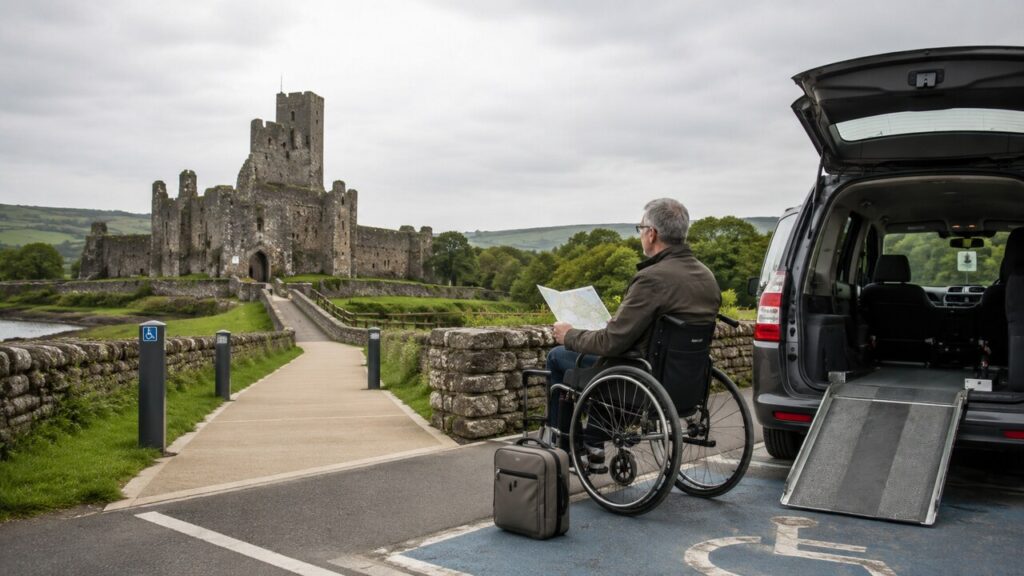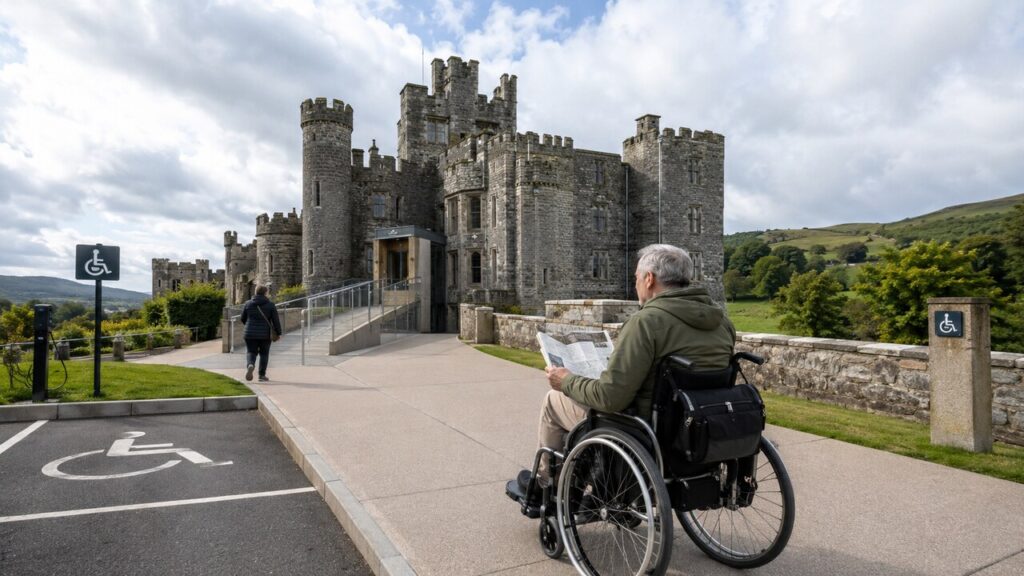
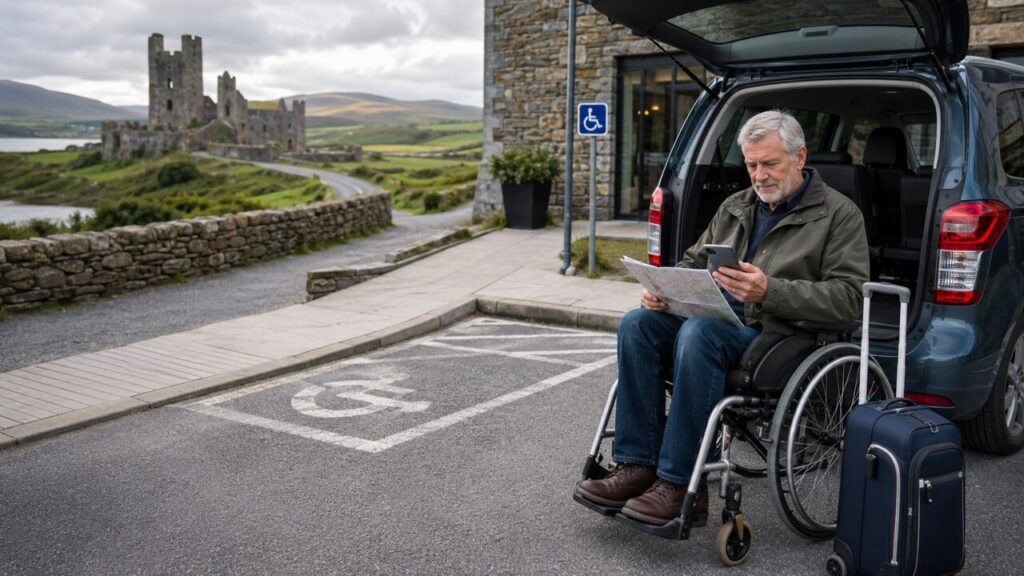
Ireland can be a wonderful destination for a first wheelchair-friendly holiday.
Its dramatic coastline, historic towns, welcoming communities and beautiful green countryside make it ideal for travellers who prefer meaningful experiences rather than rushed sightseeing. However, travelling with a wheelchair requires more preparation than simply choosing a hotel and booking a flight.
An accommodation listing may describe a room as accessible without explaining the width of the bathroom door. A railway station may have step-free access but experience a temporary lift closure. A famous castle may have an accessible visitor centre while parts of the historic building remain impossible to enter in a wheelchair.
None of these challenges means that you should abandon the idea of visiting Ireland.
They simply mean that a successful accessible trip begins with asking better questions.
This guide will help you plan your first wheelchair-friendly trip to Ireland step by step. It covers transport, accommodation, accessible attractions, equipment, daily itineraries and the practical details that can make the difference between a stressful journey and an enjoyable adventure.
Start With a Short and Realistic First Trip
Your first accessible journey to Ireland does not need to include the entire island.
Trying to visit Dublin, Galway, Cork, Kerry and the Wild Atlantic Way during one short holiday can leave any traveller exhausted. When you use a wheelchair, frequent hotel changes and complicated transfers can make an ambitious itinerary even more tiring.
For your first visit, consider staying for four to seven nights and choosing one main base.
Dublin is often the easiest starting point because it offers:
- direct flight connections;
- extensive public transport;
- a wide choice of accommodation;
- accessible taxis;
- hospitals, pharmacies and repair services;
- numerous indoor attractions for rainy days;
- several possible day trips.
Cork or Galway may also work well, particularly if you prefer a smaller city and plan to travel by car. However, your first destination should be chosen according to your practical needs rather than its popularity on social media.
Ask yourself:
- How much assistance will I need?
- Will I travel independently or with another person?
- Do I use a manual or powered wheelchair?
- Can I transfer into a standard car seat?
- Do I need a roll-in shower?
- How long can I comfortably spend away from the hotel?
- Do I prefer cities, historic attractions or countryside?
- Will I travel by public transport or hire a vehicle?
Your answers will help you build a journey around your own abilities instead of trying to adapt yourself to an unsuitable itinerary.
Choose the Best Way to Reach Ireland
Most international visitors arrive in Ireland by air, although travelling by ferry can be a practical alternative for people coming from the United Kingdom or continental Europe.
Flying to Ireland
When booking your flight, contact the airline and request assistance as early as possible.
Explain:
- whether you can walk at all;
- whether you can climb aircraft steps;
- whether you can transfer to an aisle chair;
- whether you will remain in your own wheelchair until the aircraft door;
- whether your wheelchair is manual or powered;
- the type and specifications of its battery;
- whether any detachable parts must travel in the cabin.
Do not assume that selecting a general assistance option during online booking provides the airline with all the information it needs.
Dublin Airport advises passengers requiring wheelchair assistance to arrange it directly through their airline or through the airport’s PRM assistance system. Assistance points are also available around the terminals and car parks.
Airport and airline procedures can change, so verify the current rules shortly before departure.
Take photographs of your wheelchair before checking it in. Remove loose items such as cushions, control units or footrests whenever the airline permits you to carry them separately. Attach a simple instruction sheet explaining how to release the brakes, fold the chair or disconnect the battery.
It is also sensible to place your name, telephone number and destination address on the wheelchair.
Travelling by Ferry
A ferry may be worth considering when you want to take your own wheelchair-accessible vehicle to Ireland.
This option can reduce the number of transfers and allows you to carry more equipment. You may also have greater control over your seating and mobility once you arrive.
Before booking, ask the ferry operator about:
- accessible cabins;
- roll-in shower dimensions;
- lift access between decks;
- accessible parking near the lift;
- assistance during boarding;
- emergency evacuation procedures;
- access to restaurants and outdoor decks;
- charging powered mobility equipment.
Remember that an accessible cabin must be reserved specifically. Do not rely on being allocated one automatically when you arrive.
Decide How You Will Travel Around Ireland
Your transport choice will shape the entire holiday.
Ireland has accessible public transport, particularly in larger cities, but accessibility can vary between routes, stations and rural areas. A car offers greater freedom, although hiring a suitable wheelchair-accessible vehicle may require early booking.
Using Public Transport
Transport for Ireland provides an accessibility section and a journey planner that can indicate whether particular services and stops are wheelchair accessible. Its live app can also show departure information and accessible services.
In Dublin, the Luas tram system can be particularly useful. Transport for Ireland states that Luas trams and platforms are wheelchair accessible, with ramps or lifts provided where necessary.
The majority of TFI bus services use low-floor vehicles with designated wheelchair spaces. Dublin Bus generally accepts wheelchairs up to 70 centimetres wide and 120 centimetres long without advance booking. City and town services operated by Bus Éireann are described as wheelchair accessible, although space can still be limited.
Even when a service is theoretically accessible, it is sensible to allow extra time. A wheelchair space may already be occupied, a bus ramp may be temporarily unavailable or roadworks may make a particular stop difficult to use.
Avoid planning extremely tight connections.
Travelling by Train
Irish Rail operates accessible spaces on many services, but wheelchair places are limited. Booking your wheelchair space in advance is therefore strongly recommended.
Irish Rail states that its services can generally accommodate wheelchairs and powered scooters up to specified dimensions, including a maximum width of 700 millimetres and a maximum length of 1,200 millimetres. The combined maximum weight may also apply, so powered-wheelchair users should check current requirements before booking.
Do not check only whether the train is accessible.
Check both departure and arrival stations for:
- step-free entrances;
- working lifts;
- platform access;
- accessible toilets;
- boarding ramps;
- staff availability;
- accessible onward transport.
Station facilities can differ significantly. Irish Rail publishes accessibility information for individual stations, which can help you check the entire journey rather than the train alone.
Check again on the day of travel in case a lift is out of service.
Using Accessible Taxis
An accessible taxi can be valuable for airport transfers, evenings out or journeys where public transport is inconvenient.
Tourism Ireland advises that the National Transport Authority maintains a register of wheelchair-accessible taxis and hackneys.
However, an accessible vehicle is not necessarily suitable for every wheelchair.
Before confirming a taxi, ask:
- Can I remain seated in my wheelchair?
- Is entry through the side or rear?
- Is there a ramp or a lift?
- What are the internal height and door dimensions?
- Can the driver secure my wheelchair correctly?
- Is there space for luggage?
- Can the vehicle carry a powered wheelchair?
- Must the journey be booked in advance?
Save the contact details of at least two accessible taxi companies. Availability can be limited during weekends, major events and early morning hours.
Hiring a Wheelchair-Accessible Vehicle
A wheelchair-accessible vehicle can provide the greatest independence, especially when you want to explore smaller towns, castles and countryside.
Some Irish vehicle-hire specialists offer adapted cars and wheelchair-accessible vehicles. Tourism Ireland also refers travellers to companies supplying adapted automatic cars and accessible vehicles.
Reserve well in advance, particularly during summer.
Send the company:
- the dimensions of your wheelchair;
- the combined weight of the user and chair;
- your preferred entry method;
- the number of passengers;
- your luggage requirements;
- whether you can transfer into a standard seat;
- whether you need hand controls;
- whether the vehicle must have a hoist or ramp.
Ask for photographs of the actual vehicle or an identical model. A generic description is not enough.
If you plan to remain in your wheelchair while travelling, confirm that the vehicle has an approved wheelchair tie-down and occupant restraint system.
Never Book a Hotel From the Word “Accessible” Alone
Accessible accommodation is one of the most important parts of the trip.
Unfortunately, the word “accessible” can mean very different things. One hotel may offer a fully adapted room with a roll-in shower, grab rails and sufficient turning space. Another may simply have a lift and a step-free entrance.
Before paying, contact the property directly.
Written communication is useful because it creates a record of what you were told. Ask specific questions rather than saying, “Is the room wheelchair accessible?”
Questions to Ask the Hotel
Ask about the route from the street or car park to the room:
- Is the entrance completely step-free?
- Are there slopes, gravel surfaces or heavy doors?
- Is accessible parking available?
- How far is the parking space from the entrance?
- Is the reception on the entrance level?
- Is the lift large enough for my wheelchair and companion?
- Are there steps anywhere between the entrance and the bedroom?
Ask for the bedroom measurements:
- What is the narrowest door width?
- How much space is available beside the bed?
- What is the height of the bed?
- Can furniture be removed?
- Is there room to turn the wheelchair?
- Are electrical sockets reachable?
- Can the window, curtains and heating controls be operated from a seated position?
Ask detailed bathroom questions:
- Is the shower genuinely level-access?
- Is there a fixed or portable shower seat?
- Are grab rails installed?
- Is there space beside the toilet for a lateral transfer?
- What is the toilet height?
- Is there space underneath the sink?
- Is the bathroom floor non-slip?
- Is an emergency alarm fitted?
- Does the shower have a handheld shower head?
Request recent photographs or a short video of the exact room whenever possible.
A room can be described as suitable for wheelchair users even when the bed cannot be approached from the correct side or the bathroom is too narrow for your particular chair.
Consider Self-Catering Accommodation
A hotel is not always the best choice.
An accessible self-catering apartment or cottage can provide:
- more room for equipment;
- a refrigerator for medication or food;
- flexible meal times;
- space for a companion or carer;
- a washing machine;
- a quieter environment;
- greater privacy.
However, self-catering properties must be checked as carefully as hotels. Rural cottages may have gravel drives, narrow paths, steep ramps or limited mobile-phone coverage.
Never assume that a ground-floor property is automatically step-free.
Choose Attractions That Offer More Than an Accessible Entrance
Ireland is famous for castles, ruins, coastal viewpoints and historic buildings. Many were constructed centuries before modern accessibility standards existed.
The visitor centre may be accessible while the tower, battlements or upper floors remain reachable only by stairs.
That does not necessarily make the attraction unsuitable. The key question is whether the accessible parts still provide a worthwhile experience.
Before visiting, look for:
- accessible parking;
- a firm path from the car park;
- ramp or lift access;
- accessible toilets;
- seating and rest areas;
- wheelchair loans;
- mobility scooters;
- accessible cafés;
- virtual tours of inaccessible sections;
- viewing platforms;
- companion admission policies;
- surface information for outdoor routes.
Contact the attraction when the website provides only a wheelchair symbol without details.
Ask whether paths are made from smooth paving, compacted gravel, grass or loose stone. A route that works well for a powered wheelchair may be difficult in a manual chair.
Weather can also affect accessibility. Heavy rain may turn an otherwise manageable outdoor path into mud, while strong coastal winds can make exposed viewpoints uncomfortable or unsafe.
Build a Slow and Flexible Itinerary
A wheelchair-friendly itinerary should leave room for delays, rest and changing weather.
For most first-time visitors, one major attraction and one optional activity per day is enough.
A comfortable day might include:
- a relaxed breakfast;
- one main museum, castle or scenic attraction;
- lunch in an accessible café;
- time to rest at the hotel;
- a short evening activity near the accommodation.
Avoid changing hotels every night. Each move involves packing equipment, checking out, arranging transport, confirming another accessible room and learning a new route.
Staying in one place for several nights gives you time to understand the area and develop a reliable routine.
Keep at least one unplanned half-day during the trip. You may need it because of fatigue, bad weather, a transport problem or simply because you discover somewhere you would like to visit again.
A slower itinerary is not a lesser holiday. It often allows you to experience more of the atmosphere, conversations and everyday life that make Ireland memorable.
Prepare for Ireland’s Weather and Terrain
Irish weather can change quickly.
Sunshine, wind and rain may all appear on the same day. Wheelchair users should think not only about personal clothing but also about protecting mobility equipment.
Pack:
- a waterproof jacket;
- a waterproof leg cover;
- warm layers;
- gloves suitable for pushing;
- waterproof covers for wheelchair controls;
- a dry bag for documents and electronics;
- a small towel;
- spare socks;
- a wheelchair cushion cover.
For a manual chair, wet push rims can become slippery. Gloves with a reliable grip can make a significant difference.
Cobblestones, uneven pavements and steep streets may appear in older town centres. Plan shorter routes and identify alternative entrances before setting out.
A compact portable threshold ramp may help with very small obstacles, but it should only be used when it is safe, stable and appropriate for your chair.
Create a Wheelchair Repair and Equipment Plan
A minor wheelchair problem can disrupt an entire holiday if you are unprepared.
Before departure, have your chair inspected. Check:
- tyres and inner tubes;
- brakes;
- bearings;
- footrests;
- armrests;
- joystick controls;
- battery condition;
- charging cables;
- folding mechanisms;
- removable parts.
Carry a small repair kit suited to your wheelchair. It might include:
- tyre levers;
- a suitable pump;
- spare inner tube;
- puncture repair materials;
- Allen keys;
- cable ties;
- strong tape;
- a small multi-tool;
- spare bolts or fasteners;
- the wheelchair manual;
- contact details for the manufacturer.
Powered-wheelchair users should confirm that the charger is compatible with Ireland’s electrical supply and plug system. Ireland uses Type G plugs, as in the United Kingdom.
Save the details of mobility-equipment repair companies near your destination. You may never need them, but having a backup plan reduces anxiety.
Do not keep all essential spare parts in checked luggage. Carry critical items in your cabin baggage whenever airline regulations allow it.
Plan Medication and Personal Care Carefully
Take enough medication and medical supplies for the entire journey, plus a reasonable reserve in case of delays.
Keep medicines in their original packaging and carry a copy of your prescription or a letter explaining important medical needs.
Think about daily routines that may be easy at home but more complicated during travel:
- pressure relief;
- catheter supplies;
- personal care;
- medication refrigeration;
- dietary requirements;
- accessible toilets;
- help getting into bed;
- charging medical devices;
- transferring safely.
Create a short written summary containing:
- your medical conditions;
- allergies;
- current medication;
- emergency contact details;
- travel insurance information;
- wheelchair specifications;
- instructions for assisting you safely.
Store one copy on your phone and another in your luggage.
Travel insurance should cover your declared medical conditions and mobility equipment. Read the exclusions carefully. A basic policy may not cover damage to an expensive powered wheelchair.
Research Accessible Toilets Before Each Day Out
Accessible toilets should be part of your route planning, not an afterthought.
Before leaving the hotel, identify suitable facilities near:
- transport hubs;
- shopping centres;
- museums;
- major attractions;
- libraries;
- visitor centres;
- larger hotels.
Do not assume that every toilet marked as accessible will meet your transfer needs.
Some may be too small, used for storage or locked. Others may require a key or staff assistance.
Carry your own essential hygiene supplies and keep them in an easy-to-reach bag.
When visiting rural locations, accessible toilet availability may be more limited. Plan shorter outings or include a reliable facility along the route.
Keep Important Information in One Travel File
Create a digital and printed travel folder containing:
- flight or ferry confirmations;
- assistance bookings;
- hotel accessibility confirmations;
- photographs of the room;
- transport reservations;
- taxi contact details;
- attraction information;
- travel insurance documents;
- medication details;
- emergency contacts;
- wheelchair measurements;
- repair-company details;
- copies of identification documents.
Take screenshots of crucial information so that it remains available without internet access.
It can also help to create a simple daily page with the address, transport plan, accessible entrance and telephone number for each attraction.
This preparation may feel excessive while you are at home. During the journey, however, it can save time and prevent misunderstandings.
Confirm Everything Shortly Before Departure
Accessibility information can become outdated.
A hotel lift may be awaiting repair. Building work may temporarily block a step-free entrance. A train timetable may change. An attraction may close part of its accessible route.
About one week before your trip, reconfirm:
- airport or ferry assistance;
- wheelchair transport arrangements;
- hotel room allocation;
- bathroom facilities;
- accessible taxi bookings;
- train wheelchair spaces;
- vehicle hire;
- attraction opening hours;
- lift availability;
- accessible entrances.
Then check time-sensitive details once more on the day of travel.
This is particularly important for train stations, where lift availability can affect whether a journey remains possible.
Prepare a Backup Plan for Every Essential Step
You do not need an alternative for every café or viewpoint, but you should have a backup for anything essential.
For example:
- a second accessible taxi company;
- an alternative attraction for rainy weather;
- another accessible restaurant near the hotel;
- a backup route to the station;
- a second charging cable;
- a printed hotel address;
- an emergency repair contact;
- extra medication;
- a flexible day in the itinerary.
A good backup plan does not mean expecting the holiday to go wrong.
It means that one unexpected problem will not ruin the entire journey.
A Simple First-Time Accessible Ireland Itinerary
For a first visit, a Dublin-based itinerary might look like this:
Day 1: Arrival and Orientation
Use pre-arranged assistance at the airport and an accessible taxi or confirmed public-transport route to reach your hotel.
After checking the room, explore only the immediate neighbourhood. Find the nearest pharmacy, supermarket, accessible café and reliable toilet.
Day 2: Central Dublin
Choose one major accessible attraction and combine it with a short route through the city centre. Leave time for lunch and an afternoon rest.
Day 3: Museum and Riverside Day
Visit a museum or gallery with dependable indoor access. Continue with a gentle riverside route if the weather is suitable.
Day 4: Rest or Flexible Day
Use this day for recovery, shopping, a café visit or an attraction you could not fit into an earlier day.
Day 5: Accessible Day Trip
Take a pre-booked train, organised tour or accessible vehicle to a nearby coastal town, historic site or scenic area.
Day 6: Local Discovery
Visit a less demanding attraction close to the hotel. Enjoy a relaxed meal and prepare for departure.
Day 7: Departure
Allow generous time for the airport and arrive earlier than you would for an ordinary journey.
This structure can be adapted to Cork, Galway or another base. The important principle is to combine activity with recovery time.
Final Thoughts
Planning your first wheelchair-friendly trip to Ireland may require more emails, measurements and confirmations than planning a conventional holiday.
But careful preparation gives you something valuable: confidence.
You do not need to see the whole island during one visit. You do not need to follow a fast itinerary designed for people with different mobility needs. You do not need to pretend that every place described as accessible will automatically work for you.
Choose one suitable base. Confirm the details that matter. Travel slowly. Leave room for changes.
Ireland is not perfectly accessible, and historic buildings, rural landscapes and older infrastructure can present genuine challenges. At the same time, accessible public transport, adapted accommodation, wheelchair-friendly attractions and specialist services can make a rewarding journey possible.
Your first trip should not be a test of endurance.
It should be the beginning of discovering Ireland in a way that works for you.