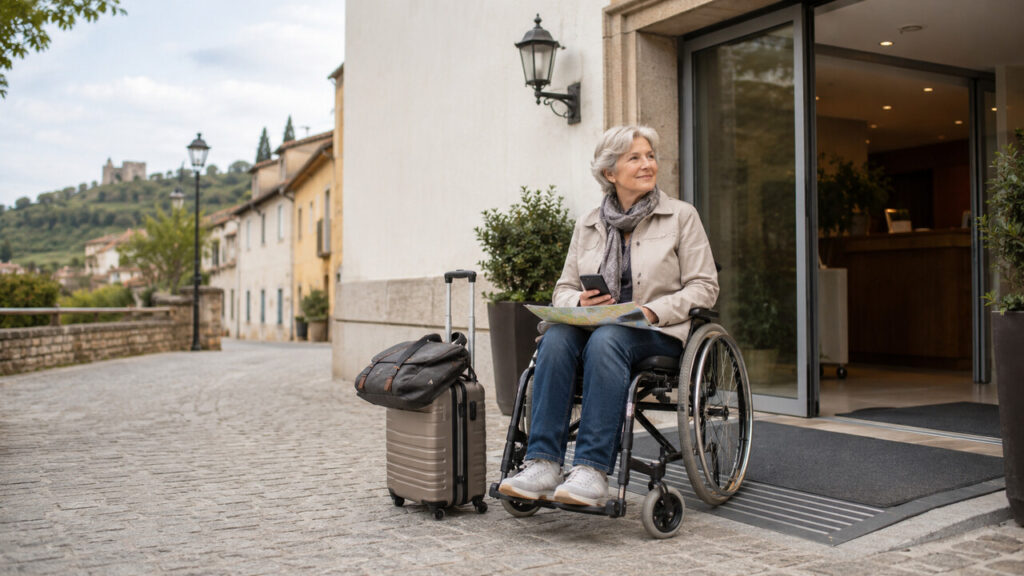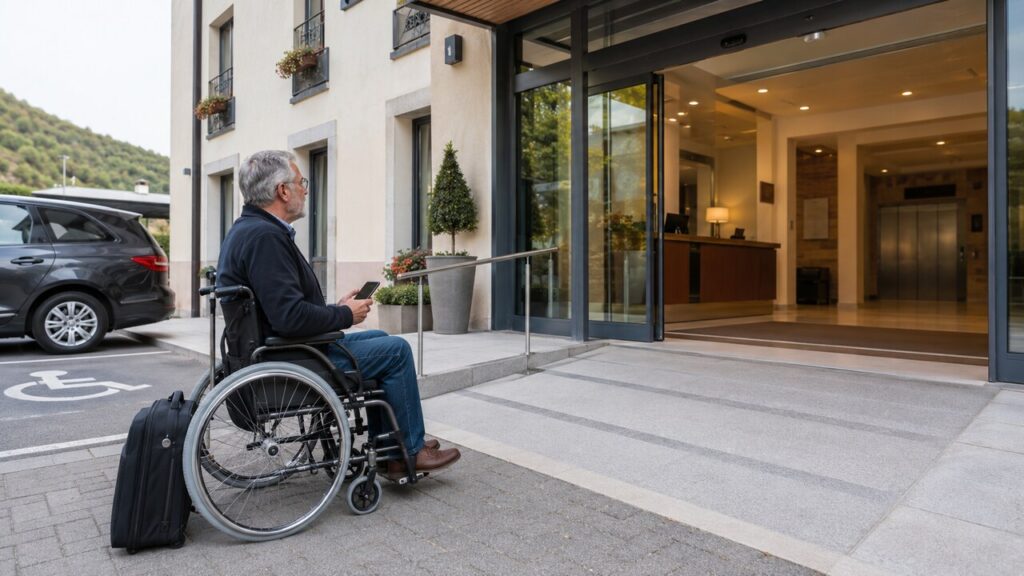
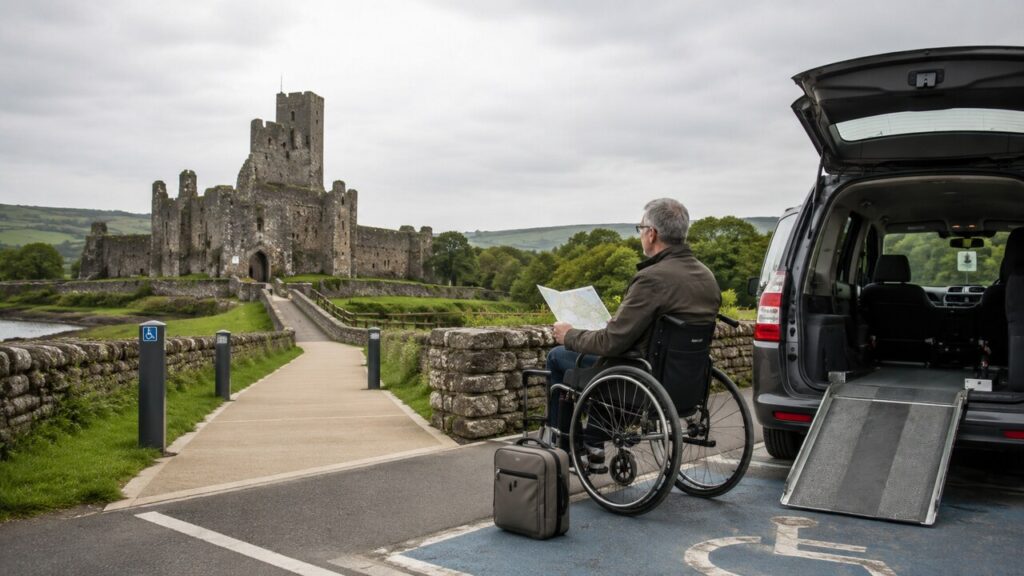
Ireland seems almost made for a castle road trip.
Ancient towers stand above small towns, ruined fortresses rise from green hills, and grand estates appear at the end of quiet country roads. Some castles are major visitor attractions, while others are little more than atmospheric stone walls beside a field or lake.
For a traveller with limited mobility, however, a successful castle road trip requires more than choosing attractive places on a map.
A castle may describe itself as accessible while offering step-free entry only to a visitor centre. A car park may be close to the entrance but covered in loose gravel. An accessible toilet may be available, but only during limited opening hours. The ground floor may be manageable while the main exhibition is reached by a narrow spiral staircase.
None of this means that you should abandon the idea.
It simply means that an accessible castle road trip around Ireland should be planned differently from a conventional sightseeing holiday.
The aim is not to visit the largest possible number of castles. It is to create a comfortable journey in which you can enjoy Irish history, countryside and local towns without exhausting yourself or constantly worrying about the next obstacle.
This guide explains how to choose suitable castles, plan a manageable route, find genuinely accessible accommodation and prepare for the realities of travelling through Ireland with a wheelchair or reduced mobility.
Start with your own definition of accessibility
The word “accessible” means different things to different people.
One traveller may need a completely step-free route, an accessible toilet and space for a powered wheelchair. Another may be able to manage several steps with support. Someone using a walking aid may be more concerned about long distances, steep slopes and places to sit.
Before looking at castles, make a simple list of your non-negotiable requirements.
Consider questions such as:
- Do you need step-free access from the car park?
- Can you manage cobblestones or loose gravel?
- What is the maximum distance you can comfortably travel?
- Do you require an accessible toilet at every stop?
- Can your wheelchair manage steep inclines?
- Do you need to remain in your wheelchair during the visit?
- Will you be travelling alone or with someone who can assist you?
- Do you require a hoist, shower chair or other equipment at your accommodation?
- How often do you need to rest?
This personal checklist is more useful than a general label on a tourism website.
A castle that works well for a manual wheelchair user travelling with assistance may be unsuitable for someone using a heavy powered chair. Similarly, a site with limited interior access may still provide an enjoyable experience if the grounds, visitor centre and main viewpoints are accessible.
Understand the challenges of historic castles
Medieval castles were designed for defence, not accessibility.
Common obstacles include:
- spiral staircases;
- narrow doorways;
- high thresholds;
- uneven stone floors;
- cobbled courtyards;
- steep hills;
- gravel paths;
- low lighting;
- small rooms;
- limited turning space;
- distant or inaccessible toilets.
Even when modern alterations have been made, heritage protection rules can limit how much a historic structure can be changed.
For this reason, it helps to divide castle attractions into three broad categories.
1. Castles with accessible interiors
These are usually restored castles, state rooms, heritage centres or historic buildings where lifts and ramps have been installed.
They can provide the most complete experience, although certain towers, battlements or underground sections may remain inaccessible.
2. Castles with partial access
You may be able to explore the ground floor, courtyard, exhibition space or gardens but not the upper rooms.
This is very common in Ireland and does not necessarily make the visit disappointing. A good ground-floor exhibition, accessible café and attractive surroundings can still make the destination worthwhile.
3. Castle ruins and viewpoints
Some sites have little or no accessible interior, but you may be able to enjoy an impressive exterior view from a nearby road, car park or level pathway.
These stops are useful between major attractions. They allow you to see more of Ireland’s heritage without committing to another long tour.
Never rely on one accessibility symbol
A wheelchair symbol is a useful starting point, but it rarely provides enough information to plan a visit confidently.
For example, Ross Castle in County Kerry warns visitors that access can be challenging because of a very steep incline. The site lists an accessible toilet, but the existence of that facility does not mean that the entire castle is easy to explore.
Listowel Castle states that its upper floors are reached by steep, winding staircases and that wheelchair access is therefore very limited.
Dalkey Castle’s heritage centre is wheelchair accessible, while its battlements are not.
These examples demonstrate why you should look beyond the general accessibility label.
Before including a castle in your itinerary, check:
- the distance from the accessible parking space to the entrance;
- the surface of the route;
- the steepest slope;
- the width of doors;
- whether there is a lift;
- which rooms are accessible;
- whether a wheelchair can join the regular guided tour;
- the location of the accessible toilet;
- whether the café is accessible;
- whether booking is required;
- whether mobility scooters are permitted;
- whether staff assistance must be arranged in advance.
Heritage Ireland advises visitors to check the page for each individual property and contact the site directly when they have specific accessibility concerns. It also states that assistance dogs are welcome and that disabled visitors and accompanying carers receive free admission at its paid sites.
Because facilities, lifts, paths and opening arrangements can change, confirm the details again shortly before travelling.
Choose regional bases instead of changing hotels every night
One of the biggest mistakes on an Irish road trip is trying to sleep in a different place every evening.
Packing, checking out, driving, visiting an attraction, locating the next hotel and unpacking again can quickly become exhausting. It also increases the risk of encountering an unsuitable bathroom or inaccessible bedroom.
A more comfortable approach is to choose two or three regional bases and stay for several nights in each.
For example:
- Dublin or County Meath: Dublin Castle, Dalkey Castle, Trim Castle and other historic attractions.
- Kilkenny or Cashel: Kilkenny Castle, Cahir Castle, the Rock of Cashel and nearby heritage towns.
- Killarney or another County Kerry base: Ross Castle, lakeside scenery and exterior castle viewpoints.
- Galway or eastern County Galway: Portumna Castle, local heritage attractions and accessible countryside stops.
This “slow base” method gives you flexibility.
You can rest when the weather is poor, change the order of your visits and spend a quiet day near the hotel without losing a prepaid overnight stay farther along the route.
For many travellers over 50 or people with disabilities, three well-planned castle visits can be far more enjoyable than seven rushed stops.
A practical castle route across Ireland
The following route is not intended as a promise that every part of every castle will be accessible. It is a starting framework that combines major heritage sites, manageable driving stages and places offering at least some potentially suitable facilities.
Accessibility should always be confirmed for your particular wheelchair and requirements.
Stage 1: Dublin and the east coast
Begin with two or three nights in or near Dublin.
Dublin Castle is a useful introduction to Irish political and architectural history. Its city-centre location makes it different from the rural fortresses you will encounter later. As parking and city-centre surfaces can create their own challenges, contact the site and research your arrival route rather than simply entering the address into a satnav.
Dalkey Castle and Heritage Centre can also work as a shorter excursion. The heritage centre is described as wheelchair accessible, although the battlements are not, and tours need to be booked online.
A Dublin base also gives you a backup plan. Should the weather make an outdoor castle visit impractical, you can substitute a museum, café or accessible city attraction.
Public transport can occasionally help you avoid difficult city parking. Transport for Ireland states that Luas trams and platforms are wheelchair accessible, with ramps or lifts provided where required.
However, a personal or adapted vehicle will usually provide greater flexibility for a longer castle journey.
Stage 2: Dublin to Trim and Kilkenny
From Dublin, consider travelling towards Trim before continuing south.
Trim Castle is one of Ireland’s most impressive Norman sites, but a dramatic castle is not automatically an easy castle. Contact the attraction before travelling and ask precisely which parts of the experience are available without stairs.
Even when interior access is limited, the surrounding view and historic town may justify the visit. This is an important principle for accessible travel: the value of a stop does not always depend on reaching the highest tower.
Continue towards Kilkenny and stay for two or three nights.
Kilkenny is a strong road-trip base because it combines a major castle with restaurants, accommodation and other attractions. Kilkenny Castle provides visitor information and a social guide that can help guests prepare for the experience before arrival.
When reserving accommodation, avoid vague questions such as, “Do you have disabled rooms?”
Instead, ask for measurements and photographs.
You need to know:
- whether there is a step at the main entrance;
- the clear width of the bedroom and bathroom doors;
- whether there is space beside the bed;
- whether the shower is genuinely level-access;
- whether grab rails are installed;
- the height of the toilet;
- whether a shower chair is available;
- whether the accessible room is reached by a dependable lift;
- where breakfast is served;
- how far the accessible parking space is from the entrance.
A hotel can describe a room as accessible simply because it has a larger bathroom. That may not be enough for your individual needs.
Stage 3: Cahir and Cashel
Cahir Castle and the Rock of Cashel can be incorporated into the same regional stage, but they should not automatically be treated as two full visits on one day.
Cahir Castle lists limited access and uneven walkways among its visitor restrictions, while also listing an accessible toilet.
This means that you should contact the staff to establish what “limited access” would mean for you in practice. Ask whether you can enter the courtyard, reach the main interpretation area and participate in part of the normal visit.
The Rock of Cashel is one of Ireland’s most recognisable historical landmarks. Its elevated location, exposed setting and old surfaces require careful planning. Even when you cannot explore every section, the exterior, surrounding countryside and nearby town can still make it a rewarding stop.
Do not schedule Cahir, Cashel and another major destination merely because they appear close together on the map.
Allow time for:
- transferring in and out of the vehicle;
- finding the correct accessible entrance;
- speaking to staff;
- using the toilet;
- resting;
- taking photographs;
- eating;
- unexpected weather;
- road delays.
An accessible road trip becomes much easier when the itinerary contains empty space.
Stage 4: Towards Kerry
The journey into County Kerry offers wonderful scenery, but some rural roads are narrow, winding and slower than their distance suggests.
Ross Castle near Killarney is beautifully positioned beside the lake, but Heritage Ireland describes access as challenging for visitors with mobility difficulties because of a very steep incline.
This does not mean that every wheelchair user must avoid it. It means that you need to assess the slope, your chair’s power, braking ability, the weather and the availability of assistance.
A powered wheelchair may cope differently from a manual chair. Wet leaves, gravel and rain can also change a route that appeared manageable in a photograph.
Killarney can still be a good base because it offers accommodation, food and scenic drives. On a low-energy day, you could enjoy castle exteriors, lakeside viewpoints or a drive through the surrounding landscape rather than taking another formal tour.
Stage 5: Kerry to Galway
Travelling from Kerry towards Galway is a significant stage, especially when you need regular rest stops.
Do not plan a major castle visit immediately after a long drive. Make the journey itself the main activity for the day.
Listowel Castle could be considered as a brief stop, but its official information states that access to the upper floors is by steep winding stairs and that wheelchair access is very limited.
A traveller who expects a complete interior tour may be disappointed. A traveller who plans to see the exterior, enjoy the town and take a rest may still find it worthwhile.
Portumna Castle and Gardens in County Galway is another possible stop. Discover Ireland describes it as having partial wheelchair access and on-site toilets.
“Partial access” should trigger a telephone call. Ask which areas are accessible, whether the garden paths are firm, whether the toilet meets your needs and whether any temporary closures are in place.
Plan your driving days realistically
Distances in Ireland can be misleading.
A route of 100 kilometres may take longer than expected because of small towns, bends, tractors, roadworks or narrow rural sections. Satnav estimates also do not include the time required for accessible parking, wheelchair transfers and rest breaks.
A sensible target is often one major attraction per day.
On shorter days, you might add:
- a castle viewpoint;
- an accessible garden;
- lunch in a nearby town;
- a scenic drive;
- a short photography stop.
Try to avoid arriving at a castle shortly before final admission. You do not want to rush through the accessible portion of a site because you spent twenty minutes locating the correct entrance.
Where possible, arrive during the quieter part of the morning. Staff may have more time to explain the accessible route, and car parks are less likely to be full.
Prepare the vehicle as carefully as the route
Your vehicle is the centre of an accessible road trip.
Before leaving, check:
- wheelchair or scooter tie-downs;
- ramp or lift operation;
- tyre pressure;
- breakdown cover;
- wheelchair charger;
- spare charging cables;
- transfer board;
- cushions;
- waterproof wheelchair cover;
- basic repair tools;
- medication and personal supplies;
- emergency contact details;
- reflective clothing or lights;
- portable power bank;
- phone holder and charging socket.
Keep essential equipment within reach rather than beneath all your luggage.
A small day bag should contain anything you may need during a visit, including rain protection, water, snacks, gloves, tissues, a portable charger and documentation relating to your parking permit.
Visitors travelling with an EU parking card can use designated disabled parking bays in other EU countries, although local parking conditions and time restrictions still need to be checked.
Never assume that an accessible bay will be vacant. Identify a backup parking area whenever possible.
Use a simple accessibility confirmation message
Calling every attraction can be tiring, especially when speech or hearing makes telephone conversations difficult.
An email gives you written confirmation and allows you to ask specific questions.
You can use this template:
Hello, I am planning to visit on [date] and I use a [manual wheelchair/powered wheelchair/mobility scooter].
Could you please confirm whether there is step-free access from the accessible parking area to the entrance? I would also like to know which parts of the castle are wheelchair accessible, whether there is an accessible toilet, and whether any paths include steep slopes, cobbles or loose gravel.
My wheelchair is approximately [width] wide. Please let me know whether I need to book an accessible tour or arrange assistance in advance.
Thank you.
Save all replies in one folder on your phone.
Include the date, contact name and any special arrival instructions. This can prevent confusion when you reach a side entrance or locked accessible gate.
Build a weather-proof itinerary
Irish weather is part of the experience, but it can also affect accessibility.
Rain may turn gravel into a difficult surface. Strong wind can make exposed hills uncomfortable. Wet stone and leaves increase the risk of slipping. A steep path that works on a dry morning may be unsafe during heavy rain.
For every outdoor castle, prepare an indoor alternative within reasonable driving distance.
Your backup might be:
- an accessible heritage centre;
- a museum;
- a shopping centre;
- a hotel lounge;
- a scenic drive;
- a café with accessible parking and toilets;
- a rest day.
Do not treat a rest day as a failure.
Accessible travel requires more energy than many people realise. Every transfer, ramp, toilet search and equipment check adds to the physical and mental workload.
A slower day may allow you to enjoy the rest of the journey instead of spending it recovering from exhaustion.
Check opening hours and booking requirements again
Castle opening arrangements can be seasonal.
Some attractions close during winter, reduce their tour schedule or accept visitors only at certain times. Guided tours can also have limited capacity. Heritage Ireland operates official online booking for a selection of attractions and warns that tickets purchased through unofficial resale platforms may not be accepted.
Check every attraction twice:
- when building your itinerary;
- one or two days before visiting.
Look for temporary lift failures, special events, restricted parking, maintenance work and changes to accessible entrances.
When access depends on a lift, ask what alternative is available if it stops working.
Carry food and water
Rural castle sites do not always have cafés, and nearby food options may involve steps, narrow doorways or inaccessible toilets.
Keep a simple supply of food and water in the vehicle.
Suitable road-trip items might include:
- sandwiches;
- fruit;
- crackers;
- yoghurt in a cool bag;
- boiled eggs;
- cereal bars;
- tea or coffee in a flask;
- extra drinking water.
A picnic is not only an emergency solution. It can become one of the most enjoyable parts of the journey, particularly when you find a quiet viewpoint overlooking a castle, lake or green valley.
Photograph the practical details
A castle road trip provides excellent material for a travel blog, YouTube channel or social media project.
Do not photograph only the castle.
Record the details that other disabled travellers genuinely need:
- accessible parking;
- the path from the car park;
- entrances and ramps;
- door thresholds;
- lifts;
- accessible toilets;
- ground surfaces;
- steep sections;
- seating;
- viewpoints reachable by wheelchair;
- café entrances;
- hotel rooms;
- vehicle setup.
Make notes immediately after each visit.
Record what worked, what was difficult and what you would do differently. Be precise about the type of wheelchair you used and whether you had assistance.
A statement such as “the castle is accessible” is less useful than:
The visitor centre and ground-floor exhibition were step-free, but the tower was reached only by stairs. The route from the car park was approximately 100 metres over a firm but slightly sloping surface.
This practical information can make your future travel content far more valuable than a standard tourist guide.
Accept that you may experience a castle differently
Traditional travel advice often presents the tower, battlements or highest viewpoint as the highlight of a castle visit.
That does not have to define your experience.
You might enjoy:
- the approach road;
- the scale of the exterior;
- an accessible courtyard;
- a ground-floor exhibition;
- the landscape around the castle;
- stories told by a guide;
- local food in the nearby town;
- photography from an accessible viewpoint;
- a conversation with staff or residents.
Accessible travel is not a lesser version of travel.
It is a different way of organising the experience around what is possible, enjoyable and meaningful to you.
Final accessible castle road-trip checklist
Before leaving home, confirm that you have:
- contacted each main castle;
- checked which rooms and grounds are accessible;
- reserved accessible accommodation in writing;
- requested bathroom photographs and measurements;
- checked accessible parking;
- identified toilets along longer routes;
- prepared an indoor weather alternative;
- limited most days to one major attraction;
- added rest days;
- checked the vehicle, ramp or lift;
- packed charging equipment and essential spare parts;
- saved emergency and breakdown numbers;
- downloaded offline maps;
- kept food and water in the car;
- confirmed current opening hours and tour bookings.
Final thoughts
An accessible castle road trip around Ireland does not need to be fast, perfect or packed with attractions.
The best journey may involve spending several nights in one place, visiting one castle slowly, stopping beside a lake and changing your plans when the weather turns.
Historic buildings will always present challenges. Some towers will remain unreachable. Some paths will be steeper than expected. Occasionally, the most useful part of a visit will be discovering exactly what needs to improve.
But with careful research, direct communication and a flexible itinerary, Ireland’s castles can still become part of an unforgettable and genuinely personal adventure.
Plan fewer stops. Ask better questions. Leave room for rest.
And remember that the purpose of the road trip is not simply to collect castles.
It is to experience Ireland with greater independence, confidence and curiosity—one accessible journey at a time.