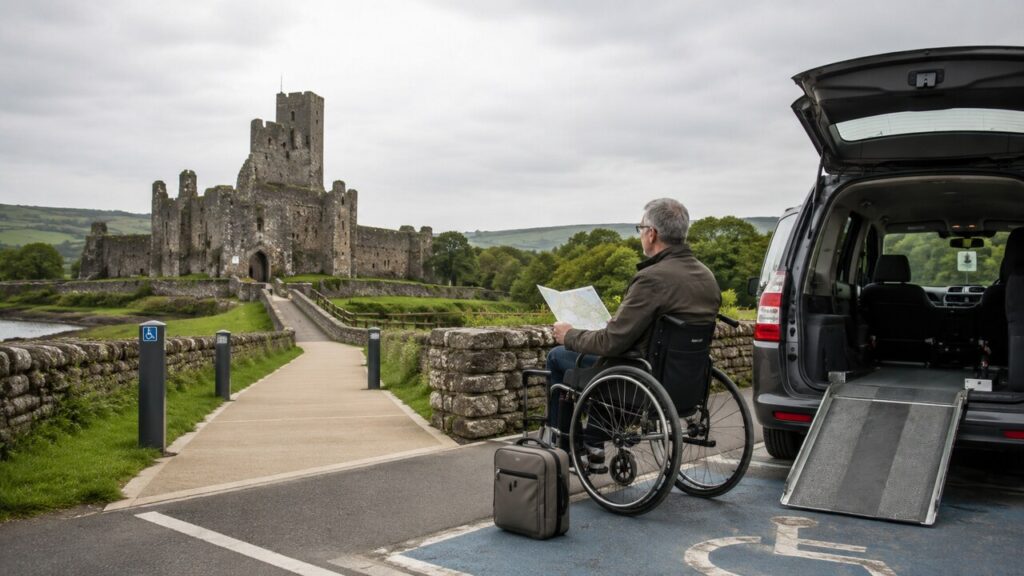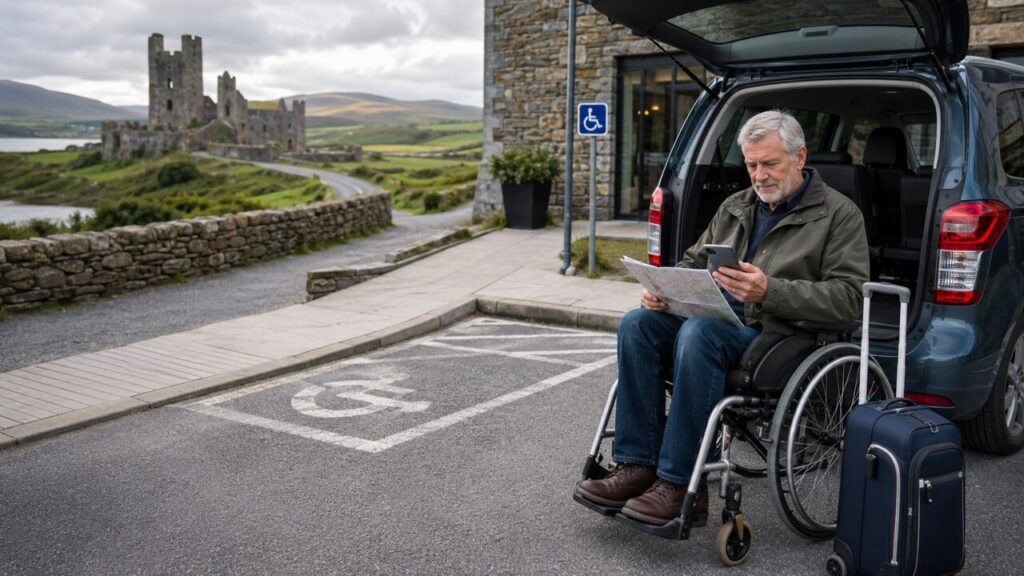
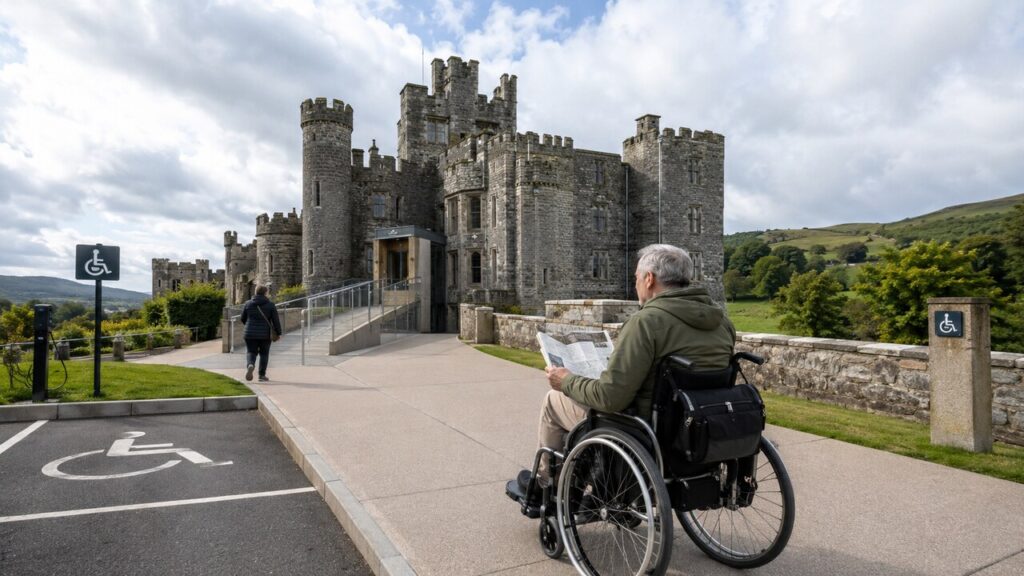
Ireland’s castles are among the country’s most memorable attractions. They stand above rivers, beside historic towns and within beautiful country estates. As a result, they offer visitors a direct connection with centuries of Irish history.
However, visiting a historic castle as a wheelchair user requires careful planning.
Many Irish castles were built for defence rather than comfort. Therefore, narrow staircases, cobbled courtyards, heavy doors and steep slopes are common. Visitors may also encounter uneven stone floors, gravel paths and small entrances.
In addition, the words “wheelchair accessible” can mean different things at different attractions. One castle may provide lift access to several floors. Another may only offer an accessible visitor centre or garden.
Fortunately, several Irish castles provide worthwhile experiences for wheelchair users. Some offer lifts, accessible toilets and step-free routes. Others have partial access but remain enjoyable because of their gardens, exhibitions or accessible ground-floor rooms.
This practical guide introduces some of the best accessible Irish castles for wheelchair users. It also explains which areas may remain difficult to reach.
Accessibility arrangements can change because of restoration work, private events, weather or equipment problems. Therefore, always contact the attraction shortly before travelling.
This is especially important if you use a powered wheelchair, mobility scooter or larger specialist chair.
What Does Wheelchair Accessible Mean at an Irish Castle?
Accessibility descriptions are not always clear.
At a modern museum, wheelchair access usually means that visitors can reach most of the main areas. At a medieval castle, however, it may only mean that a ramp leads into the reception area.
For this reason, you should look beyond the standard wheelchair symbol.
Before booking your visit, ask several practical questions:
- Is there a step-free route from the car park?
- What surface leads to the entrance?
- Can wheelchair users enter the castle itself?
- Is there a lift to the upper floors?
- Are the main exhibitions accessible?
- Is an accessible toilet available?
- Are there width or weight restrictions for wheelchairs?
- Can a companion or carer enter free of charge?
- Will staff provide assistance?
- Are there steep slopes within the grounds?
- Is accessible parking located close to the entrance?
The answers will help you decide whether the attraction suits your individual needs.
For example, a long gravel path may be manageable in a powered wheelchair. However, the same route could be difficult for a manual wheelchair user travelling independently.
Similarly, a castle may have a lift but still include heavy doors or raised thresholds.
Planning in advance can prevent disappointment and make the day much more comfortable.
1. Dublin Castle, County Dublin
Best for accessible historic interiors
Dublin Castle is one of the strongest choices for wheelchair users who want to explore important historic rooms.
The castle stands in the centre of Dublin. For centuries, it served as the headquarters of British administration in Ireland. Today, the complex contains the State Apartments, courtyards, gardens, exhibition spaces and the Chapel Royal.
The State Apartments form the main attraction. They include ceremonial rooms, decorated ceilings, paintings and historic furniture. Ireland also uses these rooms for presidential inaugurations and important state occasions.
Dublin Castle provides wheelchair access to the principal State Apartments. Staff can assist visitors in using the lift to reach the first-floor museum rooms.
In addition, wheelchair users can explore the Coach House Gallery and the Dubh Linn Gardens.
However, the Viking Excavation is not wheelchair accessible because visitors must use stairs to reach it.
The Upper Courtyard may also require extra care. Some areas contain uneven surfaces, which can be uncomfortable for wheelchair users.
Practical accessibility points
- Step-free access to the main State Apartments
- Lift access to the first-floor museum rooms
- Accessible gardens
- Accessible Coach House Gallery
- Accessible toilet
- Staff assistance
- Uneven surfaces in parts of the courtyard
- No wheelchair access to the Viking Excavation
Dublin Castle works particularly well during wet or cold weather. Much of the main experience takes place indoors. Therefore, visitors do not need to depend on good weather to enjoy the attraction.
Its central location also makes it easy to combine with other Dublin landmarks.
However, parking may be more complicated than at a countryside castle. Accessible public transport or a wheelchair-accessible taxi may be more convenient.
Before travelling, check the latest tour times. You should also confirm which rooms will be open during your visit.
Why visit Dublin Castle?
Dublin Castle provides one of Ireland’s most complete wheelchair-accessible castle experiences.
Although visitors cannot enter every historic section, the accessible route includes several important rooms. Therefore, wheelchair users can still experience a substantial part of the castle.
2. Malahide Castle and Gardens, County Dublin
Best for combining history with gardens
Malahide Castle stands within extensive parkland north of Dublin.
The castle remained connected with the Talbot family for almost 800 years. Its interior contains antique furniture, family portraits, period rooms and the impressive Great Hall.
Outside, visitors can explore gardens, lawns, woodland areas and landscaped grounds. The estate also includes a visitor centre, shops and places to eat.
Wheelchair-accessible routes are available through much of the castle and gardens. Ramps and lifts support access to key areas.
However, outdoor routes may include gravel, slopes and uneven sections. Therefore, conditions may vary depending on the weather.
Practical accessibility points
- Accessible routes through much of the castle
- Ramp access
- Lift access
- Accessible visitor facilities
- Extensive gardens and parkland
- Parking at the estate
- Some gravel or uneven outdoor surfaces
- Long distances between parts of the grounds
Malahide Castle can work especially well for wheelchair users travelling by car.
Unlike Dublin Castle, it offers the atmosphere of a traditional country estate. At the same time, it remains close to the capital.
The grounds cover a large area. Therefore, wheelchair users should consider how far they can travel comfortably.
A powered wheelchair or mobility scooter may make exploring easier. Manual wheelchair users may prefer to travel with a companion, especially when visiting the gardens.
Weather can also affect the experience. After heavy rain, some outdoor areas may become less comfortable.
Why visit Malahide Castle?
Malahide offers more than a short castle tour.
Visitors can combine history, gardens and a relaxing outdoor experience. As a result, the attraction works well for a half-day visit or a slower day during an accessible road trip.
3. Enniscorthy Castle, County Wexford
Best for a compact castle with lift access
Enniscorthy Castle is a useful choice for travellers exploring southeast Ireland.
The castle stands in the centre of Enniscorthy. Its history connects with Norman settlement, local families and major political events.
Inside, exhibitions explain the story of the castle and the surrounding town. Visitors can also learn about local history and Enniscorthy’s role in the 1916 Easter Rising.
One of the castle’s main advantages is its detailed accessibility information.
The visitor shop provides step-free access. It also has wide aisles and enough room for many wheelchair and mobility scooter users.
Lift access makes more of the interior available than at many traditional castles.
However, visitors should confirm that the lift is working before starting a long journey.
Practical accessibility points
- Step-free entrance
- Lift access within the castle
- Accessible exhibition areas
- Wide aisles in the shop
- Space for wheelchairs and mobility scooters
- Central town location
- Possible slopes around the castle
- Advance contact recommended for larger powered chairs
Enniscorthy Castle is more compact than many large estates. Therefore, it may suit visitors who prefer a shorter and more manageable attraction.
You can also combine the visit with lunch or a short trip around the town.
However, the castle’s position may create difficulties when approaching from certain streets. Ask staff about the easiest accessible route and the closest suitable parking.
A navigation app may lead you to the main entrance without considering slopes or pavement quality. Direct advice from the attraction is often more useful.
Why visit Enniscorthy Castle?
Enniscorthy Castle provides more than simple ground-floor access.
Its lift and visitor facilities make it one of the more promising historic attractions for wheelchair users in southeast Ireland.
4. Johnstown Castle Estate, Museum and Gardens, County Wexford
Best for a full accessible heritage day
Johnstown Castle offers a different experience from a defensive medieval fortress.
The Gothic Revival castle stands within an attractive estate of lakes, gardens, woodland and ornamental grounds. The site also contains the Irish Agricultural Museum.
Wheelchair users can explore many of the gardens and lakeside areas. The Victorian walled garden also offers an enjoyable outdoor experience.
The visitor centre provides accessible facilities. In addition, staff can help visitors plan a suitable route through the estate.
The distance between the visitor centre and the castle is worth considering. Visitors should allow enough time to reach a pre-booked tour.
Practical accessibility points
- Accessible visitor centre
- Wheelchair-accessible garden routes
- Accessible lakeside areas
- Victorian walled garden
- Accessible toilets
- Museum and additional exhibitions
- Distance between the visitor centre and castle
- Outdoor conditions may affect some paths
Johnstown Castle is a good choice for visitors who want more than a few historic rooms.
Even when part of the castle presents a limitation, the estate still provides gardens, exhibitions, water views and places to rest.
Because the grounds are extensive, powered wheelchair users should check their battery range before starting the visit.
A fully charged phone and compact power bank can also be useful. You may need your phone for navigation, photography or contacting a driver.
Manual wheelchair users should ask whether the route includes slopes or long gravel sections.
Why visit Johnstown Castle?
Johnstown Castle provides a varied and substantial day out.
It is especially suitable for visitors who value gardens and attractive outdoor surroundings as much as the castle interior.
5. Kilkenny Castle, County Kilkenny
Best for visiting a famous Irish landmark
Kilkenny Castle is one of Ireland’s best-known historic buildings.
The castle dominates the centre of Kilkenny. Over the centuries, different owners rebuilt and adapted it several times.
Today, many of the interiors reflect the appearance of a Victorian country house. Visitors can see decorated rooms, paintings, tapestries and period furniture.
The surrounding parkland also provides an attractive public space.
Wheelchair users can access the ground-floor rooms. However, some other levels and historic areas may remain difficult or impossible to reach.
Therefore, Kilkenny Castle offers meaningful but partial access.
Practical accessibility points
- Accessible ground-floor rooms
- Accessible visitor facilities
- Parkland beside the castle
- Central location
- Nearby cafés and other attractions
- Limited access to some upper floors
- Busy periods may make movement harder
- Outdoor surfaces can vary
Before travelling, contact the castle and ask which rooms form part of the current accessible route.
Temporary exhibitions, conservation work or private events may change the available areas.
Kilkenny itself is a popular destination. However, parts of the historic city have narrow pavements, older surfaces and slopes.
For this reason, plan your parking and route before arriving.
It may be easier to visit the castle first and then choose nearby cafés or attractions that offer confirmed step-free access.
Why visit Kilkenny Castle?
Kilkenny Castle deserves a place on an accessible itinerary because its ground-floor rooms provide a genuine historic experience.
In addition, its central location makes it easy to include in a longer stay in Kilkenny.
6. Dalkey Castle and Heritage Centre, County Dublin
Best for a smaller and more interactive attraction
Dalkey Castle and Heritage Centre provides a more compact experience than the larger estates in this guide.
The attraction stands in the coastal town of Dalkey. It combines a fortified medieval town house with exhibitions and live historical interpretation.
Actors and guides often bring local history to life through stories and demonstrations. As a result, the visit can feel more personal and interactive than a traditional museum tour.
Wheelchair users can enter the Heritage Centre. However, the battlements are not accessible.
Therefore, wheelchair users may not be able to follow every part of the standard tour.
Practical accessibility points
- Wheelchair access to the Heritage Centre
- Indoor exhibitions
- Live historical interpretation
- Compact visitor experience
- Location near Dalkey town centre
- No wheelchair access to the battlements
- Advance booking recommended
- Parking may require planning
Dalkey Castle works well as part of a day trip from Dublin.
You could combine the attraction with lunch in Dalkey or an accessible coastal drive. The area also offers attractive views and a relaxed atmosphere.
However, visitors who want to explore every part of a traditional castle may find the experience limited.
Ask staff how much of the presentation takes place in accessible areas.
Why visit Dalkey Castle?
Dalkey Castle clearly explains its access limitations.
Although the battlements remain inaccessible, the Heritage Centre can still provide an engaging and manageable visit.
7. Cahir Castle, County Tipperary
Best for medieval atmosphere and exterior views
Cahir Castle stands on a rocky island in the River Suir.
It is one of Ireland’s most impressive medieval fortresses. Its towers, defensive walls and courtyards create the dramatic atmosphere many travellers expect from an Irish castle.
However, the same medieval design creates significant accessibility barriers.
Visitors may encounter uneven walkways, cobbled surfaces and changes in level. Many upper areas also require the use of stairs.
An accessible toilet is available. Wheelchair users may also be able to explore selected exterior and lower-level sections.
Nevertheless, visitors should not expect complete access to the towers or defensive walls.
Practical accessibility points
- Accessible toilet
- Access to selected lower-level areas
- Impressive exterior views
- Central location in Cahir
- Uneven surfaces
- Limited access inside the fortress
- Stairs to towers and upper levels
- Staff advice recommended before arrival
Cahir Castle works best as a partial-access attraction.
It may suit wheelchair users who want to experience the courtyard, architecture and atmosphere. However, it is less suitable for visitors who expect to follow the full historic route.
Before arriving, ask staff which sections are currently step-free.
You should also confirm the easiest entrance and the closest accessible parking.
Why visit Cahir Castle?
Cahir is not Ireland’s most accessible castle.
However, it remains one of the most visually impressive medieval sites where wheelchair users may still enjoy part of the experience.
Irish Castles with Significant Accessibility Limitations
Some of Ireland’s most famous castles remain difficult for wheelchair users.
This does not always make them impossible to visit. Their surroundings, gardens or exterior views may still be enjoyable.
However, you should understand the restrictions before arranging transport or building an entire day around them.
Trim Castle
Trim Castle is one of Ireland’s most impressive Norman castles.
Unfortunately, wheelchair access is very restricted. Wheelchair users cannot enter the main keep. Access to parts of the grounds may also be limited.
Interpretation panels outside provide information about the castle’s history.
Therefore, the attraction may still suit visitors who mainly want to see the exterior. However, it does not provide a complete indoor experience for wheelchair users.
Ross Castle
Ross Castle stands beside the lakes of Killarney.
The setting is beautiful, but access to the castle can be challenging. Visitors may encounter a steep approach, and the interior tour includes historic spaces that are difficult to reach.
An accessible toilet is available nearby.
Wheelchair users may still enjoy the lakeside setting and exterior views. However, the full castle tour may not be suitable.
Barryscourt Castle
Barryscourt Castle includes tight spaces, spiral stairs and steep, uneven steps.
Visitors enter the castle as part of a guided tour. Therefore, wheelchair users may have very limited access to the main historic areas.
Contact the attraction before travelling and ask whether any accessible exterior or exhibition areas are open.
Portumna Castle and Gardens
Portumna Castle offers partial wheelchair access.
Some rooms and garden routes may be available, while others remain difficult to reach.
Because access arrangements may change, contact the site before visiting. Ask which rooms and outdoor paths wheelchair users can currently explore.
How to Plan an Accessible Irish Castle Visit
A successful castle visit often depends on preparation rather than luck.
The following steps can help you avoid unnecessary problems.
Contact the castle directly
Do not rely only on a general accessibility symbol.
Instead, explain your exact mobility needs.
Tell staff:
- Whether you use a manual or powered wheelchair
- The approximate width of your wheelchair
- Whether you can transfer
- Whether you can manage any steps
- Whether you travel with a companion
- Whether you need an accessible toilet
- Whether you require nearby parking
- Whether your wheelchair has a larger turning circle
Ask staff to describe the complete route from the parking area to the entrance.
The route outside the castle can be just as important as access inside.
Confirm that the lift is working
Some castles depend on a lift to provide wheelchair access to important rooms.
If the lift stops working, much of the attraction may become inaccessible.
Therefore, call shortly before travelling. This is especially important when upper-floor rooms form the main reason for your visit.
Ask about surfaces
The word “accessible” does not describe the quality of the ground.
For example, a route may have no steps but still include loose gravel, cobblestones or wet grass.
Ask staff whether the route is:
- Paved
- Gravelled
- Cobbled
- Grassy
- Steep
- Narrow
- Uneven
This information will help you decide whether you need assistance.
Allow extra time
Accessible entrances are sometimes separate from the main entrance.
Staff may need to open another door, operate a platform lift or guide you along an alternative route.
Arriving early will reduce stress. It will also help you avoid missing a guided tour.
Check the accessible toilet
An attraction may advertise an accessible toilet without explaining its size or layout.
Ask whether the toilet has:
- Level access
- Grab rails
- Space beside the toilet
- Enough turning room
- A suitable door width
- An emergency cord
For longer visits, this information can be essential.
Plan for Irish weather
Irish weather can change quickly.
A dry morning may become wet and windy within a short time. Therefore, bring suitable protection even when the forecast looks promising.
Useful items include:
- A lightweight rain jacket
- A waterproof wheelchair cover
- A small towel
- Warm clothing
- A waterproof bag for electronics
- Suitable gloves for manual wheelchair users
Rain can also make gravel, grass and old stone surfaces more difficult.
Carry essential travel equipment
A few practical items can make castle visits easier.
Consider carrying:
- A fully charged smartphone
- A compact power bank
- A secure smartphone mount when driving
- Water
- Medication
- A small wheelchair repair kit
- A comfortable cushion
- Emergency contact information
- The castle’s telephone number
- Booking confirmation
- A lightweight travel bag
Keep important items within easy reach.
Which Accessible Irish Castle Is Best?
The best choice depends on the type of experience you prefer.
Dublin Castle is ideal for visitors who want accessible historic interiors in the centre of the capital.
For a combination of history, gardens and parkland, Malahide Castle is one of the strongest choices.
Travellers looking for a compact attraction with lift access should consider Enniscorthy Castle.
Meanwhile, Johnstown Castle suits visitors who want to spend several hours exploring an accessible estate.
Kilkenny Castle offers a famous landmark and worthwhile access to its ground-floor rooms.
For a shorter and more interactive visit near Dublin, Dalkey Castle provides an enjoyable heritage experience.
Finally, Cahir Castle is best for visitors who value medieval atmosphere and exterior architecture. However, access inside remains limited.
For a first accessible Irish castle road trip, start with:
- Dublin Castle
- Malahide Castle
- Enniscorthy Castle
- Johnstown Castle
These attractions provide a useful balance of historic interiors, accessible facilities and attractive surroundings.
Final Thoughts
Ireland’s historic castles were not designed for modern accessibility.
Spiral staircases, defensive entrances and uneven courtyards will continue to prevent wheelchair users from entering some areas.
However, an inaccessible tower does not have to mean an inaccessible holiday.
Several Irish heritage attractions now provide lifts, adapted entrances, accessible toilets and improved visitor information. Staff may also offer alternative routes and practical assistance.
Therefore, choosing the right castles can make a major difference.
Wheelchair users can still experience historic rooms, exhibitions, gardens and dramatic Irish landscapes. The key is to investigate the details before travelling.
Ask what you can enter. Find out how you will reach it. Check the surfaces, parking and toilet facilities.
In addition, confirm the arrangements shortly before your visit. Build extra time into the day and keep an alternative attraction nearby.
With realistic planning, Ireland’s castles can become genuine highlights of an accessible road trip. They do not have to remain monuments viewed only through a car window.