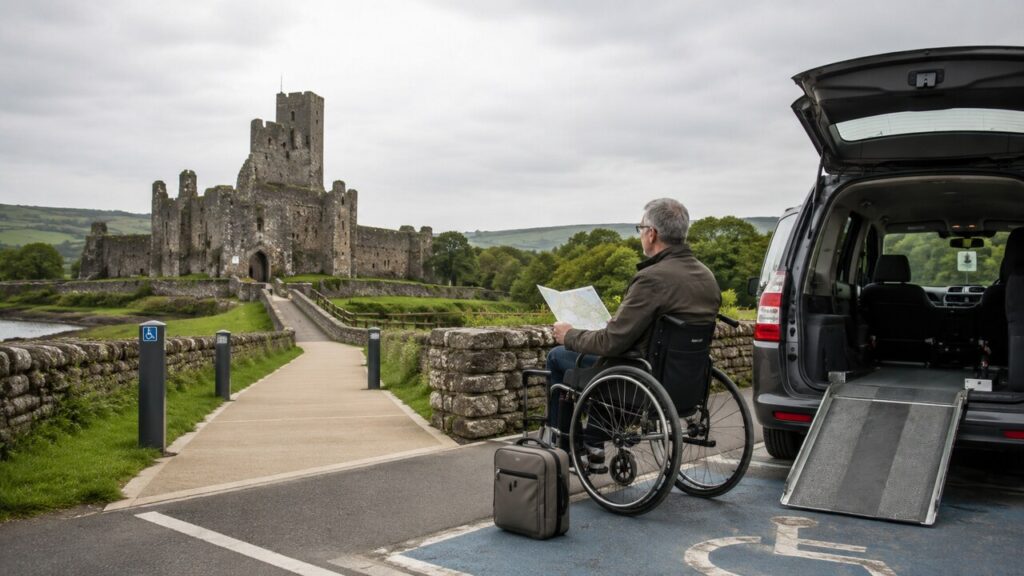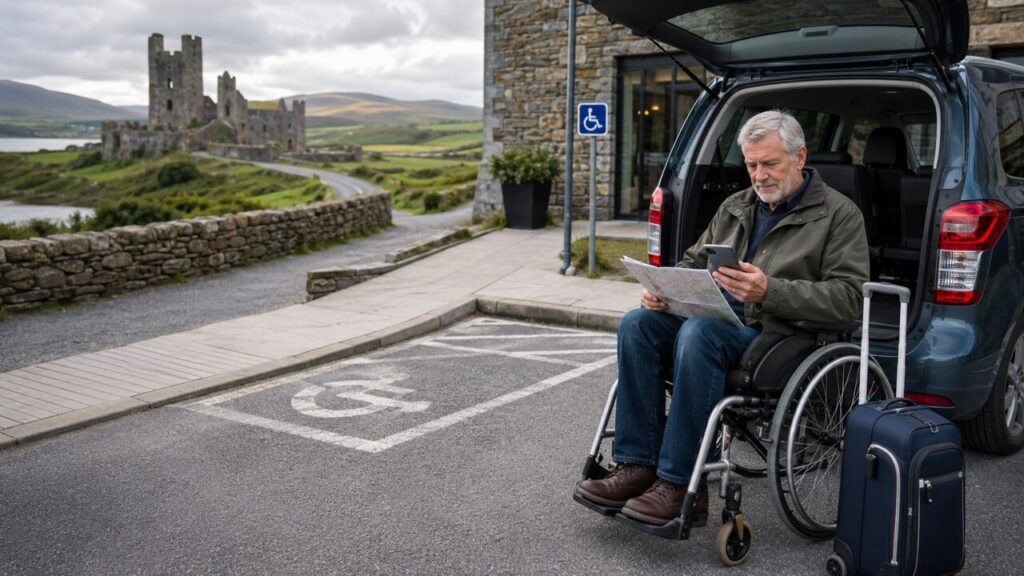
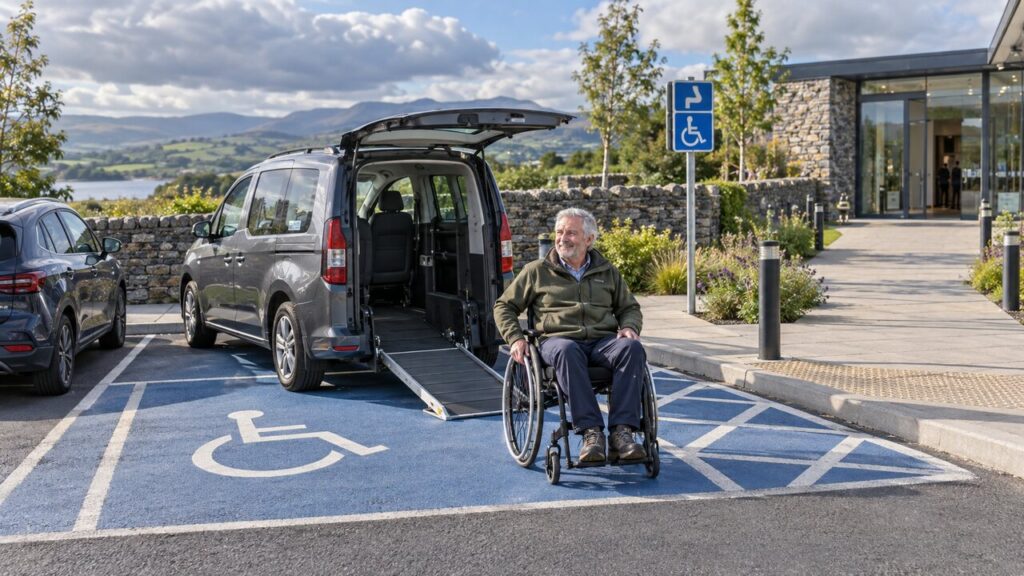
Accessible parking can make the difference between enjoying an Irish town, attraction or scenic viewpoint and having to drive away without getting out of the car.
A space may look suitable on a map, but that does not always tell you whether there is enough room for a wheelchair transfer, a dropped kerb nearby or a step-free route to the entrance.
The good news is that Ireland has designated accessible parking bays in cities, towns, public car parks and at many visitor attractions.
A valid Disabled Person’s Parking Permit—often called a European Parking Card, Blue Parking Card or simply a Blue Badge—can also provide useful parking concessions.
However, the rules are not identical everywhere. On-street parking and private car parks may operate differently, local restrictions can apply, and Northern Ireland has a separate parking system from the Republic of Ireland.
This guide explains the essentials and, just as importantly, the practical details that disabled travellers should check before setting off.
Quick answer: A valid UK Blue Badge is recognised in the Republic of Ireland. Display it clearly on the dashboard, check every local sign and never assume that a designated bay is free or unrestricted—especially in a private, barrier-controlled or multi-storey car park.
What Is the Disabled Person’s Parking Permit in Ireland?
In the Republic of Ireland, the official permit is known as the Disabled Person’s Parking Permit.
You may also see it described as the European Parking Card, Disabled Parking Permit or Blue Parking Card.
The permit belongs to the disabled person, not to a particular vehicle. It can be used when the holder is driving or travelling as a passenger, including in a hired car or a relative’s vehicle.
It must only be displayed when the permit holder is actually using the vehicle and benefiting from the parking concession.
When parked, place the permit on the dashboard so that the wheelchair symbol, serial number and expiry date can be seen clearly from outside.
Do not leave it covered by a sunshade, ticket, phone holder or windscreen reflection.
The permit does not turn every convenient place into a legal parking space. It helps the holder use designated bays and certain other parking facilities, but signs, road markings and safety restrictions still apply.
Can You Use a UK Blue Badge in the Republic of Ireland?
Yes. Current UK government guidance lists Ireland as recognising the UK Blue Badge.
This is helpful for travellers arriving by ferry from Great Britain or crossing the border from Northern Ireland.
Before travelling, check that your badge:
- is still valid for the whole trip;
- is not damaged or difficult to read;
- has the correct details and photograph;
- is stored somewhere easy to reach when you park.
Carry the original badge rather than a photocopy.
Travellers bringing a parking card from another EU country, including Poland, can use the European-format card in Ireland.
Visitors with other overseas permits should confirm recognition before departure.
Rules can change, so make one final check shortly before the journey rather than relying on advice saved months earlier.
Where Can a Permit Holder Park in Ireland?
Designated On-Street Accessible Bays
A valid permit allows you to park in a designated on-street accessible bay.
These spaces are usually marked with a wheelchair symbol on a sign, on the road surface or both.
Some are painted blue, although colour alone should never be treated as proof that a space is an official accessible bay.
According to the Irish Wheelchair Association, designated on-street accessible bays are generally free and available without a time limit unless a sign states otherwise.
Always read the sign beside the individual bay. A local time limit, operating period or other condition takes priority over a general assumption.
Ordinary On-Street Parking Spaces
Permit holders can often use ordinary on-street spaces and local-authority parking areas without charge.
In Dublin, for example, a valid Disabled Person’s Parking Permit can be used in an ordinary parking space free of charge and without a time limit.
Conditions can vary by location, so check the parking information board, meter instructions or council website.
If a sign is unclear, pay rather than risk a fine and ask the local authority for clarification later.
An ordinary bay may be useful when accessible spaces are occupied, but make sure it gives you enough room to transfer.
A narrow roadside space can be impossible to use safely even when it is legally available.
Local-Authority Car Parks
Many council-operated car parks provide free parking for permit holders, although local limits may apply.
Check whether the car park is genuinely operated by the local authority and whether the concession covers both accessible and standard bays.
Private Car Parks
Shopping centres, supermarkets, hotels, hospitals, visitor attractions and commercial multi-storey car parks set their own terms.
A Blue Badge usually allows you to use an accessible bay, but it does not automatically remove the parking charge.
This is one of the most common and costly misunderstandings.
If the entrance has a barrier, ticket machine, number-plate camera or app-based payment system, assume payment may be required until the operator confirms otherwise.
Some sites validate parking at reception. Others require vehicle registration or payment of the normal tariff.
Read the full sign before leaving the vehicle and keep any ticket or receipt.
Where the Permit Does Not Allow You to Park
In the Republic of Ireland, a Disabled Person’s Parking Permit does not allow parking in:
- a bus lane;
- a loading bay;
- a clearway;
- a space marked by single or double yellow lines;
- a taxi rank;
- a cycle lane;
- an emergency access area;
- any place where the vehicle would cause an obstruction or danger.
This is a major difference from Northern Ireland and parts of Great Britain, where a Blue Badge may permit limited parking on certain yellow lines.
Do not carry that habit across the border. In the Republic, the Irish permit guidance specifically excludes both single and double yellow lines.
Never block a dropped kerb, entrance, footpath or the access aisle beside another disabled bay.
The Republic of Ireland and Northern Ireland Have Different Rules
An all-island road trip may cross the border without an obvious checkpoint, but the parking rules still change.
In Northern Ireland, official guidance says a valid Blue Badge may be used on certain single or double yellow lines for up to three hours, provided:
- it is safe to park;
- there is no loading restriction;
- the vehicle is not too close to a junction;
- no other local restriction applies.
On-street pay-and-display areas and accessible bays may also be free unless signs say otherwise.
However, a Blue Badge does not automatically provide free parking in charged council-owned off-street car parks in Northern Ireland.
Private car parks also have their own rules.
Treat every border crossing as a reset:
- Identify whether you are in the Republic of Ireland or Northern Ireland.
- Check the relevant national and local rules.
- Read the sign at the exact parking place.
- If there is any doubt, choose a clearly marked accessible bay and confirm the conditions.
A Blue Badge Does Not Guarantee a Usable Space
Legally designated and genuinely usable are not always the same thing.
A wheelchair user may need much more than a wheelchair symbol painted on the ground.
Before switching off the engine, check the entire route from the parking bay to the destination.
Look for a Wide Access Aisle
Side-transfer wheelchair users need a clear zone beside the vehicle.
Rear-entry wheelchair-accessible vehicles may need a long, unobstructed area behind the ramp.
Never rely on empty neighbouring spaces, because another driver may arrive while you are away.
Find the Dropped Kerb Before Transferring
A wide bay is of little help if a high kerb blocks the route.
Check that the dropped kerb is close, level and not hidden behind another parked vehicle.
Its surface should lead to a continuous footpath rather than directly into moving traffic.
Inspect the Surface
Cobblestones, loose gravel, steep cambers, potholes and wet grass can be difficult for manual wheelchair users.
Ireland’s weather can also turn a manageable surface into a slippery one.
Check the Route to the Entrance
The nearest bay is not always the best bay.
One may be close to the building but separated from it by steps, while another slightly farther away offers a smooth, step-free path.
Look for:
- dropped kerbs;
- safe pedestrian crossings;
- steep gradients;
- narrow gates;
- heavy doors;
- uneven surfaces;
- a return route that remains open at closing time.
Watch the Height Limit
A converted wheelchair-accessible vehicle, roof box or campervan may be too tall for a multi-storey car park.
Check the entrance height online and again on arrival.
Do not wait until the roof is already beneath the barrier.
How to Find Accessible Parking Before You Arrive
Spontaneous travel can be enjoyable, but a few minutes of preparation can prevent a great deal of unnecessary fatigue.
Start With the Official Destination Page
Check the attraction, hotel, hospital or venue website.
Look under:
- “Accessibility”;
- “Getting here”;
- “Parking”;
- “Plan your visit”.
A useful description should explain the number and location of bays, the surface, the route to the entrance and whether parking must be booked.
If the website says only “disabled parking available”, contact the venue.
Ask specific questions rather than simply asking whether it is accessible.
For example:
“I travel in a wheelchair-accessible vehicle and need space behind the car for a ramp. Is there a marked accessible bay with a clear rear access zone and a step-free route to the entrance?”
This gives the venue much more useful information than a general question about accessibility.
Check Local-Authority Maps
Some city and county councils publish maps or datasets showing accessible parking bays.
Cork City Council provides an online map, while Dublin City Council publishes information about accessible parking in the city.
Treat maps as a planning tool, not a guarantee.
Roadworks, events, temporary restrictions and occupied bays can change the situation on the day.
Use Satellite and Street-Level Images Carefully
Digital maps can help you inspect:
- the approach road;
- the car park entrance;
- the position of accessible bays;
- the likely surface;
- nearby dropped kerbs;
- the route towards the building.
Remember that older images may no longer be accurate.
Save a screenshot of the entrance and choose a backup car park in case mobile coverage is poor.
Telephone Ahead When the Stop Matters
Call ahead for a ferry, airport, major attraction, concert, hospital appointment or timed booking.
Ask whether an accessible bay can be reserved and whether staff assistance is available.
You can also ask:
- whether the accessible entrance is open all day;
- whether a gate or barrier must be opened by staff;
- whether the route is suitable for a wheelchair;
- whether payment is required;
- whether a rear ramp can be used safely.
Accessible Parking at Common Irish Destinations
Hotels and Guest Accommodation
Do not assume that “free parking” means a designated accessible bay.
Ask how far the bay is from the accessible entrance, whether the route is level and whether guests can reserve the space.
Also check whether the accessible entrance remains unlocked and available if you expect to arrive late.
Visitor Attractions and Heritage Sites
Historic sites can have limited parking, gravel surfaces or a separate accessible entrance.
Some provide closer parking only after contacting reception. Others use a locked gate or staff-controlled route.
Before travelling, ask whether:
- accessible parking needs to be booked;
- the route is step-free;
- a wheelchair can cross the surface;
- the accessible entrance has different opening hours;
- parking arrangements change during special events.
Train Stations and Park-and-Ride Sites
Irish Rail station car parks have designated spaces for European Parking Card holders, but not every station has a car park.
Check the individual station page before travelling and confirm which platform offers the step-free route.
A parking bay beside the station building may not be useful if the accessible route to the required platform is on the opposite side of the tracks.
Town and City Centres
In busy centres, plan two or three possible parking areas.
One should ideally be slightly outside the busiest streets but linked to the centre by a smooth, step-free route.
Markets, festivals, sports fixtures and road closures can temporarily remove accessible bays.
Make a note of an accessible toilet near the parking place as well.
Parking, toilets and step-free access should be planned together rather than treated as separate problems.
What to Do If an Accessible Bay Is Blocked or Misused
First, do not confront another driver if the situation feels unsafe.
Take note of:
- the location;
- the time;
- the vehicle registration;
- the relevant parking signs;
- the way in which the bay or access aisle is blocked.
A photograph can help, but avoid photographing people unnecessarily or posting personal details publicly.
For an on-street bay or council car park, report the obstruction to the local authority’s parking enforcement service or a traffic warden.
If the vehicle creates an immediate danger, contact An Garda Síochána.
In a private car park, speak to the operator, security desk or venue manager.
If a delivery vehicle, bin, advertising board or temporary barrier occupies the access aisle, explain that it may prevent a wheelchair user from entering or leaving the vehicle.
Never park across two ordinary bays unless the operator has explicitly authorised it. Doing so can result in a charge, fine or clamping.
A Practical Accessible-Parking Checklist
Before Leaving Home
- Check the permit’s expiry date.
- Pack the original permit where it is easy to reach.
- Confirm that Ireland recognises your overseas badge.
- Research the main car park and at least one alternative.
- Check payment rules, opening hours and height limits.
- Ask whether accessible spaces can be reserved.
- Download maps or screenshots for offline use.
- Confirm the route from the bay to the entrance.
- Check for an accessible toilet nearby.
- Carry a payment card and a charged phone.
On Arrival
- Read the sign beside the bay.
- Check the main car park conditions.
- Find out whether payment or vehicle registration is required.
- Make sure the access aisle suits your transfer method.
- Locate the dropped kerb and step-free route.
- Inspect the surface and slope.
- Park wholly inside the marked bay.
- Display the badge clearly on the dashboard.
- Keep any parking ticket or receipt.
- Note the closing time.
- Set a phone reminder if a time limit applies.
Frequently Asked Questions
Is Disabled Parking Free Everywhere in Ireland?
No.
Designated on-street accessible bays are generally free for valid permit holders unless a sign states otherwise. Many local-authority spaces also offer concessions.
However, private car parks can charge their normal fee, including those at:
- hospitals;
- hotels;
- shopping centres;
- supermarkets;
- visitor attractions;
- commercial multi-storey car parks.
Always check the local conditions before leaving the vehicle.
Can a Companion Use My Badge While Collecting Me?
The badge is for the permit holder’s benefit.
It should only be displayed when that person is travelling in the vehicle as the driver or passenger.
It must not be lent to friends or relatives for their own journeys.
Can I Park on Single or Double Yellow Lines?
Not in the Republic of Ireland.
The permit does not allow parking on single or double yellow lines.
Northern Ireland has different rules and may allow limited parking on certain yellow lines when all conditions are met.
Can I Use an Accessible Bay If I Forgot My Permit?
No. A valid permit must be displayed.
Having a disability, using a wheelchair or travelling in an adapted vehicle does not replace the requirement to show the parking card.
Is a UK Blue Badge Accepted in Ireland?
Yes. Current UK government guidance states that Ireland recognises the UK Blue Badge.
You must still check local signs and private car park conditions because recognition of the badge does not make every space free or unrestricted.
Are Accessible Parking Bays Always Wider?
Accessible bays are intended to provide more room for access and transfer, but their designs and dimensions can vary.
Inspect the bay before committing to it, particularly if you need space for a side hoist or rear ramp.
Should I Leave the Badge in the Car Overnight?
Remove the badge when it is not being used.
A parking permit is an important legal document and can be attractive to thieves. Store it securely in your accommodation.
Final Thoughts
Accessible parking in Ireland is easier when you combine a valid permit with practical preparation.
The Blue Badge opens up useful options, but the sign beside the space remains more important than any general rule you remember from home.
Check who operates the car park, whether payment is required and whether the bay really supports your transfer.
Then look beyond the painted wheelchair symbol.
A level surface, enough access space, a dropped kerb and a continuous step-free route are what make a parking place genuinely usable.
For a relaxed Irish road trip, save two parking choices for every important stop.
That small habit can protect your energy, reduce uncertainty and leave more time for the part of Ireland you actually came to enjoy.
Parking rules and local arrangements can change. Check current signs and official guidance before every journey.