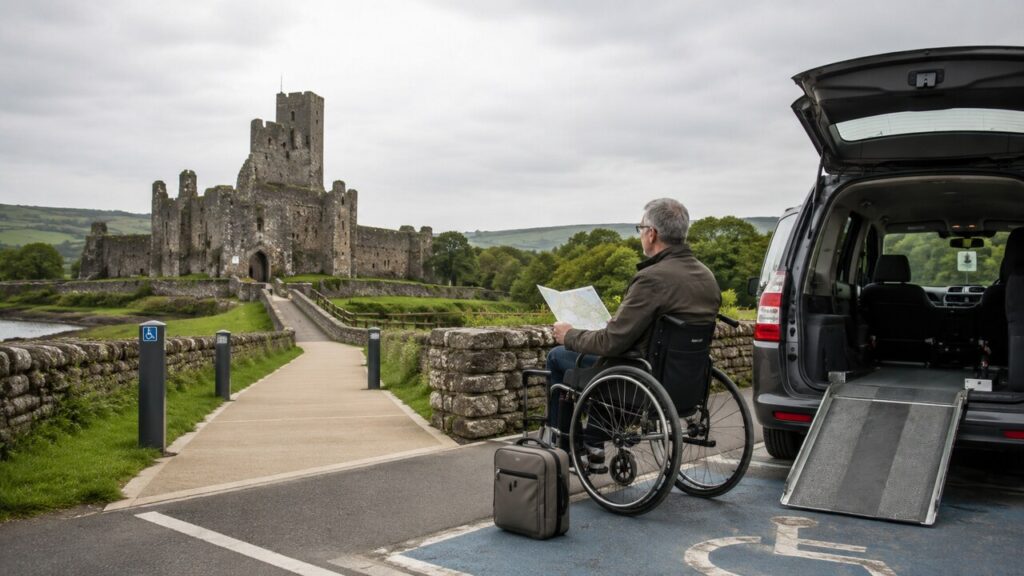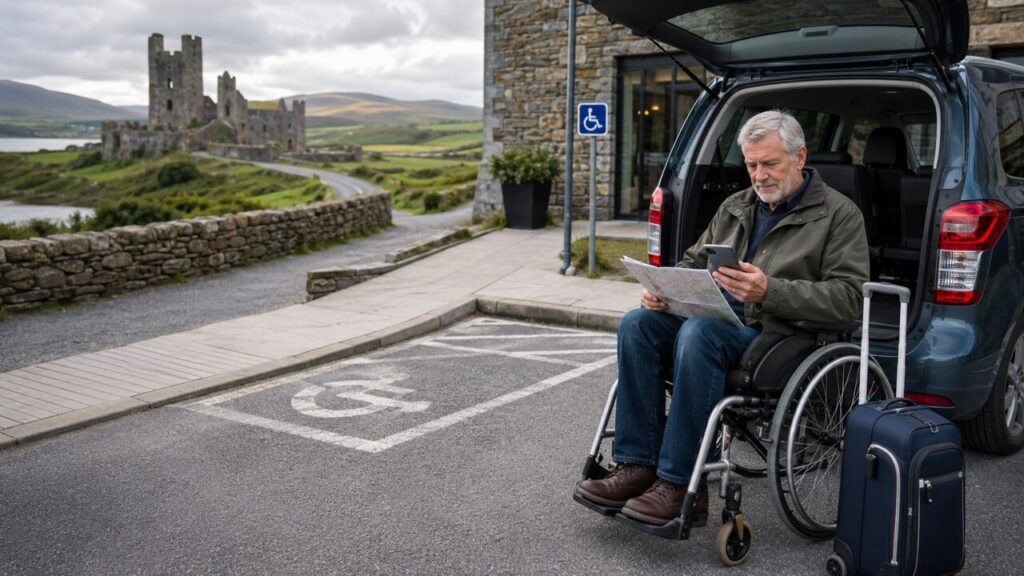
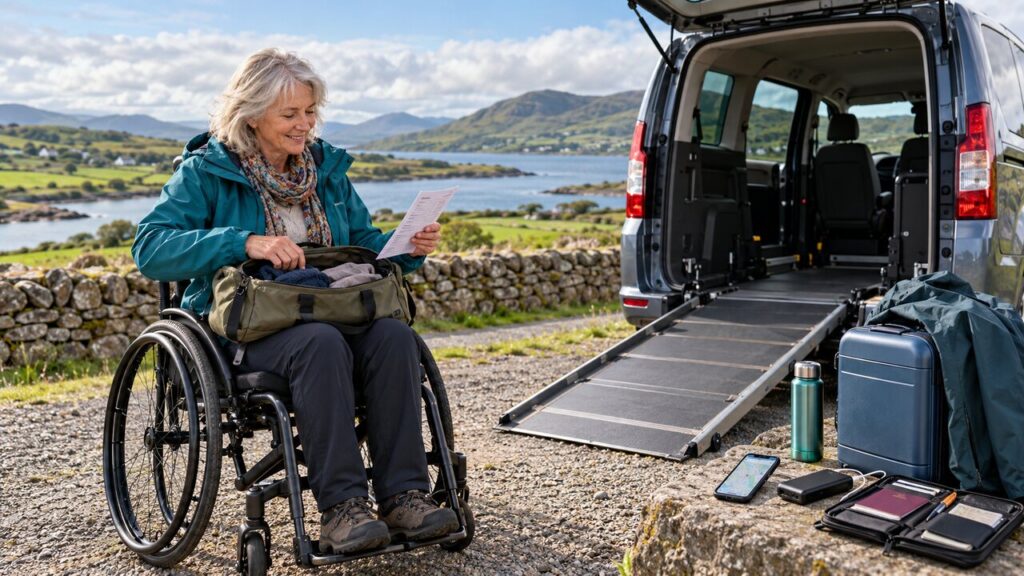
An accessible road trip around Ireland can give you something valuable: the freedom to stop when you need to, change your route and enjoy the view at your own pace. Yet packing for that freedom takes a little more thought when your wheelchair, vehicle access, personal care or equipment charging are part of the journey.
The aim is not to fill every corner of the car. It is to bring the things that keep you comfortable and independent, then put them where you can actually reach them. A spare wheelchair part hidden beneath three suitcases will not be much help at a rainy roadside stop.
This guide is for wheelchair users, disabled travellers and companions planning a journey by car or wheelchair-accessible vehicle (WAV). Adapt it to your own body, equipment and itinerary. You may need only half the items below; someone else may need additional supplies that are essential for them.
Start with three packing zones
Before writing a list, divide your belongings into three zones:
- Within reach: phone, water, medication you may need during the day, access notes, charger and anything required for an unexpected stop.
- Easy to unload: a small overnight bag, personal care supplies and essential wheelchair equipment.
- Longer-term storage: spare clothes, extra supplies and items you will not need until the next accommodation stop.
This simple system is more useful than arranging everything by category. If you travel alone, check whether you can reach the first zone safely while parked. If you travel with a companion, agree where important items will live so either of you can find them without searching.
1. Documents, confirmations and access details
Put your driving licence, vehicle hire documents, insurance details, breakdown cover, accommodation bookings and ferry or flight confirmations in one easy-to-open organiser. Keep the telephone numbers for your accommodation, rental company and breakdown provider there too. If you use a disabled parking permit, bring the original and check the rules for displaying it wherever you park.
Written accessibility confirmations matter as much as the booking itself. Save or print the information you were given about the room, entrance, accessible parking, bathroom, bed height, hoist availability or space beside the bed. A listing that simply says “accessible” does not tell you whether it works for your particular wheelchair or transfer method.
Consider a one-page sheet with your wheelchair dimensions, the type of assistance you may need and your emergency contact. Keep sensitive information secure. Save essential documents offline on your phone and carry a small paper backup in case the battery runs down or a signal disappears.
If your route crosses into Northern Ireland, check your documents, insurance, vehicle hire agreement, roaming arrangements and parking rules for that part of the journey separately. Confirm permission to take a hired vehicle across the border with the provider before travelling.
2. Your wheelchair’s everyday essentials
Pack for the wheelchair you actually use, not a generic “mobility kit”. A manual chair may call for a pump that fits its valves, a puncture repair kit or a spare inner tube, and any tool needed for a routine adjustment. A powered chair may call for its own charger, the correct cable and the manufacturer’s instructions for a simple reset or fault check.
Useful possibilities include:
- a small, familiar tool kit for adjustments you already know how to make;
- the chair’s charging cable or tyre pump;
- a spare cushion cover, if you use one;
- gloves for handling wet wheels, a ramp or muddy equipment;
- a compact cloth to dry hand rims and controls;
- the supplier’s number and details of your wheelchair model.
Do not carry a collection of unfamiliar parts “just in case”. Check what tends to wear out on your own chair and what you can safely replace away from home. Take a photograph of any model numbers before departure.
If you rely on a pressure-relief cushion, position it somewhere it cannot be crushed, soaked or forgotten during a transfer. The same principle applies to customised supports, controls and other equipment that would be difficult to replace mid-trip.
3. Vehicle access and secure travel
If you use a WAV, inspect the ramp or lift and the wheelchair restraints before the first day of the trip. Know how the system works and who to call if it stops working. Keep the operating instructions and the hire company’s support number accessible.
For a rental vehicle, confirm in writing which wheelchair and passenger arrangements are supplied. A photograph of a ramp does not tell you the usable doorway height, the ramp angle, the wheelchair position or whether the vehicle meets your particular needs. Ask how much luggage space remains when the wheelchair is in place.
If you transfer into a standard car seat, keep any transfer aid you normally use where it can be reached at every stop. Do not improvise with a ramp, restraint, belt or transfer method because the equipment looks familiar. Follow the vehicle and equipment instructions and get a proper demonstration when collecting a WAV.
Once loaded, check that bags cannot slide into the ramp area, block an exit or interfere with restraints. Leave enough room to deploy the ramp on arrival, and plan parking stops where its rear or side access will have clear space.
4. Clothing for Irish weather
Pack clothes you can layer rather than one outfit for “summer” and another for “rain”. A breathable waterproof jacket, warm mid-layer and comfortable base layer give you more flexibility when the weather changes during a drive. A hood or waterproof cap can be more practical than an umbrella when you need both hands for your wheelchair.
If you sit for long periods, consider how a coat fits at the waist and whether wet fabric will bunch behind your back. A wheelchair rain cover or lap blanket may help, but choose one that will not catch in wheels or obstruct controls. Pack a dry change of socks and trousers within easy reach, especially if you expect coastal stops or walks along exposed paths.
Footwear should suit transfers and your usual mobility needs. Bring what you know works for you; a road trip is a poor time to test brand-new shoes. Sunglasses and sunscreen also earn their place, even when you pack a raincoat. Check the local forecast and weather warnings before each day’s drive, particularly if you plan an exposed coastal route.
5. Personal care and health supplies
Make a separate list for anything you use regularly: prescribed medication, continence supplies, dressing materials, skin care products or other personal care equipment. Pack enough for the planned journey, plus a sensible margin for delays, in accordance with your own needs and professional advice. Keep time-sensitive or hard-to-replace essentials in your day bag rather than at the bottom of the boot.
Long spells in a vehicle may change how often you need breaks. Plan stops around your established routine, including any pressure-relief or positioning needs. Bring water and food that suit you, and avoid treating accessible toilets as something you can look for only when you urgently need one.
If you travel with medication, keep it in its original packaging where practical and note any storage requirements. A short list of your medicines, allergies and emergency contacts can be useful if you need assistance. Anyone who uses specialist medical equipment should check its power and transport requirements before setting off.
Your own established routine is the best starting point for this part of the packing list.
6. Phone, power and navigation backups
A phone can handle directions, booking details, parking information and calls for help. Give it a reliable power source. Bring a car charging cable that works in your vehicle, a charged power bank and a wall plug for the accommodation. Label cables if you carry several similar ones.
Download an offline map of your route before travelling, and save the addresses of your accommodation and planned stops. Screenshots of accessibility details are useful when a venue’s website is slow or a message is hard to find. A phone mount may keep navigation visible to the driver, provided it does not obscure the road or distract them.
Keep a small paper route note with the destination address, accommodation telephone number and one alternative stop. Technology makes a journey easier, but it should not be the only place you store the information needed to finish the day.
If you use a powered wheelchair, check whether your overnight accommodation has a practical, safe place to charge it. Bring the charger made for your equipment and confirm electrical compatibility if you are arriving from another country. A standard travel power bank cannot replace a wheelchair charger.
7. Food, drinks and a usable travel bag
The best snack bag is the one you can open without balancing it on your lap. Use a small, secure bag or organiser that stays in a predictable location. Pack a refillable water bottle you can lift and open comfortably, plus a few familiar snacks that tolerate time in the car.
Consider napkins, hand wipes and a small rubbish bag. A lidded cup can make an early start easier, but keep hot drinks away from your lap during transfers or on uneven roads. Avoid leaving food, medication or batteries in a car where temperature extremes could affect them.
At a stop, ask a practical question: can I get a drink, find my documents and use my phone without unloading the car? If the answer is no, rearrange the day bag before you leave.
8. Accessible toilet information and planned stops
A toilet sign on a map does not confirm that a room meets your needs. You may need to know whether there is level access, sufficient turning space, a suitable transfer side, a changing facility or a particular type of hoist. Make a short list of possible stops along each day’s route and verify the details that matter to you with the venue.
Save the venue name, telephone number, opening hours and a backup option. A museum, visitor centre, larger service area or hotel may be a useful stop, but access varies from place to place. Ask where the accessible entrance is and whether the toilet can be reached without using steps.
Give yourself more time than a route planner suggests. A break may involve parking, deploying a ramp, reaching the entrance and returning to the vehicle. Building these minutes into the itinerary makes the day more enjoyable.
For more planning ideas, read How to Find Accessible Toilets While Travelling Around Ireland.
9. Parking permit and arrival notes
If you have an eligible disabled parking card, put it on the checklist before every departure. Keep it protected when it is not on display, and check the local signs and conditions at each parking place. A permit does not guarantee an empty bay or enough room for your vehicle’s ramp.
Before driving to a castle, coastal viewpoint or town centre, find out where the accessible spaces are and which side of your vehicle needs clearance. A nominally accessible bay may still be difficult to use if its access zone is blocked. Note a second parking option when possible.
The island of Ireland includes two jurisdictions, so check current local conditions when your route includes Northern Ireland. If you are using a card issued elsewhere, verify how and where it is recognised before departure. Do not assume every car park offers the same concessions.
10. A realistic overnight bag
Pack the first night’s essentials separately: nightwear, toiletries, charger, medication or personal care supplies, a change of clothes and anything needed for a comfortable transfer. This can save you from unloading the entire vehicle in poor weather or a tight car park.
Before leaving home, test the accommodation plan rather than relying on a label. Ask about step-free entry, lift size, bathroom layout, shower access, bed height, space beside the bed and parking. If you use a hoist or need a particular transfer side, confirm those details explicitly. Save the reply with your booking.
Keep the overnight bag manageable for the person who will move it. A light case or small bag with a large zipper pull may be easier to handle than one large, heavy suitcase. If you are travelling alone, think through the complete sequence from parking to getting into the room.
11. A small contingency kit
Unexpected changes are easier to handle when the basics are already covered. Bring a torch, charged phone, accessible breakdown contact, spare clothing layer and the vehicle’s required safety equipment. Check the rental agreement or your own vehicle guidance to see what is provided.
Know what assistance your breakdown cover actually includes. Ask the provider how they would help a driver or passenger who cannot safely leave a vehicle unaided and whether an accessible onward vehicle can be arranged. Save the answer and the provider’s number offline.
In an emergency in the Republic of Ireland, call 112 or 999. Give your location, explain your mobility needs clearly and follow the emergency service’s instructions. For a routine breakdown, use your provider’s number. Do not attempt a roadside repair where traffic or the environment makes it unsafe.
If plans change, focus on the next usable stop rather than forcing the original itinerary. A shorter day is often better than arriving tired at accommodation whose entrance or facilities you have not checked.
A practical packing checklist
Use this as a starting point and remove anything that does not apply to your trip.
Keep within reach
- Phone, charging lead and charged power bank
- Water, familiar snacks and any day-use personal supplies
- Accommodation address, access notes and emergency contacts
- Parking card, where you can retrieve it when needed
- Waterproof layer and a dry cloth
Keep easy to unload
- Overnight bag and personal care kit
- Wheelchair charger or pump, as applicable
- Essential wheelchair parts and familiar tools
- Transfer aids you normally use
- Spare clothes and dry socks
Check before departure
- Driving, hire, insurance and breakdown documents
- Ramp or lift operation and wheelchair restraints
- Wheelchair tyres, battery or controls as relevant
- Confirmed room and bathroom details
- Planned accessible toilets and alternative stops
- Route forecast, weather warnings and offline maps
One final check matters more than adding another gadget: can you get to the items you will need at the first stop? Test the arrangement while the car is still parked at home.
What should you leave behind?
Accessibility does not mean carrying every device sold for travel. A bulky gadget that you cannot lift, fit beside the chair or use independently may create more work than it saves. Choose equipment that solves a specific problem in your own routine.
Do not pack items on the assumption that a companion can always retrieve them. Even when travelling together, good organisation gives both people more flexibility. Put heavy items low, protect fragile equipment and leave access to the ramp or lift clear.
Most importantly, leave some room in the schedule. Ireland’s best moments may be an unexpected sea view, a conversation in a small town or a quiet lunch after the rain. A checklist should support those moments, not turn the holiday into a test of how much you can fit into a car.
Final thoughts
For an accessible road trip around Ireland, pack around the journey you will actually make: how you travel in the vehicle, how you get out, where you take breaks and what you need at night. Keep critical items close, confirm access details before arrival and make a modest backup plan for weather or delays.
Then set off with confidence. You do not need a perfect itinerary to enjoy Ireland. You need a practical vehicle setup, reliable essentials and enough freedom to adapt when the road leads somewhere worth stopping.
Official planning resources: Tourism Ireland: Accessibility for travellers · Met Éireann: Weather warnings · Department of Transport: Disabled Parking Scheme. Check current rules and local conditions before travelling.
Related reading: Accessible Ireland Travel: What to Check Before You Go · Useful Products for an Accessible Road Trip Around Ireland · Best Wheelchair-Friendly Scenic Drives in Ireland