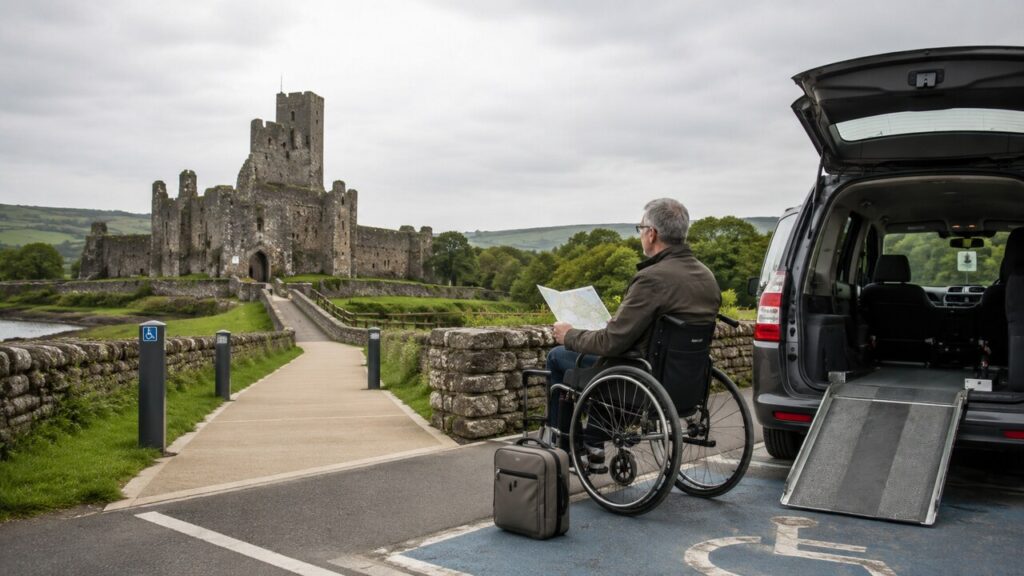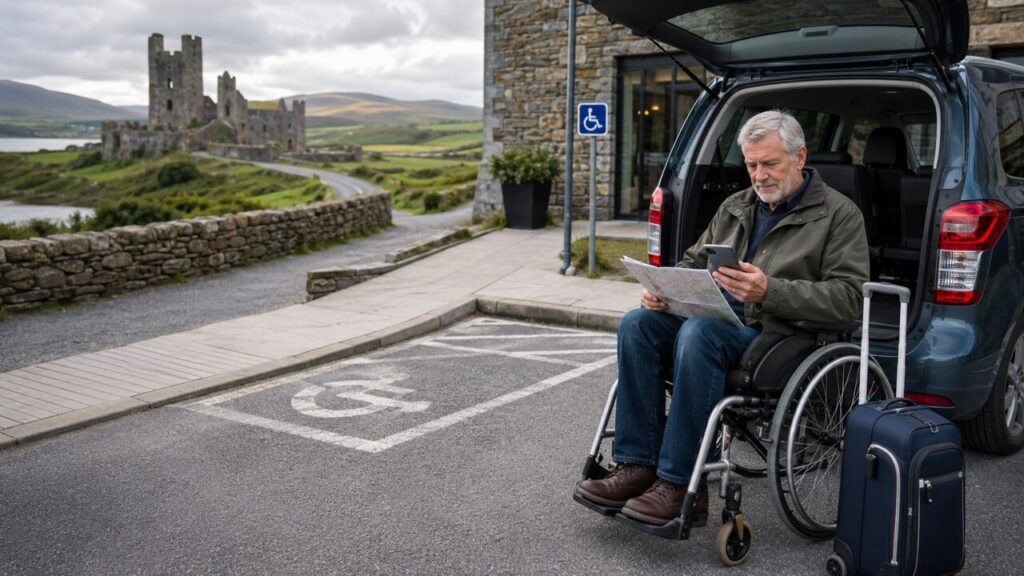
Hiring a car can give you much more freedom on an accessible trip around Ireland. You can travel at your own pace, carry mobility equipment, stop when you need a break and reach scenic places that may be difficult to visit by public transport.
However, a car described as “large”, “accessible” or “suitable for disabled customers” is not automatically right for every wheelchair user.
One traveller may be able to transfer into the driver’s seat and fold a manual wheelchair into the boot. Another may need hand controls and a steering aid. A passenger who remains seated in a wheelchair during the journey will usually need a properly converted wheelchair-accessible vehicle, commonly called a WAV, with a ramp or lift and an appropriate wheelchair and occupant restraint system.
That is why the best wheelchair-friendly rental car in Ireland is not simply the biggest or most expensive model. It is the vehicle that matches your body, wheelchair, transfer method, travelling companions and route.
This guide explains how to compare the main options, what measurements to take and which questions to ask before paying a deposit.
Start With the Way You Will Travel
Before comparing makes and models, decide which of these situations best describes your journey.
1. You Will Transfer From Your Wheelchair Into a Standard Car Seat
In this case, you may not need a fully converted WAV. A conventional automatic car could work well if:
- the seat is at a comfortable transfer height;
- the door opens widely enough;
- there is space beside the seat for a safe transfer;
- your wheelchair can be folded or dismantled;
- the boot can hold the wheelchair and everyone’s luggage;
- another traveller can help load equipment if required.
For some people, a medium-sized hatchback, estate car or compact SUV provides a useful balance between transfer height and storage. A very low car can make it difficult to lower yourself into the seat and climb out again. A tall SUV may create the opposite problem.
2. You Will Drive and Need Adaptations
If you drive with hand controls, a steering ball, a left-foot accelerator or another adaptation, do not assume a standard rental desk can arrange it when you arrive.
Enterprise Ireland currently states that hand-control driving devices can be supplied at no additional charge and can be ready within 48 hours of booking. Specialist providers may offer additional adaptations. Availability, compatibility and collection arrangements can change, so confirm the exact equipment directly and obtain the details in writing.
The controls must match the system you are trained and licensed to use. Ask for photographs, the exact control type and time for a safe familiarisation before entering traffic.
3. You Will Remain in Your Wheelchair as a Passenger
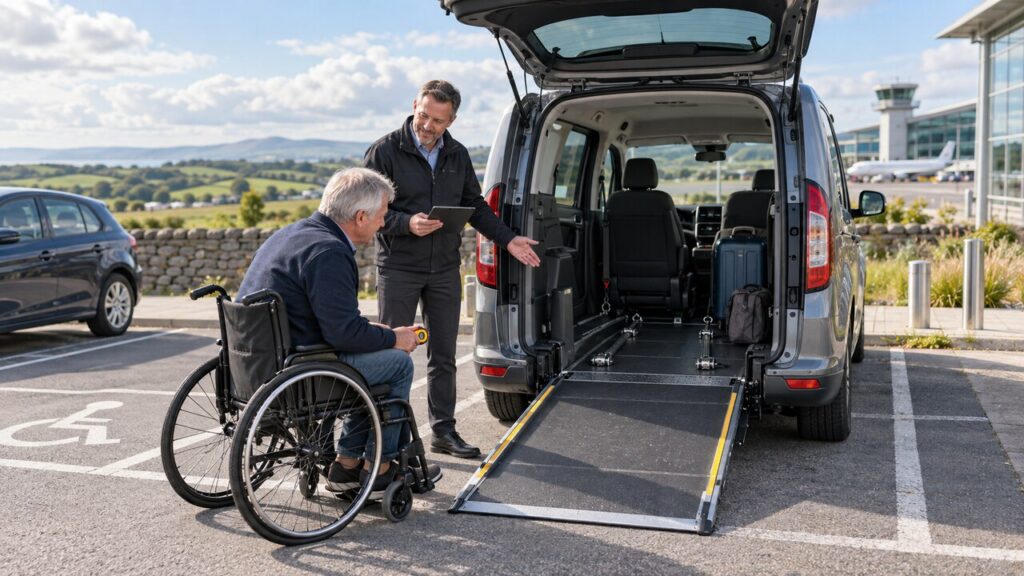
You will normally need a WAV rather than an ordinary people carrier or van. A genuine passenger WAV has a converted entry, suitable interior headroom, a ramp or lift and a system designed to secure both the wheelchair and its occupant.
Specialist Irish providers advertise converted compact vans with rear ramps, including Caddy-, Rifter- and Connect-style models. The model name alone is not enough: conversions can have different ramp angles, door heights and seating layouts.
4. You Need to Drive From Your Wheelchair
This is more specialised than passenger WAV hire. Drive-from-wheelchair and internal-transfer vehicles are less common, so contact specialist providers well in advance. Explain your setup and confirm that the vehicle, controls, insurance and restraint system suit the intended use.
Standard Car or WAV: What Is the Difference?
| Feature | Standard rental car | Passenger WAV |
|---|---|---|
| Wheelchair user transfers to a car seat | Usually yes | Optional, depending on layout |
| Travel while seated in wheelchair | No | Yes, if the wheelchair and user can be secured correctly |
| Ramp or lift | No | Usually yes |
| Wheelchair restraints | No | Yes |
| Hand controls | Sometimes available by advance request | May be available, but must be confirmed |
| Typical advantage | More choice and often easier to source | No repeated transfer and space for an occupied wheelchair |
| Main risk | Poor transfer height or insufficient boot space | Wheelchair may not fit the entry, ramp or travelling position |
Neither option is automatically better. The correct choice depends on what reduces effort and makes the complete journey safe and comfortable.
Measure the Wheelchair Before You Book
Never book a WAV using only the wheelchair brand or model. Accessories, cushions, headrests, footplates and seating systems can change its real dimensions.
Measure the wheelchair in the exact configuration in which it will travel:
- overall width at the widest point;
- overall length, including footplates or leg supports;
- total occupied height, measured from the floor to the top of the traveller’s head;
- wheelchair height, including any headrest;
- combined weight of the wheelchair and occupant;
- ground clearance, particularly for powered chairs;
- turning space required inside the vehicle.
Also record the make, model and approximate weight of the wheelchair. Take clear photographs from the front, rear and side. Send the information to the hire company and ask it to confirm suitability in writing.
For a standard car, measure the folded wheelchair or each dismantled component. If it is powered, check the weight of the heaviest part. A boot may be large enough in litres but still have an opening that is too narrow, a high loading lip or a shape that prevents the chair from passing through.
Check the Transfer, Not Just the Seat
If you transfer into a standard seat, the whole movement matters.
Ask for the following measurements or information:
- seat height from the ground;
- distance between the seat and the door sill;
- door-opening width and angle;
- height and shape of the sill;
- amount of space beside the vehicle when the door is fully open;
- whether the seat height, angle and distance from the steering wheel can be adjusted;
- whether the passenger seat can be moved far enough back;
- location of grab handles and solid handholds.
Think about where the wheelchair will stand during the transfer. Rain, wind or a narrow hotel car park can make the movement more tiring.
If you use a transfer board, check for gaps, a raised sill or a seat bolster that could obstruct it. The ideal seat height is personal.
Make Sure the Wheelchair and Luggage Fit Together
One of the most common mistakes is checking the wheelchair and luggage separately.
A boot that holds a folding wheelchair may not also hold two suitcases, a portable ramp, a pressure-relief cushion, a hoist component or charging equipment. If the rear seats must be folded to fit the chair, the vehicle may no longer carry the planned number of passengers.
List the chair, removable parts, charger, cases, walking aids and personal equipment before booking. Ask for photographs of the actual boot with the parcel shelf removed, plus the width and height of its narrowest opening.
For a heavy powered wheelchair, confirm who will load it. A standard rental car is not suitable if the chair cannot be safely lifted or if loading risks injury or damage. A hoist-equipped vehicle or WAV may be the better solution.
Inspect the Ramp or Lift on a WAV
A WAV ramp is only useful when the wheelchair can approach it, climb it and clear the doorway.
Check:
- whether entry is from the rear or side;
- usable ramp width;
- ramp length and expected gradient;
- doorway width and clear height;
- internal floor height and headroom;
- maximum permitted weight;
- size of the lowered floor;
- whether the ramp is manual or powered;
- whether assistance is needed to deploy it;
- space required behind or beside the vehicle.
A short ramp may be compact but steep. This can be difficult for a manual wheelchair user and may cause a powered chair’s footplates or anti-tip wheels to catch. Wet surfaces can also affect confidence and grip.
Rear-entry WAVs need clear space behind the vehicle. This matters in Ireland, where some village car parks, hotel spaces and scenic pull-ins can be short or tightly arranged.
A marked accessible bay does not always provide enough rear clearance for a ramp, so plan how you will park before unloading.
Confirm the Wheelchair and Occupant Restraints
Travelling in a wheelchair requires more than putting on a conventional seat belt.
Ask the provider to explain and demonstrate the complete wheelchair and occupant restraint system. A typical arrangement may include four wheelchair tie-downs together with a separate lap-and-shoulder belt for the passenger, but systems and compatible wheelchairs vary.
Before accepting the vehicle, confirm that:
- the restraints attach to appropriate points on the wheelchair;
- no strap is twisted or routed around a removable component;
- the passenger belt fits the person, not just the wheelchair;
- the wheelchair faces in the intended direction;
- the headrest or back support is correctly positioned where supplied;
- the driver or companion can operate every restraint confidently;
- the wheelchair brakes and any powered functions are set as instructed;
- unused belts cannot become trapped under the wheels.
Repeat the restraint process yourself while a staff member watches. Do not drive away without understanding the system.
Choose a Vehicle That Suits Irish Roads
Ireland rewards travellers with beautiful coastal routes, quiet countryside and historic towns, but the roads can vary greatly.
Rural lanes may be narrow or uneven, town-centre spaces compact and scenic stops sloping or covered with gravel.
This creates a genuine trade-off. A larger vehicle offers more interior space, but it may be harder to park or manoeuvre. A compact WAV can be easier on narrow roads, but only if it provides enough doorway height, ramp clearance and passenger comfort.
For most travellers, the right approach is to choose the smallest vehicle that safely accommodates the wheelchair, passengers and luggage — not the smallest vehicle available.
An automatic transmission may reduce workload, especially when driving on the left for the first time or using hand controls. Parking sensors and a reversing camera can also help, but only rely on features guaranteed in writing.
Plan Collection and Return Carefully
Airport collection sounds convenient, but accessible hire often involves extra arrangements.
Ask whether the vehicle will be:
- waiting at the airport terminal;
- collected from a rental desk and nearby car park;
- delivered by a specialist provider;
- reached by a shuttle bus;
- collected from the provider’s own premises.
If a shuttle is involved, confirm that it can carry you, your wheelchair and all luggage. Do not assume an airport car-rental shuttle is wheelchair accessible.
Motability Ireland currently advertises Dublin Airport collection and drop-off for adapted cars and WAVs. Get the exact meeting location, contact number and out-of-hours procedure before travelling.
Allow extra time to inspect the ramp, practise the restraints, adjust controls, photograph the vehicle and load equipment.
Check the Driving, Insurance and Payment Conditions
Accessibility does not replace the normal rental requirements.
Before paying, ask the provider to confirm:
- accepted driving licences and whether an International Driving Permit is required;
- minimum and maximum driver ages;
- how long the driver must have held a full licence;
- whether licence codes or medical restrictions affect the booking;
- permitted additional drivers;
- deposit and accepted payment cards;
- insurance excess and optional excess reduction;
- cover for glass, tyres, underbody, roof, ramp and adaptations;
- roadside assistance arrangements;
- rules for travel into Northern Ireland;
- mileage limits and fuel or charging policy;
- cancellation terms if the promised adaptation is unavailable.
If your route crosses the border, remember that the Republic of Ireland and Northern Ireland are different jurisdictions. Confirm that the rental agreement and insurance allow the journey.
Ask how tolls are handled as well. Ireland’s M50 uses barrier-free tolling, and rental companies may operate their own payment or administration process. Follow the provider’s written instructions rather than making assumptions about direct payment.
Ask for the Exact Vehicle or an Equivalent With Defined Features
Ordinary rental bookings often promise a vehicle category rather than a specific model. For an accessible booking, “or similar” can cause serious problems.
If a named vehicle is replaced, the alternative must still meet your essential requirements. Put these in writing:
- automatic transmission;
- confirmed hand-control type;
- minimum door and interior height;
- minimum ramp width and load capacity;
- sufficient occupied-wheelchair space;
- required seating layout;
- wheelchair and occupant restraints;
- boot dimensions;
- airport delivery or accessible collection.
Ask what suitable replacement is available if the booked vehicle is damaged or unavailable.
15 Questions to Ask the Rental Company
Use this checklist before confirming your wheelchair accessible car hire in Ireland:
- Is this a standard car, an adapted driver’s car or a passenger WAV?
- Can you guarantee the adaptation and essential dimensions in writing?
- Will my wheelchair fit through the entry and inside the travelling position?
- What are the ramp width, length, gradient and maximum load?
- What are the doorway height and occupied interior headroom?
- Which wheelchair and occupant restraint system is installed?
- Will staff demonstrate the ramp, controls and restraints at handover?
- How many seats remain available when the wheelchair position is occupied?
- Is there still enough room for all luggage and mobility equipment?
- Which hand controls or steering aids are fitted?
- Where exactly will collection and return take place?
- Is any airport shuttle fully accessible?
- What insurance excess applies to the vehicle and its adaptations?
- May the vehicle be driven across the border into Northern Ireland?
- What suitable replacement is available if this vehicle cannot be supplied?
A Message You Can Send Before Booking
Copy and adapt this message:
Hello, I am planning to hire a wheelchair-friendly vehicle in Ireland from [date] to [date]. The wheelchair user will [transfer into a standard seat/remain in the wheelchair as a passenger/drive using adaptations].
The occupied wheelchair measures [width] cm wide, [length] cm long and [height] cm from the floor to the top of the traveller’s head. The combined wheelchair and occupant weight is approximately [weight] kg.
We will have [number] travellers and [number] suitcases.
Please confirm the exact vehicle or conversion, entry and interior dimensions, ramp or lift details, restraint system, remaining seats, luggage space, collection arrangements, insurance terms and the type of any driving adaptations.
Please also confirm what equivalent accessible vehicle would be supplied if the booked one became unavailable.
Inspect Everything Before Leaving
At collection, do not limit the inspection to scratches and fuel level.
Test the accessibility features in a safe area:
- open and close every relevant door;
- deploy and stow the ramp or lift;
- enter and exit with the actual wheelchair;
- check head, shoulder and foot clearance;
- secure the wheelchair and passenger;
- test hand controls and steering aids while stationary;
- confirm mirrors, seat position and visibility;
- load the luggage;
- locate the spare wheel or repair kit;
- save the breakdown and emergency numbers.
Photograph the bodywork, wheels, glass, ramp, floor and adaptations. Report any damage before departure and make sure it is recorded.
If the vehicle does not match the written specification, raise the issue immediately. It is better to delay the journey than accept a vehicle that makes transfers unsafe or cannot secure the wheelchair correctly.
Frequently Asked Questions
Can I Hire a Car With Hand Controls in Ireland?
Yes. Book in advance and confirm the control type, transmission, collection point and insurance in writing.
Can a Wheelchair User Remain in Their Chair in an Ordinary Rental Van?
No. The vehicle needs suitable access, a safe travelling position and an appropriate wheelchair and occupant restraint system.
Is a WAV Always the Best Choice?
Not necessarily. A standard automatic may suit a traveller who transfers comfortably, while a WAV can avoid repeated difficult or painful transfers.
How Early Should I Book an Adapted Rental Car?
As early as practical, especially for summer or uncommon adaptations. Specialist fleets are small, so confirm the vehicle before making dependent non-refundable plans.
Should I Choose a Large Vehicle for Rural Ireland?
Choose enough space for safe access, passengers and luggage without unnecessary size. A compact WAV can be easier on narrow roads if every critical measurement works.
Can I Take a Rental Car From the Republic of Ireland Into Northern Ireland?
Often, but terms vary. Confirm permission, insurance, roadside assistance and charges before crossing the border.
Final Thoughts
A wheelchair-friendly rental car can transform an Irish holiday. It can make scenic drives, accessible attractions, rural accommodation and spontaneous rest stops much easier to enjoy.
Define what “wheelchair-friendly” means for you. Decide whether you will transfer or remain in the chair, measure the travelling setup, check access and luggage space, obtain the details in writing and test everything at collection.
The goal is not simply to find a car that looks large enough. It is to choose a vehicle that protects your comfort, energy and independence throughout the journey.
With the right questions and advance planning, the rental car can support an accessible Irish road trip instead of becoming an obstacle after arrival.